Showing posts sorted by relevance for query Linux kernel. Sort by date Show all posts

Debian GNU/Linux 6.0.5 Released

Debian GNU/Linux 6.0.5 Released

Developers at Debian project is pleased to announce the fifth update of its stable distribution Debian 6.0 codenamed squeeze. According to the project release this update mainly adds corrections for security problems to the stable release, along with a few adjustments for serious problems. Security advisories were already published separately and are referenced where available. If you have Debian 6.0.x already installed, it is not necessary to reinstall, you only need to install all the latest updates from your nearest mirror site. 

What's new in Debian GNU/Linux 6.0.2:-
  • aide Properly support large files on 32-bit systems; fix group for bind9 log files
  • approx Don't try caching InRelease or non-.gz compressed files
  • apr Fix apr_ino_t changing size depending on -D_FILE_OFFSET_BITS on kfreebsd-*
  • apt Fix file size calculation on big-endian arches; don't prompt for CD re-insertion on "apt-get update"; add XZ support
  • apt-listchanges Correctly handle NEWS files containing only one entry
  • base-files Update /etc/debian_version
  • clive Adapt for liveleak.com changes
  • dbus Fix local DoS for system services (CVE-2011-2200)
  • deborphan Exclude libreoffice from --guess-section output; trap WINCH in a POSIX way; minor translation fixes
  • dokuwiki Fix an ACL bypass issue in the XMLRPC interface
  • dpkg Fix regression in 'dpkg-divert --rename'; dpkg-split: don't corrupt metadata on 32-bit systems; fix vsnprintf() compat declaration
  • e2fsprogs Various bug fixes
  • fakechroot Fix 'debootstrap --variant=fakechroot'
  • fcgiwrap Fix init script's 'stop' target
  • gdm3 Reset SIGPIPE handler before starting the session; execute the PostSession script even when GDM is killed or shut down
  • git Allow remove and purge in one step by terminating the git-daemon/log service before removing the gitlog user
  • gnome-settings-daemon Work around possible race condition when starting Xsettings manager
  • ia32-libs Refresh packages from stable and proposed-updates.
  • iceowl Security updates
  • im-config Avoid breaking login via GDM if im-config is removed but not purged
  • inn Stop using 'sort +1n' in makehistory; disable outdated CHECK_INCLUDED_TEXT option by default
  • josm Give more verbose explanation to users who haven't agreed to the new OSM license
  • kde4libs Wildcard SSL certificate and XSS security fixes; ktar checksum and UTF-8 longlink fixes
  • kdenetwork Improve fix for CVE-2010-1000 directory traversal issue
  • kernel-wedge Add hpsa and pm8001 to scsi-extra-modules; add bna to nic-extra-modules
  • kerneltop Increase line buffer size to 1024 bytes
  • klibc ipconfig: escape DHCP options and correctly handle multiple connected network devices (CVE-2011-1930)
  • krb5 Fix DoS; fix interoperability with w2k8r2 KDCs; fix invalid free and double free; don't make authentication fail if PAC verification fails
  • kupfer Use correct parameter type to allow keybindings to work again
  • libapache2-mod-perl2 Rebuild against apr 1.4.2-6+squeeze3 to pick up apr_ino_t size fix on kFreeBSD
  • libburn Don't create images with overly-restrictive permissions
  • libfinance-quotehist-perl Disable test suite, broken by website changes
  • libmms Fix alignment issues on arm
  • linux-2.6 New hardware support; add longterm 2.6.32.41; fix oops via corrupted partition tables
  • linux-kernel-di-amd64-2.6 Rebuild against kernel-wedge 2.74+squeeze3
  • linux-kernel-di-armel-2.6 Rebuild against kernel-wedge 2.74+squeeze3
  • linux-kernel-di-i386-2.6 Rebuild against kernel-wedge 2.74+squeeze3
  • linux-kernel-di-ia64-2.6 Rebuild against kernel-wedge 2.74+squeeze3
  • linux-kernel-di-mips-2.6 Rebuild against kernel-wedge 2.74+squeeze3
  • linux-kernel-di-mipsel-2.6 Rebuild against kernel-wedge 2.74+squeeze3
  • linux-kernel-di-powerpc-2.6 Rebuild against kernel-wedge 2.74+squeeze3
  • linux-kernel-di-s390-2.6 Rebuild against kernel-wedge 2.74+squeeze3
  • linux-kernel-di-sparc-2.6 Rebuild against kernel-wedge 2.74+squeeze3
  • lua-expat Fix the 'billion laughs' DoS attack
  • monkeysphere Fix monkeysphere-host revoke-key
  • nagios-plugins Allocate a big enough buffer to handle all IPs of hosts being pinged
  • nsd3 Remove statoverride before removing the package's user
  • openldap Fix possible database corruption issues, several security issues and dpkg-reconfigure
  • php-svn Rebuild against apr 1.4.2-6+squeeze3 to pick up apr_ino_t size fix on kFreeBSD
  • php5 Rebuild against apr 1.4.2-6+squeeze3 to pick up apr_ino_t size fix on kFreeBSD
  • pianobar Update API keys for XMLRPC v30
  • postgresql-8.4 New upstream bugfix release; fix pg_upgrade use with TOAST tables
  • prosody Fix the 'billion laughs' DoS attack
  • puppet Fix service provider to properly use update-rc.d disable API
  • python-apt Strip multiarch by default in RealParseDepends; add XZ support
  • python-gudev Add missing dependency on python-gobject
  • q4wine Stop shipping the library in lib64
  • qemu Don't register qemu-mips(el) with binfmt on mips(el)
  • qemu-kvm Fix division by 0 with some guests; fix vnc zlib overflow; don't abort on user hardware errors; fix migration on 32-bit
  • qt4-x11 Blacklist some fraudulent SSL certificates; fix weakness in wildcard certificate verification
  • rapidsvn Rebuild against apr 1.4.2-6+squeeze3 to pick up apr_ino_t size fix on kFreeBSD
  • refpolicy Various permissions fixes
  • reprepro Handle Release files which don't contain md5sums
  • ruby1.8 Fix upgrades from lenny by making libruby1.8 conflict/replace irb1.8 and rdoc1.8
  • samba Fix undefined symbol error from tdb2.so; several printing related bugs and a gid leak in winbind / idmap. Document the new and potentially disruptive 'map untrusted to domain'
  • schroot Fix loading of dchroot.conf
  • softhsm Remove statoverride entries before the package's user
  • sun-java6 New upstream security update
  • tzdata New upstream version
  • vimperator Resolve compatibility issues with iceweasel
  • widelands Fix potential security issue in Internet games
  • xenomai Adapt kernel patch to apply cleanly to squeeze's kernel
  • xserver-xorg-video-tseng Fix driver initialisation

To Download Debian 6.0 codenamed "squeeze" Click Here
  

-Source (Softpedia, Debian Project)

SHARE OUR NEWS DIRECTLY ON SOCIAL NETWORKS:-

Microsoft Gets Recognition Among Top 20 Linux Kernel Contributors

Microsoft Gets Recognition Among Top 20 Linux Kernel Contributors

The Linux Foundation announced the top Linux kernel development contributors, with Microsoft getting on the list for the first time. The top 10 contributors to the Linux kernel in this latest report include "Red Hat, Intel, Novell, IBM, Texas Instruments, Broadcom, Nokia, Samsung, Oracle and Google," according to the report. For the first time, Microsoft has made the list of the top 20 contributors to the Linux kernel. Microsoft placed at No. 17 among companies that have contributed the most toward developing the Linux OS's kernel. As the Linux Foundation's announcement pointed out, it represents quite a change from the time when Microsoft CEO Steve Ballmer called Linux "a cancer" is now working within the collaborative development model to support its virtualization efforts and its customers. Because Linux has reached a state of ubiquity, in which both the enterprise and mobile computing markets are relying on the operating system, Microsoft is clearly working to adapt. In other words, some might recall the old adage: "If you can't beat 'em, join 'em.". The foundation suggested that Microsoft is "clearly working to adapt" in a world where Linux is used across enterprise and mobile environments.
The foundation's latest report, "Linux Kernel Development: How Fast It is Going, Who is Doing It, What They are Doing and Who is Sponsoring It," covers work completed through the Linux kernel 3.2 release, with an emphasis on the releases made since the last update to this report in December 2010 (2.6.36 to 3.2). 

Since 2005, there have been more than 7,800 developers contributing to the Linux kernel, according to the announcement. The foundation also claimed that "75 percent" of Linux kernel developers get paid for doing it. The full report, "Linux Kernel Development: How Fast It is Going. To Download the full report click Here


SHARE OUR NEWS DIRECTLY ON SOCIAL NETWORKS:-

Unbreakable Enterprise Kernel Release 2 For Oracle Linux With Linux kernel 3.0 & btrfs

Unbreakable Enterprise Kernel Release 2 For Oracle Linux With Linux kernel 3.0 & btrfs 
Today Oracle officially released its Enterprise Kernel Release 2 for Oracle Linux which incorporates the recently released Linux 3.0 kernel & the newly added file system known as btrfs. Since October of 2010, Unbreakable Linux 2 is the second major update of Oracle’s Linux distribution. It also features technical previews of Linux Containers and Sun-developed DTrace but those features are not yet commercially supported. Enterprise Kernel Release 2 is available to all Oracle Linux subscribers today and is included with Oracle Linux 5 and 6. In a brief interview, Oracle execs said Btrfs, which is standard in Oracle Linux, supports data stores of up to 16 exabytes, is optimized for solid state disks, incorporates data integrity and is simple to administer. Enterprise Kernel 2 was tested on two-socket and Oracle’s most powerful 8 socket systems and demonstrated an impressive 5 million transactions per minute on x86 systems and reportedly offers fastest performance on Intel systems.
Linux 3.0 was the first version of the kernel to support the Btrfs next-generation file system. Btrfs can manage up to 16 exabytes of data in one namespace, which should ease the burden of data management for organizations with that much material. It provides the ability to automatically back up data and a way to do RAID backups without external controllers. It also is optimized for solid-state hard drives, rather than the drives based on spinning disks.
Some key Highlights In This Release Include:-
  • Btrfs file system
  • Performance and scalability improvements
  • Virtualization improvements
  • Transparent Huge Pages and Memory compaction
  • Cgroups improvements
  • Linux Containers
  • OCFS2 improvements
  • Updated Device Drivers
For more information, please see the Unbreakable Enterprise Kernel Release 2 features and benefits document and consult the release notes for more For installation instructions, check out the Getting Started with the Unbreakable Enterprise Kernel installation guide on the Oracle Technology Network.


SHARE OUR NEWS DIRECTLY ON SOCIAL NETWORKS:-

Linux Kernel 3.0


Last week began with speculation about a new kernel version number that ultimately resulted in the first big number change for Linux in more than a decade. Along the way, we also saw new Linux distribution releases, including Fedora 15 and the first beta of Red Hat Enterprise Linux 5.7.

1. Linux 3.0

Make no mistake about it, after two decades of being the leader of the Linux community, Linus Torvalds still makes the big decisions.
This week, Torvalds made the huge decision of starting a new numbered version of Linux, advancing the kernel to Linux 3.0, with a first release candidate debuting early Sunday. The Linux 3.0 kernel came after a week of discussion, which began with Torvalds first mentioning that he was considering advancing the number to Linux 2.8, instead of having a Linux 2.6.40 kernel release. "The voices in my head also tell me that the numbers are getting too big," Torvalds wrote in a mailing list posting. By the end of the week, Torvalds was advocating for a 3.0 release, as Linux is now entering its third decade. While big number version changes can often represent binary compatibility or big feature change issue with a software project, that's not the case with Linux 3.0. The 3.0 nameplate is a time-based thing, and it isn't about new features. Considering Linux 2.0 came out in 1996 and the more recent 2.6 branch began in 2003, the big number change is a long time coming for Linux. While some software projects, like Google's Chrome, change major version numbers every three months, Linux has iterated on the 2.6.x branch for more than seven years. The change to 3.0 may seem a bit arbitrary, but it makes sense on many levels. The time has come for a number change as Linux enters its third decade.

2. Fedora 15

This past week also marked the debut of Fedora 15, codenamed 'Lovelock.' While Linux 3.0 isn't about new features, Fedora 15 is about features, most notably the GNOME 3.0 desktop. Fedora 15 is the first of the big Linux distributions to integrate GNOME 3 and its associated GNOME Shell user interface. Fedora 15's GNOME 3 desktop stands in contrast to the Unity desktop that rival distribution Ubuntu debuted in April. While Fedora is a big backer of GNOME Shell, the project also realizes it's not for everyone and includes fallback mechanisms for older hardware as well as other desktop options, including KDE, Xfce and LXDE. Time will tell whether users prefer GNOME Shell to Unity or if they end up rejecting both desktops in favor of something else.

3. Linux Mint 11

For Ubuntu users that don't want Unity and don't want to move to Fedora (or something else), there is Linux Mint. Over the past couple of years, Mint has emerged as a community favorite alternative to Ubuntu. Based on Ubuntu, Mint takes the best of Ubuntu and aims to make it even easier to use. For GNOME users, Mint has elected not to use either GNOME shell or Unity, providing users with a more traditional user interface. Given the backlash in some corners against Unity on Ubuntu, it's likely that Linux Mint 11 will attract more than its fair share of Ubuntu 11.04 refugees. Will those former Ubuntu users stick with Mint over time? Considering Mint is based on Ubuntu, that's a bet that doesn't carry too much risk.

4. Red Hat Enterprise Linux 5.7

No, it's not a major new version number of Red Hat's Enterprise Linux (RHEL), but RHEL 5.7 is still an important release. This past week, Red Hat released the first beta of RHEL 5.7 with new driver and stability updates. RHEL 5.0 first came out in 2007 and has since been superseded by RHEL 6, which came out at the end of 2010. There is a class of users that don't magically switch overnight to major new releases (if ever) and that's why RHEL 5.7 is important. Looking beyond the usual set of driver updates, Red Hat (NYSE: RHT) also packed in at least one new feature too. RHEL 5.7 supports OpenSCAP, which is an open source implementation of the Security Content Automation Protocol (SCAP) framework for creating a standardized approach for maintaining secure systems. While RHEL 5.7 isn't a major new release, for Red Hat's RHEL 5 customer base, it's a solid update that will refresh their installed servers.

5. Puppy Linux

Linux users come in all shapes and sizes. While big vendors like Red Hat target mission-critical enterprise systems, other distros, like Puppy Linux, serve a different audience. Wary Puppy Linux is a minimal Linux distributions that requires less hardware resources than other distros. This makes it ideal for older hardware that other distros (and any other OS) would deem to be obsolete. This past week Wary Puppy Linux 5.1.2 was released with the promise of even better support for older hardware.


SHARE OUR NEWS DIRECTLY ON SOCIAL NETWORKS:-

Linux Kernel Update Brings a New Wave of Hardware Support


Updates to the Linux kernel are always exciting because of the advance look they provide at what's to come in upcoming Linux distributions, and Thursday's 2.6.39 release is no exception.
Perhaps most notable for the hundreds of new drivers it includes--portending a world of even better hardware support in upcoming distributions of the free and open source operating system--the new release also includes virtualization improvements, simplified firewall configuration and a host of other new features.
Though it was delayed by a few days, work on version 2.6.39 "has been fairly 'easy'," Linux creator Linus Torvalds wrote in an explanatory e-mail announcing the release.
Not only did the release take just 65 days of development, but "-rc2 was calm, -rc3 was _really_ calm, and -rc7 was tiny," Torvalds explained. "And while this has more commits than -rc7 had, I didn't feel like that changed the overall picture much: we really did have much less churn after the merge window closed than we usually do. Which actually makes me pretty happy about the state of 2.6.39

Not only did the release take just 65 days of development, but "-rc2 was calm, -rc3 was _really_ calm, and -rc7 was tiny," Torvalds explained. "And while this has more commits than -rc7 had, I didn't feel like that changed the overall picture much: we really did have much less churn after the merge window closed than we usually do. Which actually makes me pretty happy about the state of 2.6.39."


AMD 'Cayman' Graphics Support
Among the new and enhanced drivers present in Linux kernel 2.6.39 are support for AMD "Cayman" high-end graphics cards and GPUs as well as drivers for Samsung notebook function keys and Realtek RTL8192CU and RTL8188CU Wi-Fi chips, according to a report on The H.

The b43 driver code for Broadcom 802.11n chips has also been bolstered so that BCM4321 and BCM4322 components, among others, are now at least partly supported. Then there's the iwlwifi driver, which now reportedly supports Intel 2000 series WLAN chips.

An enhanced Nouveau driver boosts support for Nvidia GPUs while a basic Poulsbo KMS driver is included, but without acceleration support, Phoronix reports.


'IP set' for Firewalls
Support for IP set, meanwhile, makes it easier to configure and deploy a firewall, while a new network back-end eases Xen virtualization. Bluetooth code has been enhanced, and modified TCP protocol code can reduce perceived latencies during network communication by as much as 10 percent, The H reports.
Two downsides to the new release, on the other hand, include the fact that the Linux kernel is still "burning through power," according to Phoronix, as well as that support for Intel's Sandy Bridge processors is not yet included.
Linux distributions such as Ubuntu and Linux Mint are drawing more attention and users than ever before thanks to their ever-improving compatibility and usability. It's great to see all the many improvements that are still to come.


SHARE OUR NEWS DIRECTLY ON SOCIAL NETWORKS:-

'Kali Linux' The Most Advanced & Stable Penetration Testing Distribution

From The Makers of BackTrack We Got 'Kali Linux' The Most AdvancedStable Penetration Testing Distribution 

Fans of world famous penetration testing distribution 'BackTrack' can now taste another flavor as the developer at BackTrack and Offensive Security has introduced a new Linux distribution targets enterprise security, offering a suite of helpful tools for rigorous testing calling it "Kali Linux." In the official release note Offensive-Security claimed that Kali Linux is the most advanced, robust, and stable penetration testing distribution to date. From that note we also came to know that this new distribution is a product of seven years long knowledge and experience which make Kali Linux the “next generation” penetration testing distribution. Now lets look at the main features of Kali Linux at a glance: 

Kali Linux Features:-

Kali is a complete re-build of BackTrack Linux, adhering completely to Debian development standards. All-new infrastructure has been put in place, all tools were reviewed and packaged, and we use Git for our VCS.
  • More than 300 penetration testing tools: After reviewing every tool that was included in BackTrack, we eliminated a great number of tools that either did not work or had other tools available that provided similar functionality.
  • Free and always will be: Kali Linux, like its predecessor, is completely free and always will be. You will never, ever have to pay for Kali Linux.
  • Open source Git tree: We are huge proponents of open source software and ourdevelopment tree is available for all to see and all sources are available for those who wish to tweak and rebuild packages.
  • FHS compliant: Kali has been developed to adhere to the Filesystem Hierarchy Standard, allowing all Linux users to easily locate binaries, support files, libraries, etc.
  • Vast wireless device support: We have built Kali Linux to support as many wireless devices as we possibly can, allowing it to run properly on a wide variety of hardware and making it compatible with numerous USB and other wireless devices.
  • Custom kernel patched for injection: As penetration testers, the development team often needs to do wireless assessments so our kernel has the latest injection patches included.
  • Secure development environment: The Kali Linux team is made up of a small group of trusted individuals who can only commit packages and interact with the repositories while using multiple secure protocols.
  • GPG signed packages and repos: All Kali packages are signed by each individual developer when they are built and committed and the repositories subsequently sign the packages as well.
  • Multi-language: Although pentesting tools tend to be written in English, we have ensured that Kali has true multilingual support, allowing more users to operate in their native language and locate the tools they need for the job.
  • Completely customizable: We completely understand that not everyone will agree with our design decisions so we have made it as easy as possible for our more adventurous users tocustomize Kali Linux to their liking, all the way down to the kernel.
  • ARMEL and ARMHF support: Since ARM-based systems are becoming more and more prevalent and inexpensive, we knew that Kali’s ARM support would need to be as robust as we could manage, resulting in working installations for both ARMEL and ARMHF systems. Kali Linux has ARM repositories integrated with the mainline distribution so tools for ARM will be updated in conjunction with the rest of the distribution. Kali is currently available for the following ARM devices:
Kali is specifically tailored to penetration testing and therefore, all documentation on this site assumes prior knowledge of the Linux operating system. For more information, I would like to request you to visit the official website of Kali Linux. 


SHARE OUR NEWS DIRECTLY ON SOCIAL NETWORKS:-

Linux Kernel 3.3 Released With Android Merge, New File Systems & More Security

Linux Kernel 3.3 Released With Android Merge, New File Systems & More Security

After a few of rc release, finally Linus Torvalds has released Linux Kernel 3.3. According to the release note by Torvaldas - " Things did indeed calm down during the last week, and the shortlog looks pretty boring. The diffstat from -rc7 is dominated by the arch/tile defconfig changes, the rest is pretty small, although there are changes spread out in various subsystem s(drivers, filesystem, networking, perf tools)."
Summary:- This release features as the most important change the merge of kernel 
code from the Android project. But there is more, it also includes support for a new 
architecture (TI C6X), much improved balancing and the ability to restripe between 
different RAID profiles in Btrfs, and several network improvements: a virtual switch
implementation (Open vSwitch) designed for virtualization scenarios, a faster and 
more scalable alternative to the "bonding" driver, a configurable limit to the 
transmission queue of the network devices to fight bufferbloat, a network priority 
control group and per-cgroup TCP buffer limits. There are also many small 
features and new drivers and fixes are also available. 
 
Prominent Features in Linux 3.3:-
  • Android merge
  • Btrfs: restriping between different RAID levels, improved balancing, improved debugging tools
  • Open vSwitch
  • Bufferbloat fighting: Byte queue limits
  • Per-cgroup TCP buffer limits
  • Network priority control group
  • Better ext4 online resizing
  • New architecture: TI C6X
  • EFI boot support
  • Driver and architecture-specific change
  • Memory Management
  • Virtualization
  • Crypto
  • Security
  • Tracing/profiling
     
     
    For more information click here & to Download  Linux Kernel 3.3  
    Click Here


SHARE OUR NEWS DIRECTLY ON SOCIAL NETWORKS:-

Security Breach on The Linux Foundation, Linux.com & their Subdomains


Dig a the history and go back into the previous week I hope you can surely remember  the attack on Linuxkernel.org. Now The Linux foundation is under cyber attack. the Linux Foundation has pulled its websites from the web to clean up from a “security breach.”
A notice posted on the Linux Foundation said the entire infrastructure including LinuxFoundation.org, Linux.com, and their sub domains are down for maintenance due to a security breach that was discovered on September 8, 2011.
“The LinuxFoundation made this decision in the interest of extreme caution and security best practices. We believe this breach was connected to the intrusion on kernel.org,” the group said.


Official Notice By The Linux Foundation is posted on their website and that is:- 

"Linux Foundation infrastructure including LinuxFoundation.org, Linux.com, and their subdomains are down for maintenance due to a security breach that was discovered on September 8, 2011. The Linux Foundation made this decision in the interest of extreme caution and security best practices. We believe this breach was connected to the intrusion on kernel.org.
We are in the process of restoring services in a secure manner as quickly as possible. As with any intrusion and as a matter of caution, you should consider the passwords and SSH keys that you have used on these sites compromised. If you have reused these passwords on other sites, please change them immediately. We are currently auditing all systems and will update this statement when we have more information.
We apologize for the inconvenience. We are taking this matter seriously and appreciate your patience. The Linux Foundation infrastructure houses a variety of services and programs including Linux.com, Open Printing, Linux Mark, Linux Foundation events and others, but does not include the Linux kernel or its code repositories.
Please contact us at info@linuxfoundation.org with questions about this matter."

For More Information Click Here


SHARE OUR NEWS DIRECTLY ON SOCIAL NETWORKS:-

Linux Kernel 3.4 First Release Candidate (rc1) Available For Testing

Linux Kernel 3.4 First Release Candidate (rc1) Available For Testing
Couple of weeks ago we got Linux Kernel 3.3 final. Just after two weeks of this release Linus Torvaldas announced the immediate availability of the the first release candidate (rc1) of Linux Kernel 3.4. According to the release note by Torvaldas - "If you actually counted, it has only been 13 days. And if somebody delayed their pull request until the last day of the merge window, I'm sure they'll be even happier to delay it another two months until the next merge window. Yay! That said, there are four pull requests in my mailbox that weren't delayed, and that I will (probably) still pull, but that I wanted to get extra confirmation from *other* maintainers from first. So they were sent in time, I just decided that I can make the actual pull choice a bit later.

The four remaining pull requests (and the people I want comments from) are:-

  • HSI (High Speed Synchronous Serial Interface)- framework. I'm planning on pulling this into 3.4, it's in my queue, but I wanted to bring it up one more time in case somebody has issues with it. Ping?
  • pohmelfs- The old pohmelfs got deleted from staging, there's an all-new one waiting in the sidelines. Al was a bit unhappy about some of it, Evgeniy fixed it up some, and then the discussion died. Again, I'm likely to pull this, but I wanted more commentary on it.
  • drm- dma-buf prime support. Dave Airlie sent me the pull request but didn't push very hard for it, it's in my "ok, I can still pull it for 3.4 if individual DRM driver people tell me that it will make their lives easier." So this is in limbo - I have nothing against it, but I won't pull unless I get a few people say "yes, please".
  • DMA-mapping framework- The tree now has a few more acks from people, and it's largely in the same situation as HSI is: I'll probably pull, but I really wanted the users who are impacted to actually talk to me about it."
To Download Linux 3.4-rc1 Click Here

SHARE OUR NEWS DIRECTLY ON SOCIAL NETWORKS:-

Linux kernel (OMAP4) Vulnerabilities, Affected Distribution Ubuntu 10.10


kernel incorrectly handled certain VLAN packets leading to a remote attacker could send specially crafted traffic to crash the system, leading to a denial of service. EFI GUID partition table was not correctly parsed leading to  A physically local attacker that could insert mountable devices could exploit this to crash the system or possibly gain root privileges.

=============================================
Ubuntu Security Notice USN-1220-1
September 29, 2011

linux-ti-omap4 vulnerabilities

=============================================
A security issue affects these releases of Ubuntu and its derivatives:
- Ubuntu 10.10

Summary:
Multiple kernel flaws have been fixed.
Software Description:
- linux-ti-omap4: Linux kernel for OMAP4

Details:-

Ryan Sweat discovered that the kernel incorrectly handled certain VLAN
packets. On some systems, a remote attacker could send specially crafted
traffic to crash the system, leading to a denial of service.
(CVE-2011-1576)
Timo Warns discovered that the EFI GUID partition table was not correctly
parsed. A physically local attacker that could insert mountable devices
could exploit this to crash the system or possibly gain root privileges.
(CVE-2011-1776)
Dan Rosenberg discovered that the IPv4 diagnostic routines did not
correctly validate certain requests. A local attacker could exploit this to
consume CPU resources, leading to a denial of service. (CVE-2011-2213)
Dan Rosenberg discovered that the Bluetooth stack incorrectly handled
certain L2CAP requests. If a system was using Bluetooth, a remote attacker
could send specially crafted traffic to crash the system or gain root
privileges. (CVE-2011-2497)
Mauro Carvalho Chehab discovered that the si4713 radio driver did not
correctly check the length of memory copies. If this hardware was
available, a local attacker could exploit this to crash the system or gain
root privileges. (CVE-2011-2700)
Herbert Xu discovered that certain fields were incorrectly handled when
Generic Receive Offload (CVE-2011-2723)
Time Warns discovered that long symlinks were incorrectly handled on Be
filesystems. A local attacker could exploit this with a malformed Be
filesystem and crash the system, leading to a denial of service.
(CVE-2011-2928)
Dan Kaminsky discovered that the kernel incorrectly handled random sequence
number generation. An attacker could use this flaw to possibly predict
sequence numbers and inject packets. (CVE-2011-3188)
Darren Lavender discovered that the CIFS client incorrectly handled certain
large values. A remote attacker with a malicious server could exploit this
to crash the system or possibly execute arbitrary code as the root user.
(CVE-2011-3191)

-News Source (Ubuntu)


SHARE OUR NEWS DIRECTLY ON SOCIAL NETWORKS:-

Microsoft Fixes & Apologizes Embarrassing 'Big Boobs' String (0xB16B00B5) From Linux Code

Microsoft Fixes & Apologizes Embarrassing 'Big Boobs' String (0xB16B00B5) From Linux Code

Buried in the software that connects the Linux kernel to Microsoft‘s HyperV virtualization program was the following code string: '0xB16B00B5'The string was spotted by programmer Paolo Bonzini, who posted about his discovery to the Linux Kernel mailing list saying “Somone (sic) was trying to be funny, I guess”.
The string was used every time the Microsoft program ran a virtual version of Linux. Linux developer Dr Matthew Garrett is upset by what he sees as “straightforward childish humour”. He points out that previously Microsoft used the string 0x0B00B135 (or “BOOBIES” to non-programmers) in a previously submitted piece of code. Dr Garrett points out that the string may be used to connect Linux system to Microsoft’s Azure cloud platform, making the problem even tougher to fix. “So, full marks, Microsoft,” says Dr Garrett. “You’ve managed to make the kernel more offensive to half the population and you’ve made it awkward for us to rectify it”. Microsoft was made aware of the code quickly issued an apologetic statement, saying “We thank the community for reporting this issue and apologize for the offensive string. We have submitted a patch to fix this issue and the change will be published in a future release of the kernel.”  The software giant then immediately issued a patch that corrected the string. In early June, Microsoft suffered another embarrassment over '"vulgar" language used during a song and dance routine at a company conference.


SHARE OUR NEWS DIRECTLY ON SOCIAL NETWORKS:-

Red Hat Enterprise Virtualization 3.0 (Public Beta)


Public beta of Red Hat Enterprise Virtualization 3.0 is now available. The release is based on the KVM hypervisor integrated in the Linux kernel and on the open source virtualisation management system from the oVirt project
RHEV 3.0 supports up to 160 CPU cores and 2 TB of RAM on a host system; up to 64 virtual CPUs can be allocated to guests. Performance has been improved in networks as well as on systems with a lot of memory and heavy I/O loads, now that KVM network stacks have been moved into the kernel; "transparent huge pages" and a para-virtualised interrupt controller also help to improve performance. 

Red Hat Enterprise Virtualization 3.0 Includes Updates Such As:-
  • Red Hat Enterprise Virtualization Manager is now a Java application running on JBoss Enterprise Application Platform on Red Hat Enterprise Linux
  • A power user portal that provides end users with a self-service interface to provision virtual machines, define templates and administer their own environments
  • A RESTful API that allows complete configuration and management of Red Hat Enterprise Virtualization for use by customers or a rich ecosystem of management Partners
  • Extended multi-level administrative capabilities, allowing fine-grained resource control, Role Based Access control, delegation and hierarchical management
  • New local storage capabilities
  • An integrated and embedded reporting engine allowing for analysis of historic usage trends and utilization reports
  • SPICE WAN optimization and enhanced performance including dynamic compression and automatic tuning of desktop effects and color depth. The new version of SPICE also features enhanced support for Linux desktops.  
  • An updated KVM hypervisor with new capabilities focused around scalability, performance and security, such as:

Host Scalability:-
Red Hat Enterprise Virtualization now supports up to 160 cores and 2TB of memory on a host system. This allows customers to get better consolidation ratios running several hundred VMs on a given host.

Guest Scalability:-
Red Hat Enterprise Virtualization can now support up to 64 virtual CPUs per guest, up to twice that of some competitors, allowing even larger workloads to be virtualized.
Red Hat Enterprise Virtualization now supports 512GB.

Performance:-
  • vhost-net: We have moved the KVM networking stack from userspace into the Linux kernel, which greatly improves performance and reduces latency.
  • Transparant Huge Pages: New feature where the Linux kernel dynamically creates large memory pages (2MB -vs- 4KB) for virtual machines, improving performance by reducing the number of times that memory is accessed, typically improving performance for most workloads.
  • x2paic: Paravirtualized interrupt controller in the VM, which reduces guest overhead and can improve guest performance in interrupt-heavy workloads.
  • Async-IO: For block I/O operations, in many cases yielding notable improvement in block I/O.

Security:-
Use of SELinux-based sVirt infrastructure for military-grade hardening of the hypervisor.


For More information and to Download Red Hat Enterprise Virtualization 3.0 Click Here


SHARE OUR NEWS DIRECTLY ON SOCIAL NETWORKS:-

Welcome back, Linux kernel (kernel.org is back with latest stable kernel 3.0.4)


Just under a month ago, the official distribution site for the Linux kernel was put down. The site was down for almost a month. What ever  the good news is that kernel.org is back with latest stable kernel 3.0.4. It's not all roses, though. As the site itself remarks:
Thanks to all for your patience and understanding during our outage and please bear with us as we bring up the different kernel.org systems over the next few weeks. We will be writing up a report on the incident in the future.

For More information Click Here


SHARE OUR NEWS DIRECTLY ON SOCIAL NETWORKS:-

Red Hat Inc Announced The General Availability Red Hat Enterprise Linux (RHEL) 6.5

Red Hat Inc Announced The General Availability Red Hat Enterprise Linux (RHEL) 6.5 

The RHEL 6x series get another important update as Red Hat Inc, the world's leading provider of open source solutions announced the general availability of Red Hat Enterprise Linux 6.5, the latest version of Red Hat Enterprise Linux 6. According to the official press release of Red Hat -RHEL 6.5 expands Red Hat’s vision of providing an enterprise platform that has the stability to free IT to take on major infrastructure challenges and the flexibility to handle future requirements, with an extensive partner and support ecosystem. 
Red Hat Enterprise Linux 6.5 is mainly designed for those who build and manage large, complex IT projects, especially enterprises that require an open hybrid cloud. From security and networking to virtualization, Red Hat Enterprise Linux 6.5 provides the capabilities needed to manage these environments, such as tools that aid in quickly tuning the system to run SAP applications based on published best practices from SAP.“Red Hat Enterprise Linux 6.5 provides the innovation expected from the industry’s leading enterprise Linux operating system while also delivering a mature platform for business operations, be it standardizing operating environments or supporting critical applications. The newest version of Red Hat Enterprise Linux 6 forms the building blocks of the entire Red Hat portfolio, including OpenShift and OpenStack, making it a perfect foundation for enterprises looking to explore the open hybrid cloud.”-said Jim Totton, vice president and general manager of Red Hat Inc. Now lets take a closer look to the main highlights of RHEL 6.5 : 

Securing the Next-Generation Enterprise
Red Hat Enterprise Linux 6.5 continues the push for integrated security functionality that combines ease-of-use and up-to-date security standards into the platform. The addition of a centralized certificate trust store enables standardized certificate access for security services. Also included are tools that meet leading security standards, including OpenSCAP 2.1, which implements the National Institute of Standards and Technology’s (NIST’s) Security Content Automation Protocol (SCAP) 1.2 standard. With these additions, Red Hat Enterprise Linux 6 provides a secure platform upon which to build mission-critical services and applications.

Networking – When Every (Micro)Second Matters
In the financial services and trading-related industries, application latency is measured in microseconds, not seconds. Now, the latest version of Red Hat Enterprise Linux 6 fully supports sub-microsecond clock accuracy over the local area network (LAN) using the Precision Time Protocol (PTP). Precision time synchronization is a key enabler for delivering better performance for high-speed, low latency applications. Red Hat Enterprise Linux 6.5 can now be used to track time on trading transactions, improving time stamp accuracy on archived data or precisely synchronizing time locally or globally. Thanks to other networking enhancements in Red Hat Enterprise Linux 6.5, system administrators now have a more comprehensive view of network activity. These new capabilities enable sysadmins to inspect IGMP (Internet Group Management Protocol) data to list multicast router ports, multicast groups with active subscribers and their associated interfaces, all of which are important to many modern networking scenarios, including streaming media.

Virtualization Enhancements
Red Hat Enterprise Linux 6.5 continues Red Hat’s commitment to improving the overall virtualization experience and includes several improvements that make it a compelling choice for running in virtualized environments. Sysadmins can now dynamically enable or disable virtual processors (vCPUs) in active guests, making it an ideal choice for elastic workloads. The handling of memory intensive applications as Red Hat Enterprise Linux guests has also been improved, with configurations supported for up to 4TB of memory on the Kernel-based Virtual Machine (KVM) hypervisor. The KVM hypervisor also integrates with GlusterFS volumes to provide direct access to the distributed storage platform, improving performance when accessing Red Hat Storage or GlusterFS volumes. Finally, guest drivers have been updated to improve performance of Red Hat Enterprise Linux 6.5 running as a guest on supported third-party hypervisors.

Evolving Ease-of-Use, Storage, and More
As application deployment options grow, portability becomes increasingly important. Red Hat Enterprise Linux 6.5 enables customers to deploy application images in containers created using Docker in their environment of choice: physical, virtual, or cloud. Docker is an open source project to package and run lightweight, self-sufficient containers; containers save developers time by eliminating integration and infrastructure design tasks. Red Hat Enterprise Linux 6.5 stays current with the advancements in Solid-State Drive (SSD) controller interface, introducing support for NVM Express (NVMe)-based SSDs. The NVMe specification aims to standardize the interface for PCIe-based SSDs and its inclusion in Red Hat Enterprise Linux 6.5 positions the platform to support an expanding range of future NVMe-based devices.

Improvements have also been added to improve enterprise storage scalability within Red Hat Enterprise Linux 6.5. It is now possible to configure more than 255 LUNs connected to a single iSCSI target. In addition, control and recovery from SAN for iSCSI and Fibre Channel has been enhanced, and updates to the kexec/kdump mechanism now make it possible to create debug (dump) files on systems configured with very large memory (e.g. 6TB).

Red Hat Enterprise Linux 6.5 makes it easier to track and manage subscription consumption across the enterprise, integrating subscription tracking into existing business workflow. Usability enhancements include support for remote access to Windows clients and servers that use a newer version of the RDP protocol, including Windows 7 and 8 desktops and Windows Server 2012

To Download Red Hat Enterprise Linux 6.5 Click Here


SHARE OUR NEWS DIRECTLY ON SOCIAL NETWORKS:-

Red Hat Enterprise Linux 7 Beta Arrives! Download Now And You Can Win $500

Red Hat Enterprise Linux (RHEL) 7 Arrived With Expanded Container Support, Performance Profiles, XFS As the Default Filesystem & Many More. 
We have just spent a less than a month time after the release of Red Hat Enterprise Linux 6.5 made available globally, yet again the American multinational software company, leading the world for open-source software has announced the availability of a first public beta release of Red Hat Enterprise Linux (RHEL) version 7. Based on Fedora 19 and the upstream Linux 3.10 kernel, Red Hat Enterprise Linux 7 will provide users with powerful new capabilities that streamline and automate installation and deployment, simplify management, and enhance ease-of-use, all while delivering the stability that enterprises have come to expect from Red Hat. This further solidifies Red Hat Enterprise Linux's place as the world's leading Linux platform and a standard for the enterprise of the future. Whether rolling out new applications, virtualizing environments or scaling the business with cloud, Red Hat Enterprise Linux 7 delivers the keystone to IT success. The beta release of Red Hat Enterprise Linux 7 adds value to new and existing IT projects across industries by adding key capabilities to improve critical but often cumbersome IT tasks like virtualization and storage while offering a clear pathway to the open hybrid cloudIn their official Red Hat Enterprise Linux YouTube channel, Red Hat posted a short video where you can hear what the team at Red Hat has to say about the next-generation of the world’s leading Linux platform.

Red Hat Enterprise Linux 7 Beta showcases hundreds of new features and enhancements, including: 
  • Linux Containers - Enabling applications to be created and deployed in isolated environments with allocated resources and permissions.
  • Performance Management – Using built in tools, you can optimize performance out-of-the-box.
  • Physical and Hosted In-place Upgrades - In-place upgrades for common server deployment types are now supported. Additionally, virtual machine migration from a Red Hat Enterprise Linux 6 host to a Red Hat Enterprise Linux 7 host is possible, without virtual machine modification or downtime.
  • File Systems – File systems continue to be a major focus of development and innovation.
    • XFS is now the default file system, supporting file systems up to 500TB
    • ext4 file systems are now supported to 50TB and include block sizes up to 1MB
    • btrfs file systems are now available to test
  • Networking – Enhanced networking configuration and operation. Added support for some of the latest networking standards, including:
    • 40Gb Ethernet support
    • Improved channel bonding
    • TCP performance improvements
    • Low latency socket poll support
  • Storage – Expanded support for enterprise level storage arrays. Improved scalable storage stack for deployments that are less disk intensive. Improved storage management for heterogeneous storage environments.
  • Windows Interoperability – Bridge Windows™ and Linux infrastructure by integrating SAMBA 4.1 with existing Microsoft Active Directory domains. Or, deploy Red Hat Enterprise Linux Identity Management in a parallel trust zone with Active Directory.
  • Subsystem Management – Simplified configuration and administration with uniform management tools for networking, storage, file systems, performance, identities and security. Leveraging the OpenLMI framework, enables use of scripts and APIs to automate management.
To know deeply about the hot features and enhancement of RHEL 7 beta 1, click hereI am quite sure that, after going through with the above description, all of you are very much excited to grab this brand new beta of RHEL 7. Like the previous beta release, this time also The Red Hat Enterprise Linux 7 beta has been made available to Red Hat customers, partners, and members of the public. For further information and to access the beta click here. Last but not least, with this release Red Hat also calls for an very interesting competition, where you can participate & win $500 while telling Red Hat, what interests you most in RHEL 7 beta. So what are you waiting for, lets download RHEL 7 and explore it. 


SHARE OUR NEWS DIRECTLY ON SOCIAL NETWORKS:-

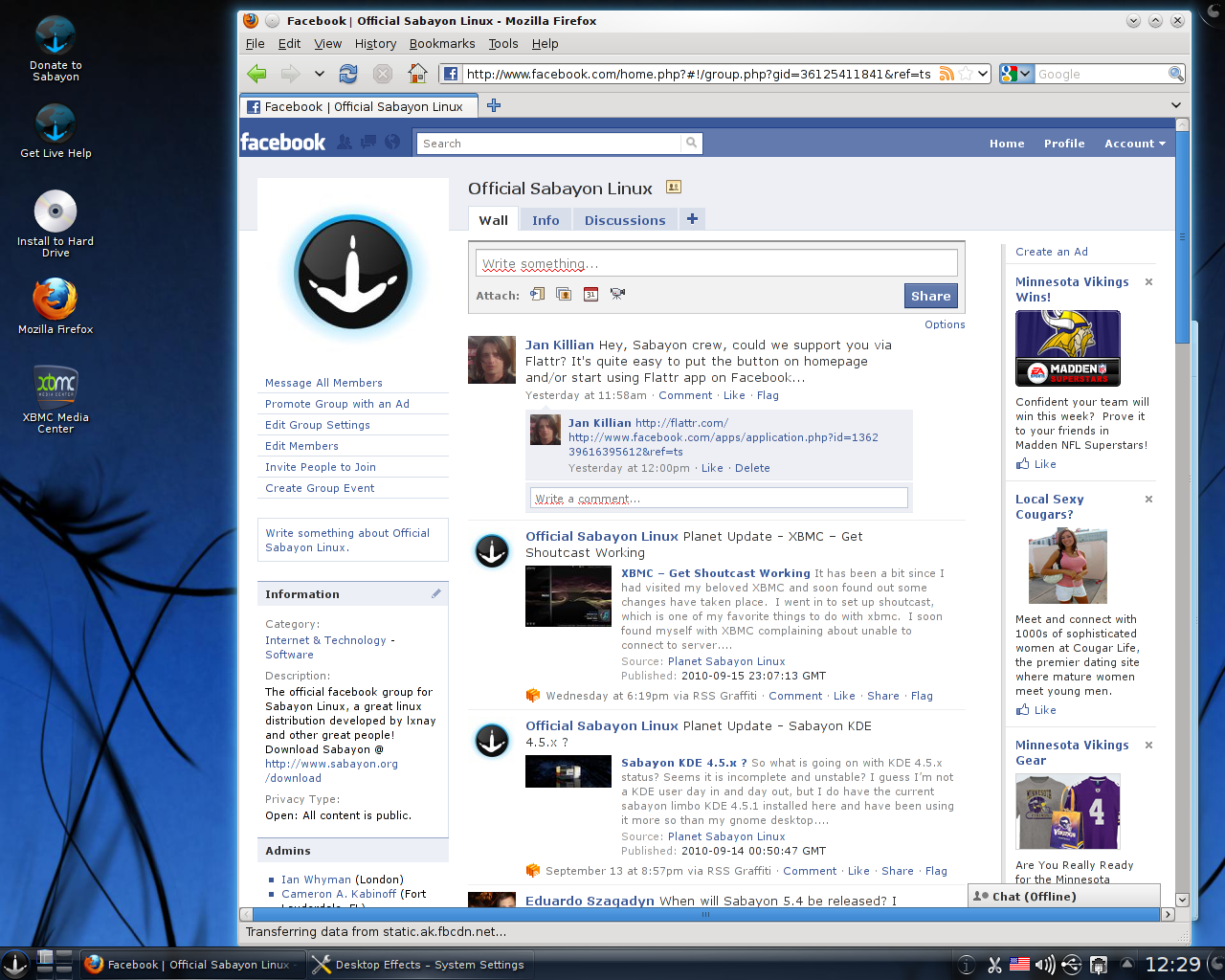
Sabayon Linux 8 Released (Gentoo-Based)

Sabayon Linux 8 Released (Gentoo-Based)
Earlier we have talked couple of times about Sabayon Linux. This week the devoper team announced the immediate availability of Sabayon Linux 8. Gentoo-based Sabayon touts its variety of packages and installations to choose from, and even though their FAQ mentions its appropriateness for new Linux users, it’s aimed at more experienced users who want to customize to their hearts’ content. As expected Sabayon GNOME 3.2.2, KDE 4.7.4 (4.8.0 available in testing repo), Xfce 4.8, LibreOffice 3.4.4, SpinBase (bare-metal flavour for building your own ISO images), ServerBase (same but with server-optimized kernel), CoreCDX, for those liking Fluxbox are included in this release.
Features:- 
  • The first and best way to try a Gentoo-based Linux distribution at its full power, with all working out-of-the-box and no compilation needed at all
  • The first Extreme-Rolling Release distribution, with automated repository package version bumping, thanks to Entropy Matter ebuild tracker
  • Faster, cleaner and more evolved than any other rolling distro out there: we work hard to bring you the most stable rolling release experience
  • Keep up-to-date your system in minutes while maintaining full Gentoo Portage compatibility
  • Focusing on performance: GCC 4.6 with Graphite Loop Transformation infrastructure and Link Time Optimizations enabled
  • Always up-to-date Linux Kernel 3.2 (and experimental "Fusion" Kernels available in repositories)
  • Providing extra Server-oriented Linux kernels (OpenVZ, Vserver, Generic Server)
  • Natively supporting the btrfs filesystem (besides ext4, aufs, and others)
  • Transform Sabayon into an full-featured HTPC Operating System (Media Center) using XBMC 10.1 (11.0 available soon)
  • GNOME 3.2.2 Visual Environment
  • KDE 4.7.4 Desktop Environment (4.8.0 available in a few days)
  • Improved Xfce 4.8 out-of-the-box experience (for those missing GNOME2)
  • Improved LibreOffice integration, updated to 3.4.4
  • Migrated to libav as ffmpeg replacement
  • Migrated to Java 7 and Subversion 1.7
  • Cinnamon and Razor Qt available in repositories
  • Entropy Framework (Package Manager, Web Services) updated to 1.0_rc86, consolidating stability and performance
  • Support for IME and non-roman fonts at install time
  • Support for non-latin languages at install time
  • More than 12000 packages available for x86_64, i686
  • ARMv7 versions already available, with more than 2000 packages ready to be installed
Important Fixes:-

To Download Sabayon Linux 8 Click Here


SHARE OUR NEWS DIRECTLY ON SOCIAL NETWORKS:-

Related Posts Plugin for WordPress, Blogger...