Stuxnet Clones May Be Used To Hit US


Officials at the US Department of Homeland Security are warning that cybercriminals could create clones of offshoots of the Stuxnet computer worm and attack American power plants, water treatment facilities, and other key parts of the infrastructure, various media outlets have reported.
The self-replicating malware, which was originally detected last July, was used to disrupt nuclear-enrichment programs in Iran, according to Reuters reports on Thursday. Stuxnet reportedly targeted Siemens-branded industrial control systems, exploiting four previously unidentified vulnerabilities in Microsoft Windows in order to seize control of the operating systems.
"Copies of the Stuxnet code, in various different iterations, have been publicly available for some time now," officials from Homeland Security said in a submission to the House Energy and Commerce Committee, reports Telegraph Technology Correspondent Christopher Williams.
"The Department is concerned that attackers could use the increasingly public information about the code to develop variants targeted at broader installations of programmable equipment in control systems," they continued, adding that officials would "remain vigilant and continue analysis and mitigation efforts of any derivative malware."
Forensic evidence suggests that Stuxnet, which has been referred to by cybercrime experts as one of if not the most complex computer virus ever determined, could have been the product of a joint operation launched by the US and Israel, Williams said.
According to Reuters, Roberta Stempfley, acting assistant secretary with the Office of Cyber Security and Communications, and Sean McGurk, director of the National Cybersecurity and Communications Integration Center, also testified before a House Energy and Commerce subcommittee on Tuesday.
Furthermore, Dan Goodin of the Register reports that Stempfley and McGurk warned the House Subcommittee on Oversight and Investigations that several different nation states, terrorist networks, organized crime groups, and individuals located within American territory are currently capable "of targeting elements of the US information infrastructure to disrupt, or destroy systems upon which we depend."
Williams reports that similar concerns prompted the British government to invest £650 million (approximately $1 billion) in cybersecurity in 2010.


-News Source (Red Orbit)


SHARE OUR NEWS DIRECTLY ON SOCIAL NETWORKS:-

6 Websites Hacked by Minhal Mehdi

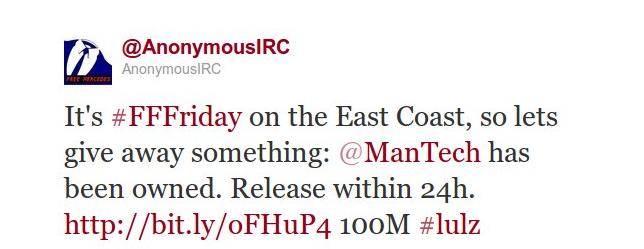
Anonymous claims to have breach ManTech International's Network


A tweet sent by the hacker group Anonymous at midnight yesterday claims the group has broken into the network of defense contractor ManTech International and intends to release seized documents within 24 hours.
"ManTech has been owned. Release within 24h," said the Anonymous tweet.

SHARE OUR NEWS DIRECTLY ON SOCIAL NETWORKS:-

Mac OS X Lion Login Password Vulnerability


A password recovery company has advised users of the Mac OS X Lion to disable the ‘automatic login’ feature of the operating system from Apple (NASDAQ:AAPL) due to a vulnerability that was discovered recently.
The vulnerability of the recently released Mac OS X Lion reportedly exposed the login passwords whenever the Mac is in sleep mode or is locked according to Passware, which provides password recovery software applications to law enforcement organizations. The same issue also affects the earlier version of the OS from Apple, the Snow Leopard.
The company indicated that it was necessary for users of the Mac OS X Lion to connect with the FireWire port of the Mac for them to retrieve the password through direct memory access. Sales of the latest OS from Apple started a week ago at the App Store with a price tag of $30. Apple has pointed out that the Mac OS X Lion provides numerous new features.

Fortunately this issue can be easily resolved by users when they disable the automatic login feature on the Mac OS X Lion. The users can also opt to shut down the computers since the passwords will not be saved in the memory once the computers are turned off. The FireWire port can also be disabled by the users to guard against this vulnerability on the Mac OS X Lion.
The company also indicated that its newest offering, the Passware Kit Forensic will be able to deal with the vulnerability on the Mac OS X Lion since the software will reportedly recover the login password.
When the automatic login feature is disabled, the computer will be secured even if the passwords are recoverable while the Mac is in sleep mode. With the automatic login feature in the Mac OS X Lion, anyone who works on the computer can access the device.
Users will have to type in their password into the computer using their profile in order to disable the automatic login feature of the Mac OS X Lion. Passware has indicated that it has already used the same system of accessing apparently secured data as ut was able to decrypt some hard drives that were encrypted using TrueCrypt and BitLocker.

SHARE OUR NEWS DIRECTLY ON SOCIAL NETWORKS:-

Netsparker 2.0 Released (Web Application Security Scanner)

Mavituna Security has released V2.0 of its web application security scanner Netsparker. The new version includes 16 new security checks, 15 new features and a variety of minor improvements.
New in V2.0 is a Vulnerability Database with a list of known vulnerabilities for Apache, Tomcat, MSSQL and MySQL. When Netsparker identifies one of these systems, it’ll reference the database and report all known vulnerabilities for that particular version with severity, exploit details and CVE references.

The new security checks performed by Netsparker 2.0 include: SSL checks (Netsparker will report weak ciphers, self-signed SSLs and similar SSL / Certificate related issues), Tomcat default files checks, ASP.NET MVC version disclosure checks and  Mongrel / Nginx version disclosure checks.

The vulnerability engine has also been enhanced:

    * Improved Signature based SQL Injection detection
    * LFI checks improved and coverage increased
    * Attribute-based XSS checks improved
    * PHP source code disclosure checks improved
    * Protocol-based XSS attacks significantly improved
    * ASP.NET / .NET Framework 4 Viewstate support added. MAC Enabled and Encryption issues will also be reported correctly in .NET Framework 4 systems
    * ORACLE SQL Injection checks improved

On a lighter note, Mavituna Security are also proud of the new dramatic splash screen. You can’t beat that!

For more Information About Netsparker 2.0 click Here

SHARE OUR NEWS DIRECTLY ON SOCIAL NETWORKS:-

Personal Information of 35 Million Internet Users in South Korea was Stolen

 
The personal information of about 35 million Internet users in South Korea was stolen in an alleged hacking attack that originated in China, officials said Thursday.
Hackers purportedly attacked popular Internet and social media sites Nate and Cyworld earlier this week, stealing data such as social security numbers and email addresses, the Korea Communications Commission said in a statement.
The regulator said that the operator of the sites, SK Communications, alleged the attack originated from computers in China based on their Internet Protocol addresses. IP addresses are the Web equivalent of a street address or phone number.
The stolen data included user IDs, passwords, social security numbers, names, mobile phone numbers and email addresses. Nate said the social security numbers and passwords are encrypted so that they are not available for illegal use.

South Korean police said Thursday their investigation could take several months.

Kim Jie-won, a KCC official, said that if proven, the alleged attack would be the largest Internet hacking case to have taken place in South Korea.

The country is one of the most wired in the world and its citizens some of the most Internet-savvy. South Korea has a population of about 50 million people. More than 80 percent of households have broadband access to the Internet, according to the country's statistical office.
South Korea has faced Internet attacks before, with blame frequently pinned on hackers operating from IP addresses in China. China has denied all charges of hacking in the past and says the country itself is a victim of hacking.
In May, South Korean prosecutors said that hackers in North Korea  had broken into the computer network of a South Korean bank earlier this year. The prosecutors said software used in the hacking was similar to that used in a 2009 attack that paralyzed South Korean and U.S. websites.

North Korea has flatly denied any responsibility for the attacks.
 
-News Source (Yahoo)

SHARE OUR NEWS DIRECTLY ON SOCIAL NETWORKS:-

LulzSec Spokesman Busted By Scotland Yard


Scotland Yard's cybercrime unit has arrested a teenager it suspects of working as the spokesman for the Lulz Security hacking collective, officials said Wednesday.
The Metropolitan Police's Central e-Crime Unit arrested a 18-year-old at an address in Scotland's remote Shetland Islands, the force said in a statement. His name wasn't released, but police said he was believed to be "Topiary," one of LulzSec's most prominent members.
Police originally gave his age as 19 but later issued a correction. 
LulzSec shot to prominence in May with attacks on the US Public Broadcasting Service - whose website it defaced by posting a bogus story claiming that the late rapper Tupac Shakur had been discovered alive in New Zealand.
The group is a spin-off of Anonymous, an amorphous collection of Internet enthusiasts, pranksters and activists whose targets have included the Church of Scientology, the music industry, and financial companies including Visa and MasterCard.
Topiary was linked to both groups, serving as the on-again, off-again media liaison for the publicity-hungry hackers.
In his only known television interview, on the "David Pakman Show" earlier this year, Topiary phoned in via Skype to feud with Shirley Phelps-Roper of the Westboro Baptist Church, a Kansas-based group notorious for picketing the funerals of slain American soldiers.
Anonymous vandalised the church's website live over the course of the interview.
In conversations with The Associated Press, Topiary said he controlled LulzSec's Twitter feed, which garnered some 300,000 followers over the course of its six-week-long Internet rampage.
LulzSec has claimed responsibility for breaches at pornography websites, gaming companies, and law enforcement organisations. It's also claimed credit for harassing seemingly random targets including an obscure New Jersey-based magnet manufacturer.
One its most spectacular hacks was against Sony Pictures Entertainment. The group posted the usernames, passwords, email addresses and phone numbers of tens of thousands of people, many of whom had given Sony their information for sweepstakes draws. Another stinging series of breaches last month targeted Arizona's police force in protest against its contentious immigration law. Officers had to scramble to change their numbers because their phones were being jammed with calls.
Shortly thereafter the group abruptly announced it was disbanding, although Topiary said at the time that the group wasn't bowing to police pressure.
"We're not quitting because we're afraid of law enforcement," he said in a Skype call. "The press are getting bored of us, and we're getting bored of us."
Attempts to reach Topiary since then have been unsuccessful, although his group recently re-emerged from retirement, defacing The Sun newspaper's website with a fake story claiming that media tycoon Rupert Murdoch had died. In one of its last messages, LulzSec said it was working with unnamed media outlets on a WikiLeaks-style release of emails it claimed to have stolen from the tabloid.
Topiary's once-plentiful Twitter feed was practically wiped clean Wednesday. The only remaining post, from nearly a week ago, read: "You cannot arrest an idea."
The latest arrest is one of an increasing number claimed by law enforcement in Britain and the United States in connection to their investigations into Anonymous and its offshoots. Last week, the FBI, British and Dutch officials carried out 21 arrests, many of them related to the group's attacks on Internet payment provider PayPal Inc., which has been targeted over its refusal to process donations to WikiLeaks.
Last month another 19-year-old, Ryan Cleary, was charged with attacks on Britain's Serious Organized Crime Agency and various UK-based music sites. Although at least one of the attacks he was charged with seemed linked to LulzSec, Topiary claimed at the time that Cleary was at most only tangentially involved with the group.
Scotland Yard said Wednesday it was also searching a residential address in Lincolnshire, in central England, and interviewing an unnamed 17-year-old in connection with the investigation. The second teen has not been arrested.

-News Source (IBN)

SHARE OUR NEWS DIRECTLY ON SOCIAL NETWORKS:-

Related Posts Plugin for WordPress, Blogger...