Showing posts sorted by relevance for query SpyEye. Sort by date Show all posts

Zeus Strategy Followed By SpyEye & Here The Victim is Android Users


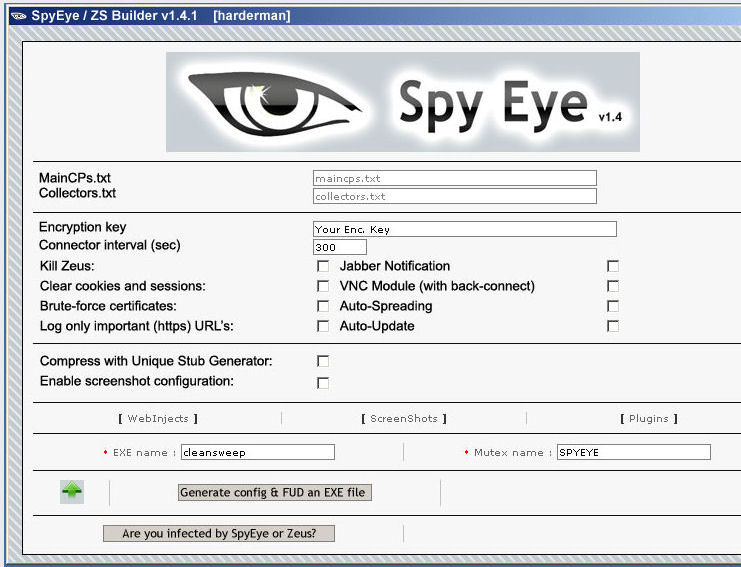
In the world of Windows malware, SpyEye is a widespread malicious toolkit for creating and managing botnets. It is designed primarily for stealing banking credentials and other confidential information from infected systems. SpyEye is a major competitor of the infamous Zeus toolkit.
Zeus (also known as ZBot) generated a lot of interest in the mobile security community a couple of months ago when an Android version was discovered. Of course, we did not have to wait long before a version of SpyEye targeting Android was also developed, and sure enough a malicious SpyEye Android app was discovered a few days ago.
The functionality of Zeus and SpyEye on Windows is quite similar, so I was curious as to how similar their respective Android versions would be.
Zeus for Android purports to be a version of Trusteer Rapport security software. This social engineering trick is used in an attempt to convince the user that the application they are installing is legitimate.
SpyEye for Android, now detected by Sophos products as Andr/Spitmo-A, uses a slightly different but similar social engineering technique. When the user of a PC infected by the Windows version of SpyEye visits a targeted banking website, and when the site is using mobile transaction authorization numbers, the SpyEye Trojan may inject HTML content which will instruct the user to download and install the Android program to be used for transaction authorisation.


The SpyEye application package does not show up as an icon in the "All apps" menu, so the user will only be able to find the package when the "Manage Applications" is launched from the mobile device's settings.
The application uses the display name "System" so that it seems like a standard Android system application.
When installed, Zeus for Android displayed a fake activation screen, and Spitmo is again very similar. However, Spitmo uses different tactics to convince the user that it is a legitimate application.
It applies for the following Android permissions:-
  • android.provider.Telephony.SMS_RECEIVED
  • android.intent.action.NEW_OUTGOING_CALL

This allows the malware to intercept outgoing phone calls. When a number is dialed, the call is intercepted before the connection is made and the dialed phone number is matched to a special number specified by the attacker in the alleged helper application installation instructions. If the number matches, Spitmo displays a fake activation number, which is always 251340. Once installed, the functionality of Zeus and SpyEye are pretty much the same. A broadcast receiver intercepts all received SMS text messages and sends them to a command and control server using an HTTP POST request. The submitted information includes the sender's number and the full content of the message.So far, it does not seem that this attack is widespread, but it shows that the developers of major malicious toolkits are closely watching their competition and matching the latest features. It also seems that support for Android is increasingly becoming an important part of their product strategy.

-News Source (N.Security)


SHARE OUR NEWS DIRECTLY ON SOCIAL NETWORKS:-

SpyEye Banking Trojan Swallowing US, Russia & Ukraine -Said AhnLab

SpyEye Banking Trojan Swallowing US, Russia & Ukraine -Said AhnLab 

Researcher at AhnLab has figure out a significant majority of the domains and hosts for the SpyEye Banking Trojan are in the US. The malicious code has gained attention as of late for the threat it poses to online banking user information. According to SpyEye-relevant host data extracted by the AhnLab Packet Center, 48% of all SpyEye domains were found to be located in the US, followed by Russia at 7%, and the Ukraine at 6%. The AhnLab Packet Center is the company’s malicious packet analysis system, which assesses suspicious packet data, including that from SpyEye C&C servers. The findings indicate that the main targets of SpyEye are mainly in the US, and that North American financial institutions and users should remain especially vigilant.
Since its toolkit first became public in 2010, the SpyEye Trojan has produced many variants. According to analysis by the AhnLab Packet Center, the “10310” variant was identified as the most distributed version at 34.5%. The “10299” and “10290” variants followed at 14.7% and 14.6%, respectively. Additional variants are expected in the future. SpyEye, along with ZeuS, are notorious banking Trojans that have helped thieves steal more than $100 million around the world. Without an end-user PC solution, banks face great difficulty protecting individual customers from the sophisticated threats posed by these malicious codes. AOS ensures comprehensive transaction security with its Anti-keylogger, Firewall and Anti-virus/spyware agents for individual user PCs, as well as Secure Browser which creates an independent online space for safe communication. With AOS’ unique approach to transaction security, banks are able to deliver complete peace of mind to their online customers.

The four components of the AhnLab Online Security (AOS) solution, designed to protect the entire transaction process, include:-
  • AOS Secure Browser: Provides a dedicated security browser that creates an independent and protected environment for online transactions. It secures user banking data against Man-In-The-Browser (MITB) attacks such as SpyEye and ZeuS, memory hacking, webpage alteration, HTML injection, cross-site scripting (XSS), browser help object (BHO) hacking, screen capturing, debugging, and reverse engineering.
  • AOS Anti-keylogger: Delivers the protection needed to keep account information safe and prevent theft of personal banking data during input via a keyboard.
  • AOS Firewall: Protects the user by detecting and blocking unauthorized intrusions and hacking attempts and preventing the leakage of personal information.
  • AOS Anti-virus/spyware: Secures online transactions against the latest malicious codes with AhnLab’s cloud based security technology known as ASD (AhnLab Smart Defense).
Yesterday we have discussed that Microsoft’s Digital Crimes Unit coordinated with several financial services organizations and the United States seized the two command-and-control servers of Zeus


-Source (Market-Watch)

SHARE OUR NEWS DIRECTLY ON SOCIAL NETWORKS:-

SpyEye is Becoming A Big Threat For Cyber Security


SpyEye, a potentially dangerous hacking tool, has become widely available for anyone to buy, giving rise to concerns about the threat posed by cyber attacks.
According to an article on USA Today, security researchers have predicted a large rise in the number of attacks orchestrated using SpyEye for the rest of the year.
The toolkit, which is far more dangerous and sophisticated than ZeuS, was previously used by a group of elite hackers and was sold for as much as $10,000.
However, after a group of French security researchers managed to crack the toolkit’s activation key, its entire source code has been laid bare for hackers to replicate and sell for as low as $95, making it available for virtual anyone with malicious intent. "SpyEye is very dynamic and versatile," Amit Klein, chief technical officer of Trusteer warns.
“Every level of criminal, from the lowest to the highest rungs, can now use one of the deadliest Swiss Army knife hacking toolkits in the world,"  Sean Bodmer, senior threat intelligence analyst at network security firm Damballa, told USA Today.
Ever since the toolkit was released online, 14 cyber gangs have taken advantage of it, sending commands to thousands of botnet PCs in the United States.

-News Source (ITPro Portal)

SHARE OUR NEWS DIRECTLY ON SOCIAL NETWORKS:-

SpyEye Trojan found in Virgin Media


SOCA detected the virus created to steal bank details The SpyEye trojan virus, which is designed to steal online bank accounts information, has infected over 1,500 PCs of Internet service provider Virgin Media. The malicious virus infections were detected by the Serious Organised Crime Agency (SOCA), which alerted Virgin Media. SOCA is investigating the matter. Virgin Media has sent letters to its broadband customers which have instructions on how to remove the virus, which usually affects Microsoft Windows systems, and avoid  escalation of security threats. The SpyEye trojan virus was first detected in 2009.
SOCA cyber chief Lee Miles said he welcomed "steps taken within industry to utilise the information and resources provided by law enforcement and raise awareness of online safety". A Virgin Media spokesman said the response of its customers about the infection had been "generally positive". The company's executive director of broadband Jon James said, "Cybercrime is on the rise and the increasing sophistication of malware infections mean that all Internet users could be at risk with devastating effects."  

SHARE OUR NEWS DIRECTLY ON SOCIAL NETWORKS:-

RSA Said: Zeus v2.1.0.10 Became The Most Infamous & Propagated Trojan in Cybercrime History


The RSA Research Lab investigated and monitord a large number of malicious cybercrime servers operating in the wild. What RSA researchers discovered was nothing less than the robust mercenary workings of a virtual heist machine, one that has been operational on an ongoing basis, militating and robbing financial data from hundreds of thousands of infected users all over the world. The tool of choice—Zeus v2.1.0.10, the most advanced variant of Zeus to date. The end result: endless logs of compromised financial data and untold numbers of wire-fraud transactions.
According to the official blog of RSA:- 

A Privately Developed Zeus Upgrade:-
Unlike the large majority of banking Trojan, the Zeus Trojan has always been a commercial code, sold by its creator to those who could afford an advanced fraud tool and understood how to use it. With time, Zeus became the most infamous and most propagated Trojan in cybercrime history. In October 2010, nearly one year ago, the bequeathing of the Zeus Trojan’s source code by its owner “Slavik”, to his then biggest rival, the SpyEye Trojan’s coder (“Harderman”), united the future of 2 giant commercial codes and threw a Zeus-faced wildcard into the game when its entire source code was leaked in March 2011.
But it was nearly two months before the announcement of the code ‘merger’ was even made that RSA researchers were already looking at a rather special upgrade of the Zeus Trojan: Zeus v2.1. A surprising and rare new version which included some of the most sophisticated additions to the Zeus code seen in recent times, making it more impervious and hardened thus shutting-out a lot of potential interference with this variant’s configuration and its communication patterns. At the time (early September 2010), our team was in the possession of a single variant of this upgrade and was not entirely sure what it represented as yet. The interesting part of the upgrade was its low propagation numbers and the time lapse it took for the Lab to see more of it in the wild. True Zeus 2.1.0.10 variants were not being sold in underground forums. These two initial observations already suggested that the new upgrade was the property of one cybercriminal or a single cybercrime gang.
Within six months, Zeus 2.1.0.10 was being detected more and more often, and although the number of variants kept growing, the trigger list in each and every one of them was identical – a rare case for Zeus variants in which each operator updates his own list of triggers. This was the third sign pointing to a single operations team for Zeus 2.1.0.10.
June 2011 – a sharp peak in Zeus 2.1.0.10 attacks resulted from the propagation of hundreds of variants of this upgraded version. To date, the RSA Research Lab detected 414 different variants, and yet, each and every variant still went after the exact same trigger list. At this point it was clear that Zeus 2.1.0.10 belongs to one gang who had the Zeus source code way before the merger, way prior to the code leak and before anyone even imagined what would become of Zeus.
This gang developed their own Zeus Trojan using Zeus’ source codes and its mainframe; this gang operates Zeus 2.1.0.10 without sharing their malevolent creation with outsiders.

Zeus 2.1.0.10 Has its Own Techniques:-
More than the actual upgrade of the Trojan code, the new Zeus 2.1.0.10 behaved in a new way, unlike the one observed in other Zeus variants. Unlike other advance Trojans who contact the mothership through reverse proxies, fast flux networks, or those who use their own botnet as proxies – Zeus 2.1.0.10 never communicates directly with the mothership. This special variant further uses another obfuscation technique for cases where it fails to find a live update point. In order to make sure the botnet always ‘calls home’ Zeus 2.1.0.10’s operators programmed a randomized, on-the-fly domain name generator, based on a constant algorithm the Trojan’s configuration dictates. The algorithm creates 1,020 domain names (URLs) per day. Each new and unique domain name is a string of letters. The suffix “/news” or “/forum” follows the domain name when it is used for the Trojan’s update and drop communications.
The cybercriminal operation team behind the scenes has the same algorithm. They know exactly when the whole botnet will attempt to communicate with a specific new domain name, and then simply go and buy that domain name, hosting each one through facilities located all over the world. At that point, the whole botnet queries the new domain with a request for the update file – and receives it, and the C&C queries its bots for the stolen data they have in store – and receives it.  Mission accomplished.
This all happens without anyone outside the gang knowing their algorithm or being able to guess which communication channel they will choose for their botnet next. Even if an external party was to attempt to solve the algorithm, they would have to buy the domains before the gang does, thus engaging in a race against time and paying for numerous domain registrations every hour (!). No matter how many domains an adversary buys, the bot masters will eventually buy one and the botnet will end up communicating with it.
The communication through randomized domains generated by the Trojan is directed through a list of legitimate VPS and legitimate cloud services used as a proxy. This raptures any further tracking possibilities of the true motherships which militate the immense botnet.
Zeus 2.1.0.10’s behavior pattern has never been used in Zeus or SpyEye variants, but it sure is identical to another Trojan’s sophisticated and diuturnal operations – Sinowal. A long standing, privately owned Trojan, operated by an organized cybercrime gang based out of Russia, Sinowal is perhaps one of the most persevering private banking Trojans; one whose nefarious nature has been the intrigue of many security researchers since as early as 2006.
It was initially somewhat surprising to see that Zeus 2.1.0.10 was not only a private version of Zeus, it also behaves exactly in the same manner as Sinowal similarly held by Russian-speaking cybercriminals. These common denominators raised a logical suspicion as to the possibility of the two sharing some links if not operated by the same gang altogether.

For more information and to see the RSA blog article about Zeus click Here


SHARE OUR NEWS DIRECTLY ON SOCIAL NETWORKS:-

PDF Malware Using New Tricks to Exploit Vulnerability


Security researchers have identified a new trick in PDF files being sent as email attachments that obfuscate attack code by encoding it inside an image file.

Malicious PDF files are using a new trick to avoid detection by almost all major antivirus scanners on the market, according to security researchers. Researchers from Avast and Sophos independently noticed PDF files making the rounds in March that weren’t being flagged as malicious but had the ability to compromise a machine just by being opened. The originating address was often suspicious, and the attachments accompanied emails purporting to be an order receipt. The attachments themselves often had names containing the supposed order number.
When the attachments were opened under Adobe 8.1.1 or Adobe 9.3, the compromised computer would connect to a remote site and download malware, usually SpyEye, ZBot  or FakeAV, Paul Baccas, a senior threat researcher at Sophos Labs, wrote on the company’s Naked Security blog on April 15.
“The PDFs did not seem to be using any exploit that I could see and yet they were downloading malware,” wrote Baccas.
It turned out these files were using a new trick to re-exploit the CVE-2010-0188 vulnerability Adobe had patched over a year ago on Feb. 16, 2010, according to Baccas.
The exploit is specific to Reader and would not execute in Google Chrome’s PDF Plugin, Jiri Sejtko, a senior virus analyst and researcher at Avast Software, wrote on the company blog April 22. While that’s a good sign, Chrome generally asks users if it should open the file in Reader if it can’t display the file correctly. In this day and age, many users would likely say yes, making them vulnerable, according to Sejtko.
The PDF specifications allow several filters to be used on raw data, either singly or in conjunction with each other, Sejtko said. Anyone can create valid PDF files where the data uses five different filters, or even multiple layers of the same filter. This allows malware authors to embed malicious code deep inside the filters, out of reach of even the most aggressive scanner.
“Our parser was unable to get any suitable content that we could define as malicious,” Sejtko said.
Files exploiting this vulnerability normally use an XML file that contains the raw data for a TIFF image file containing highly obfuscated code, Baccas said. In this case, the attackers were using parameters to control how the filters operate and crafting the attack code embedded in the raw data to conform to these parameters.
The filter being used to encrypt the malicious code was also meant to be used only for black and white images. The exploit detected by Avast researchers combined two filters, one for text and one for images, to hide the payload.
“Who would have thought that a pure image algorithm might be used as a standard filter on any object stream?” Sejtko said. While the “bad guys” are building a specially crafted TIFF image file in the PDF files, the trick can be used to hide special JavaScript and font files, as well.
Compared to other attacks, this attack is seen in “only a very small number” of attacks, Sejtko said, but has also been used in targeted attacks. While the CVE-2010-0188 flaw has been closed in current versions of Adobe Reader, users on older and unpatched versions of the software remain vulnerable to these malicious PDF files.

SHARE OUR NEWS DIRECTLY ON SOCIAL NETWORKS:-

An army of techies waging war on spam


It's a vast, invisible battle, going on all the time - and, unbeknownst to you, your computer may be one of the battlegrounds.
The struggle pits thousands of smart, evil folks, who send out trillions of pieces of spam e-mail, against the people in law enforcement and business guarding against them and trying to shut them down.
On the front lines against spam and cybercrime, some analyze malicious computer code (malware), and others - in the young science of cyberforensics - examine computers and drives confiscated in investigations.
Spam - hated word - is again in the news. A May 3 FBI alert warned of e-mail carrying purported images or videos of Osama bin Laden. "This will leave you speechless)," the spam says. "See picture of bin laden dead!"
Don't even open it, warned the alert. "This malicious software or malware can embed itself in computers and spread to users' contact lists, thereby infecting the systems of associates, friends, and family members."
Pumped out by networks (botnets) of malware-enslaved personal computers, unwanted e-mail - random junk, ads, porn, viruses, Trojan horses, get-rich-quick offers from Nigerian nobility - makes up most of all e-mail sent in the world. By far. Estimates range around 80 percent - but a 2007 Microsoft security report in October put it at 97 percent. It ranges from crud to criminal. As for malware, the United States has about 2.2 million computers (more than any other country) infected, according to Microsoft numbers (likely to be low).
"I guarantee," says FBI Special Agent Brian Herrick, director of the FBI Cyber Crime Squad in Philadelphia, "that thousands of Inquirer readers probably have computers infected with spam or malware, part of a botnet just pumping out spam."
The cyberthugs have an advantage, says Special Agent Cerena Coughlin, also of the Cyber Crime Squad. "We can stop them for a while, but they always come up with ways to circumvent it. And we're more restricted. We have to follow the letter of the law - they don't."
The extent of it is staggering. Before U.S. marshals took it down in March, the Rustock botnet was pumping out an estimated 30 billion spam e-mails a day. The botnets - big names include ZeuS, SpyEye, Dogma, Koobface, and Alureon - are run by criminal groups that use servers and supercomputers in several countries. Tracing their activity is extremely difficult and calls for highly skilled technical workers.
One of 16 such FBI squads in the country, the Philadelphia Cyber Crime Squad has 15 agents working full-time on cybercrime; the national program began in 1996. Working with national and international agencies, the squad studies and traces viruses, junk, and spam. Cases involve computer intrusions (everything from local hackers to international cyberespionage and terrorism), child exploitation (as in pornography), intellectual-property rights (copyright infringement, movies, music, software, proprietary business secrets), Internet fraud, and identity theft.
Coughlin says, "We are insanely busy. This is the third-busiest squad in the country, because of where it is and all the affected business and government concerns nearby. We don't have enough bodies for all the work there is."
In the Philadelphia area, the FBI joins hands with local businesses such as banks, agribusiness, and utilities (enterprises often attacked by spam and cybercrime) in a group called InfraGard. There are more than 1,400 local members - "So many people want to be part of it that we don't even need to solicit members," Coughlin says.
At monthly meetings, members share information, news, and tips. The FBI gives presentations and talks, and individual members speak about the cases they face. "It's a communication channel," Herrick says, "between the U.S. government and people in industry down in the trenches, looking to protect critical infrastructure."
Current president of the local chapter of InfraGard is Brian Schaeffer, chief information officer of Liberty Bell Bank in Marlton. He says, "I get thousands of cyberattacks a day. A lot of them are idiots just wanting to show what they can do. But a lot of them are looking to access banking information."
Like most banks, Liberty Bell has a strong firewall, "so hackers take a back-door approach," sending bank clients "phishing" e-mails - which pretend to be trustworthy communications but hide nasty intentions. "If a client even opens such an e-mail, they can get into their account information, their contacts, the keys to the kingdom."
Such attacks mean that "not only do I have to defend my own system, but also I try to help the customers with theirs. If their computers get infected, their account and credit information could get sold to strangers, and that could hurt us all." Schaeffer tells of an elderly couple who came to his bank one day, and just by coincidence, a bank clerk brought him a suspicious request "to withdraw a huge amount of money from their account - but there they were, sitting with us, so we knew some hackers had got at their information through e-mail."
He says InfraGard "has given me a network of people I can go to if I see things I never saw before. If I have a question, there's likely to be someone with an answer."
The other side of the battle is cyberforensics. Think of it as CSI with computers. It's happening right now, with the cache of computers, flash drives, and other cyberstuff taken from Osama bin Laden's compound in Abbottabad, Pakistan. U.S. agents instantly began to analyze this precious trove for criminal evidence - and links to other al-Qaeda operatives.
Work much like this goes on in Radnor at the FBI's Regional Computer Forensics Laboratory, one of 16 such labs in the country. As with InfraGard, the flavor is distinctly federal/local. Law enforcement agencies - such as the police departments of Philadelphia, Lancaster, Lower Merion, and Lower Providence - send officers to guest-work at the lab and receive training and experience in fighting computer crime.
Supervisory Special Agent J.P. McDonald directs the lab, which has been involved in some of the highest-profile local investigations of recent years, including the 2007 Fort Dix attack plot, the manhunt for the Coatesville arsonists, the case of former State Sen. Vincent J. Fumo, and the 2007-08 "Bonnie and Clyde" case of Jocelyn Kirsch and Edward Anderton, now in prison for fraud and identity theft.
"You can track the growth of cyberforensics along the same timeline as computers," McDonald says. "The FBI's program began in 1999, and, as of the mid-2000s, cyberevidence now has recognition and a firm track record in courts."
The lab is a techie's paradise, with gadgets and screens galore, racks of digital evidence sealed in antistatic wrap, sophisticated hard-drive readers, radiofrequency-shielded spaces, and kiosks for quick analysis of cell phones and thumb drives. "The majority of what we do," McDonald says, "is analysis of what's in a machine, how it got there, and then making a timeline of the history of what got there when."
"People's electronic devices are really an extension of their thoughts," says Philadelphia Police Lt. Edward Monaghan, deputy director of the lab. "If you're into NASCAR, you're likely to have NASCAR stuff in your computer. Thugs who are into drugs and money like to have their pictures taken with drugs, guns, and money. It sounds dumb, but they love it. That's what cyberevidence is all about."
The FBI's Herrick is resigned to a long battle: "There's probably some high school kid someplace in the Midwest - or maybe Europe or Asia someplace - who's cooking up something nobody's ever seen before. You really have to stay on your game with these guys."


SHARE OUR NEWS DIRECTLY ON SOCIAL NETWORKS:-

Edward Pearson Sent To Jail For Stealing 8Million Customers Banking & PayPal Details

Edward Pearson (23 Years Aged Hacker) Sent To Jail For Stealing 8Million Customers Banking & PayPal Details

A 23 years aged hacker from UK named Edward Pearson has been sent to prison to pilfer eight million personal identities (ID fraud). Between January 1 2010 and August 30 2011, he used of malicious computer programs to get his hands on - wait for it - eight MILLION personal identities. According to report he used highly sophisticated cyber-weapons such as Zeus and SpyEye, to hunt down personal details on the Internet. 
One of his programs scanned through 200,000 accounts registered to online payment service PayPal - identifying names, passwords and current balances. Luckily, Pearson got caught after only making a £2,400 ($3,800 USD). The authorities estimate he could have walked away with as much as £800,000 ($1.3M USD).  Authorities were alerted to the problem when his 21-year-old girlfriend, Cassandra Mennim, used stolen credit cards to book rooms at the upmarket Cedar Court Grand and Lady Anne Middleton Hotels. Investigators looking into the case eventually identified him as G-Zero on hacking forms. Pearson has been jailed for 26 months, whilst girlfriend Cassandra Mennim admitted two counts of obtaining services dishonestly and was given 12 months’ supervision.


-Source (NS & DailyMail)


SHARE OUR NEWS DIRECTLY ON SOCIAL NETWORKS:-

Related Posts Plugin for WordPress, Blogger...