Showing posts sorted by relevance for query kernel. Sort by date Show all posts

Debian GNU/Linux 6.0.5 Released

Debian GNU/Linux 6.0.5 Released

Developers at Debian project is pleased to announce the fifth update of its stable distribution Debian 6.0 codenamed squeeze. According to the project release this update mainly adds corrections for security problems to the stable release, along with a few adjustments for serious problems. Security advisories were already published separately and are referenced where available. If you have Debian 6.0.x already installed, it is not necessary to reinstall, you only need to install all the latest updates from your nearest mirror site. 

What's new in Debian GNU/Linux 6.0.2:-
  • aide Properly support large files on 32-bit systems; fix group for bind9 log files
  • approx Don't try caching InRelease or non-.gz compressed files
  • apr Fix apr_ino_t changing size depending on -D_FILE_OFFSET_BITS on kfreebsd-*
  • apt Fix file size calculation on big-endian arches; don't prompt for CD re-insertion on "apt-get update"; add XZ support
  • apt-listchanges Correctly handle NEWS files containing only one entry
  • base-files Update /etc/debian_version
  • clive Adapt for liveleak.com changes
  • dbus Fix local DoS for system services (CVE-2011-2200)
  • deborphan Exclude libreoffice from --guess-section output; trap WINCH in a POSIX way; minor translation fixes
  • dokuwiki Fix an ACL bypass issue in the XMLRPC interface
  • dpkg Fix regression in 'dpkg-divert --rename'; dpkg-split: don't corrupt metadata on 32-bit systems; fix vsnprintf() compat declaration
  • e2fsprogs Various bug fixes
  • fakechroot Fix 'debootstrap --variant=fakechroot'
  • fcgiwrap Fix init script's 'stop' target
  • gdm3 Reset SIGPIPE handler before starting the session; execute the PostSession script even when GDM is killed or shut down
  • git Allow remove and purge in one step by terminating the git-daemon/log service before removing the gitlog user
  • gnome-settings-daemon Work around possible race condition when starting Xsettings manager
  • ia32-libs Refresh packages from stable and proposed-updates.
  • iceowl Security updates
  • im-config Avoid breaking login via GDM if im-config is removed but not purged
  • inn Stop using 'sort +1n' in makehistory; disable outdated CHECK_INCLUDED_TEXT option by default
  • josm Give more verbose explanation to users who haven't agreed to the new OSM license
  • kde4libs Wildcard SSL certificate and XSS security fixes; ktar checksum and UTF-8 longlink fixes
  • kdenetwork Improve fix for CVE-2010-1000 directory traversal issue
  • kernel-wedge Add hpsa and pm8001 to scsi-extra-modules; add bna to nic-extra-modules
  • kerneltop Increase line buffer size to 1024 bytes
  • klibc ipconfig: escape DHCP options and correctly handle multiple connected network devices (CVE-2011-1930)
  • krb5 Fix DoS; fix interoperability with w2k8r2 KDCs; fix invalid free and double free; don't make authentication fail if PAC verification fails
  • kupfer Use correct parameter type to allow keybindings to work again
  • libapache2-mod-perl2 Rebuild against apr 1.4.2-6+squeeze3 to pick up apr_ino_t size fix on kFreeBSD
  • libburn Don't create images with overly-restrictive permissions
  • libfinance-quotehist-perl Disable test suite, broken by website changes
  • libmms Fix alignment issues on arm
  • linux-2.6 New hardware support; add longterm 2.6.32.41; fix oops via corrupted partition tables
  • linux-kernel-di-amd64-2.6 Rebuild against kernel-wedge 2.74+squeeze3
  • linux-kernel-di-armel-2.6 Rebuild against kernel-wedge 2.74+squeeze3
  • linux-kernel-di-i386-2.6 Rebuild against kernel-wedge 2.74+squeeze3
  • linux-kernel-di-ia64-2.6 Rebuild against kernel-wedge 2.74+squeeze3
  • linux-kernel-di-mips-2.6 Rebuild against kernel-wedge 2.74+squeeze3
  • linux-kernel-di-mipsel-2.6 Rebuild against kernel-wedge 2.74+squeeze3
  • linux-kernel-di-powerpc-2.6 Rebuild against kernel-wedge 2.74+squeeze3
  • linux-kernel-di-s390-2.6 Rebuild against kernel-wedge 2.74+squeeze3
  • linux-kernel-di-sparc-2.6 Rebuild against kernel-wedge 2.74+squeeze3
  • lua-expat Fix the 'billion laughs' DoS attack
  • monkeysphere Fix monkeysphere-host revoke-key
  • nagios-plugins Allocate a big enough buffer to handle all IPs of hosts being pinged
  • nsd3 Remove statoverride before removing the package's user
  • openldap Fix possible database corruption issues, several security issues and dpkg-reconfigure
  • php-svn Rebuild against apr 1.4.2-6+squeeze3 to pick up apr_ino_t size fix on kFreeBSD
  • php5 Rebuild against apr 1.4.2-6+squeeze3 to pick up apr_ino_t size fix on kFreeBSD
  • pianobar Update API keys for XMLRPC v30
  • postgresql-8.4 New upstream bugfix release; fix pg_upgrade use with TOAST tables
  • prosody Fix the 'billion laughs' DoS attack
  • puppet Fix service provider to properly use update-rc.d disable API
  • python-apt Strip multiarch by default in RealParseDepends; add XZ support
  • python-gudev Add missing dependency on python-gobject
  • q4wine Stop shipping the library in lib64
  • qemu Don't register qemu-mips(el) with binfmt on mips(el)
  • qemu-kvm Fix division by 0 with some guests; fix vnc zlib overflow; don't abort on user hardware errors; fix migration on 32-bit
  • qt4-x11 Blacklist some fraudulent SSL certificates; fix weakness in wildcard certificate verification
  • rapidsvn Rebuild against apr 1.4.2-6+squeeze3 to pick up apr_ino_t size fix on kFreeBSD
  • refpolicy Various permissions fixes
  • reprepro Handle Release files which don't contain md5sums
  • ruby1.8 Fix upgrades from lenny by making libruby1.8 conflict/replace irb1.8 and rdoc1.8
  • samba Fix undefined symbol error from tdb2.so; several printing related bugs and a gid leak in winbind / idmap. Document the new and potentially disruptive 'map untrusted to domain'
  • schroot Fix loading of dchroot.conf
  • softhsm Remove statoverride entries before the package's user
  • sun-java6 New upstream security update
  • tzdata New upstream version
  • vimperator Resolve compatibility issues with iceweasel
  • widelands Fix potential security issue in Internet games
  • xenomai Adapt kernel patch to apply cleanly to squeeze's kernel
  • xserver-xorg-video-tseng Fix driver initialisation

To Download Debian 6.0 codenamed "squeeze" Click Here
  

-Source (Softpedia, Debian Project)

SHARE OUR NEWS DIRECTLY ON SOCIAL NETWORKS:-

Linux Repository Kernel.org Was Under Cyber Attack


Kernel.org, a site that distributes Linux source kernels, has suffered a breach of security according to a leaked email by Chief Administrator John Hawley. First noticed on August 28, it's believed multiple infected servers sat undetected for 17 days. Shortly after the leaked email went public, Kernel.org released a statement confirming intruders had gained root access to at least one server. The intruders reportedly gained access to the server with compromised user credentials, but it's unknown how they obtained root access from there.
Files belonging to SSH were modified and running live. A Trojan was also added to the start-up scripts and all user interactions were logged, possibly compromising usernames and passwords. The infected servers have been taken offline with backups made pending further investigation and full analysis on the code in Git. All servers will have full reinstalls and the respective authorities in Europe and the United States have been notified.
One major advantage in the case of Kernel.org is that the Git version control system is used to manage the entire development lifecycle of kernel packages. Each version of every package has its own cryptographically secure SHA-1 hash calculated, which changes as the package does. This creates a development history for each package, making it impossible to introduce changes without them being noticed.
Many will consider this attack to be a serious problem, but Kernel.org moved quickly to reassure everyone that repositories remained unaffected and they are working closely with the hundreds of users of kernel.org to change passwords and SSH keys.
They are also going to audit all security policies and make improvements if required to ensure this is a onetime event. The site was keen to note that it takes security seriously and is pursuing all avenues to find the attackers and prevent future infiltrations

The Leaked Email by Chief Administrator John Hawley:-

"...---------- Forwarded message ----------
From: J.H. <warthog9@kernel.org>
Date: 2011/8/29
Subject: [kernel.org users] [KORG] Master back-end break-in
To: users@kernel.org


-----BEGIN PGP SIGNED MESSAGE-----
Hash: SHA1

Afternoon Everyone,

As you can guess from the subject line, I've not had what many would
consider a "good" day.  Earlier today discovered a trojan existing on
HPA's personal colo machine, as well as hera.  Upon some investigation
there are a couple of kernel.org boxes, specifically hera and odin1,
with potential pre-cursors on demeter2, zeus1 and zeus2, that have been
hit by this.

As it stands right now, HPA is working on cleaning his box, and
I'm working on hera (odin1 and zeus1 are out of rotation still for other
reasons), mainly so that if one of us finds something of interest, we
can deal with it and compare notes on the other box.

Points of interest:

- - Break-in seems to have initially occurred no later than August 12th

- - Files belonging to ssh (openssh, openssh-server and openssh-clients)
were modified and running live.  These have been uninstalled and
removed, all processes were killed and known good copies were
reinstalled.  That said all users may wish to consider taking this
opportunity to change their passwords and update ssh keys (particularly
if you had an ssh private key on hera).  This seems to have occurred on
or around August 19th.

- - A trojan startup file was added to rc3.d

- - User interactions were logged, as well as some exploit code.  We have
retained this for now.

- - Trojan initially discovered due to the Xnest /dev/mem error message
w/o Xnest installed; have been seen on other systems.  It is unclear if
systems that exhibit this message are susceptible, compromised or not.
If you see this, and you don't have Xnest installed, please investigate.

- - It *appears* that 3.1-rc2 might have blocked the exploit injector, we
don't know if this is intentional or a side affect of another bugfix or
change.

- - System is being verified from backups, signatures, etc.  As of right
now things look correct, however we may take the system down soon to do
a full reinstall and for more invasive checking.

- - As a precaution a number of packages have been removed from the
system, if something was removed that you were using please let us know
so we can put it back.

- - At this time we do not know the vector that was used to get into the
systems, but the attackers had gained root access level privileges.

That's what we know right now, some of the recent instabilities may have
been caused by these intrusions, and we are looking into everything.

If you are on the box, keep an eye out, and if you see something please
let us know immediately.
Beyond that, verify your git trees and make sure things are correct.

- - John 'Warthog9' Hawley
Chief Kernel.org Administrator
-----BEGIN PGP SIGNATURE-----
Version: GnuPG v1.4.11 (GNU/Linux)
Comment: Using GnuPG with Fedora - http://enigmail.mozdev.org/
iEYEARECAAYFAk5a5U0ACgkQ/E3kyWU9dif+1ACfYPlgq/keFrFO77AmQVduKGwx
TAcAnRAu6nHt74+5aC+fPeb8aT0hcy2K
=Semd.."

For More information Click Here
-News Source (TECH SPOT & Kernel.org)

SHARE OUR NEWS DIRECTLY ON SOCIAL NETWORKS:-

Unbreakable Enterprise Kernel Release 2 For Oracle Linux With Linux kernel 3.0 & btrfs

Unbreakable Enterprise Kernel Release 2 For Oracle Linux With Linux kernel 3.0 & btrfs 
Today Oracle officially released its Enterprise Kernel Release 2 for Oracle Linux which incorporates the recently released Linux 3.0 kernel & the newly added file system known as btrfs. Since October of 2010, Unbreakable Linux 2 is the second major update of Oracle’s Linux distribution. It also features technical previews of Linux Containers and Sun-developed DTrace but those features are not yet commercially supported. Enterprise Kernel Release 2 is available to all Oracle Linux subscribers today and is included with Oracle Linux 5 and 6. In a brief interview, Oracle execs said Btrfs, which is standard in Oracle Linux, supports data stores of up to 16 exabytes, is optimized for solid state disks, incorporates data integrity and is simple to administer. Enterprise Kernel 2 was tested on two-socket and Oracle’s most powerful 8 socket systems and demonstrated an impressive 5 million transactions per minute on x86 systems and reportedly offers fastest performance on Intel systems.
Linux 3.0 was the first version of the kernel to support the Btrfs next-generation file system. Btrfs can manage up to 16 exabytes of data in one namespace, which should ease the burden of data management for organizations with that much material. It provides the ability to automatically back up data and a way to do RAID backups without external controllers. It also is optimized for solid-state hard drives, rather than the drives based on spinning disks.
Some key Highlights In This Release Include:-
  • Btrfs file system
  • Performance and scalability improvements
  • Virtualization improvements
  • Transparent Huge Pages and Memory compaction
  • Cgroups improvements
  • Linux Containers
  • OCFS2 improvements
  • Updated Device Drivers
For more information, please see the Unbreakable Enterprise Kernel Release 2 features and benefits document and consult the release notes for more For installation instructions, check out the Getting Started with the Unbreakable Enterprise Kernel installation guide on the Oracle Technology Network.


SHARE OUR NEWS DIRECTLY ON SOCIAL NETWORKS:-

Microsoft Gets Recognition Among Top 20 Linux Kernel Contributors

Microsoft Gets Recognition Among Top 20 Linux Kernel Contributors

The Linux Foundation announced the top Linux kernel development contributors, with Microsoft getting on the list for the first time. The top 10 contributors to the Linux kernel in this latest report include "Red Hat, Intel, Novell, IBM, Texas Instruments, Broadcom, Nokia, Samsung, Oracle and Google," according to the report. For the first time, Microsoft has made the list of the top 20 contributors to the Linux kernel. Microsoft placed at No. 17 among companies that have contributed the most toward developing the Linux OS's kernel. As the Linux Foundation's announcement pointed out, it represents quite a change from the time when Microsoft CEO Steve Ballmer called Linux "a cancer" is now working within the collaborative development model to support its virtualization efforts and its customers. Because Linux has reached a state of ubiquity, in which both the enterprise and mobile computing markets are relying on the operating system, Microsoft is clearly working to adapt. In other words, some might recall the old adage: "If you can't beat 'em, join 'em.". The foundation suggested that Microsoft is "clearly working to adapt" in a world where Linux is used across enterprise and mobile environments.
The foundation's latest report, "Linux Kernel Development: How Fast It is Going, Who is Doing It, What They are Doing and Who is Sponsoring It," covers work completed through the Linux kernel 3.2 release, with an emphasis on the releases made since the last update to this report in December 2010 (2.6.36 to 3.2). 

Since 2005, there have been more than 7,800 developers contributing to the Linux kernel, according to the announcement. The foundation also claimed that "75 percent" of Linux kernel developers get paid for doing it. The full report, "Linux Kernel Development: How Fast It is Going. To Download the full report click Here


SHARE OUR NEWS DIRECTLY ON SOCIAL NETWORKS:-

Welcome back, Linux kernel (kernel.org is back with latest stable kernel 3.0.4)


Just under a month ago, the official distribution site for the Linux kernel was put down. The site was down for almost a month. What ever  the good news is that kernel.org is back with latest stable kernel 3.0.4. It's not all roses, though. As the site itself remarks:
Thanks to all for your patience and understanding during our outage and please bear with us as we bring up the different kernel.org systems over the next few weeks. We will be writing up a report on the incident in the future.

For More information Click Here


SHARE OUR NEWS DIRECTLY ON SOCIAL NETWORKS:-

Apple Releases iOS 6.0.1, Serious Flaws in Kernel, Passcode Lock & WebKit Patched

Apple Releases iOS 6.0.1, Serious Flaws in Kernel, Passcode Lock & WebKit Patched

Couple of moths ago we got iOS6, where Apple added over 200 new features, including Apple's own Maps app, Facebook integration, Siri improvements, Apple's new Passbook digital wallet app, and more. iOS 6 is compatible with the third-generation iPad, iPad 2, iPhone 4S, iPhone 4, iPhone 3GS, and fourth-generation iPod touch. With such tremendous features there also several security bugs have been spotted in the wild, which is affecting millions of iOS users across the globe. Among those bugs the most serious seems to be a kernel flaw discovered by researcher Mark Dowd of Azimuth Security and Eric Monti of Square that affects iPhone 3GS and later, as well iPod Touch and iPad2 and later. An attacker exploiting the vulnerability could essentially bypass address space randomization layout (ASLR) protections using a malicious application, and could determine addresses in the kernel, Apple’s advisory said. The researchers said the vulnerability, which could expose data to an attacker, occurs in the way iOS handles application programming interfaces in relation to kernel extensions. 

Apple has released updates for iOS 6 which include security fixes. The iOS 6.0.1 update includes security fixes for the kernel, passcode locking and WebKit. The WebKit issues were also fixed in an update of the Safari web browser for Mac OS X. “Responses containing an OSBundleMachOHeaders key may have included kernel addresses, which may aid in bypassing address space layout randomization protection,” Apple said. “This issue was addressed by unsliding the addresses before returning them.” 
A vulnerability in iOS’ Passcode Lock was also addressed in the latest update that could allow someone with access to the iOS device to access Passbook passes without entering a passcode. “A state management issue existed in the handling of Passbook passes at the lock screen. This issue was addressed through improved handling of Passbook passes,” Apple said. Finally, a pair of WebKit vulnerabilities were patched.
The first involved how iOS handled JavaScript arrays, and could allow an attacker to remotely execute code if a user visited a malicious site and was infected. Apple said it addressed the matter through additional validation of JavaScript arrays. The other WebKit flaw is a use-after-free issue in the handling of SVG images. Scalable vector graphics (SVG) are file formats for static or animated graphics. A user visiting a website hosting a malicious graphic could experience application crashes or worse, an attacker could remotely execute code.  
The iOS 6.0.1 software update also includes fixes for the iPhone 5 to allow it to install over the air updates and to make it work better with WPA2 Wi-Fi networks. There are also corrections for bugs which flashed horizontal lines over the keyboard and stopped the camera flash going off. The two WebKit issues were also the only issues apparently fixed in the Safari 6.0.2 update. Safari 6.0.2 is available through Software Update for Mac OS X 10.7 Lion and the Mac App Store for Mac OS X 10.8 Mountain Lion.

-Source (Apple, threat post & The-H)


SHARE OUR NEWS DIRECTLY ON SOCIAL NETWORKS:-

Linux 3.2 kernel Arrived With Lots Of Prominent Features


Finally Linux 3.2 kernel has been released. The whole process get delayed because Linux Repository Kernel.org was breached on August 2011 and later it was kept for maintenance for a long day. After certain time Kernel.org came live with with Linux kernel 3.0.4. And now we have the latest one 3.2 kernel though the last stable version is 3.1.7. 
Summary:-  This release includes support for Ext4 block sizes bigger than 4KB and up to 1MB, which improve performance with big files; btrfs has been updated with faster scrubbing, automatic backup of critical filesystem metadata and tools for manual inspection of the filesystems; the process scheduler has added support to set upper limits of CPU time; the desktop reponsiveness in presence of heavy writes has been improved, TCP has been updated to include an algorithm which speeds up the recovery of the connection after lost packets; the profiling tool "perf top" has added support for live inspection of tasks and libraries and see the annotated assembly code; the Device Mapper has added support for 'thin provisioning' of storage, and a new architeture has been added: the Hexagon DSP processor from Qualcomm. Other drivers and small improvements and fixes are also available in this release. 

Prominent Features:-
  • Ext4: Support for bigger block sizes
  • Btrfs: Faster scrubbing, automatic backup of tree roots, detailed corruption messages, manual inspection of metadata
  • Process bandwith controller
  • New architecture: Hexagon
  • Thin provisioning and recursive snapshots in the Device Mapper
  • I/O-less dirty throttling, reduce filesystem writeback from page reclaim
  • TCP Proportional Rate Reduction
  • Improved live profiling tool "perf top"
  • Cross memory attach
  • Driver and architecture-specific changes
  • File systems :- [Ext4, Ext3, CIFS, Btrfs, JFFS2, EXOFS, NFS, GFS2, SQUASHFS]
  • Memory management
  • Networking
  • Device Mapper
  • Power management
  • Virtualization
  • Crypto
  • Security
  • Tracing/profiling

To Download The Full Source Click Here


SHARE OUR NEWS DIRECTLY ON SOCIAL NETWORKS:-

Linux kernel (OMAP4) Vulnerabilities, Affected Distribution Ubuntu 10.10


kernel incorrectly handled certain VLAN packets leading to a remote attacker could send specially crafted traffic to crash the system, leading to a denial of service. EFI GUID partition table was not correctly parsed leading to  A physically local attacker that could insert mountable devices could exploit this to crash the system or possibly gain root privileges.

=============================================
Ubuntu Security Notice USN-1220-1
September 29, 2011

linux-ti-omap4 vulnerabilities

=============================================
A security issue affects these releases of Ubuntu and its derivatives:
- Ubuntu 10.10

Summary:
Multiple kernel flaws have been fixed.
Software Description:
- linux-ti-omap4: Linux kernel for OMAP4

Details:-

Ryan Sweat discovered that the kernel incorrectly handled certain VLAN
packets. On some systems, a remote attacker could send specially crafted
traffic to crash the system, leading to a denial of service.
(CVE-2011-1576)
Timo Warns discovered that the EFI GUID partition table was not correctly
parsed. A physically local attacker that could insert mountable devices
could exploit this to crash the system or possibly gain root privileges.
(CVE-2011-1776)
Dan Rosenberg discovered that the IPv4 diagnostic routines did not
correctly validate certain requests. A local attacker could exploit this to
consume CPU resources, leading to a denial of service. (CVE-2011-2213)
Dan Rosenberg discovered that the Bluetooth stack incorrectly handled
certain L2CAP requests. If a system was using Bluetooth, a remote attacker
could send specially crafted traffic to crash the system or gain root
privileges. (CVE-2011-2497)
Mauro Carvalho Chehab discovered that the si4713 radio driver did not
correctly check the length of memory copies. If this hardware was
available, a local attacker could exploit this to crash the system or gain
root privileges. (CVE-2011-2700)
Herbert Xu discovered that certain fields were incorrectly handled when
Generic Receive Offload (CVE-2011-2723)
Time Warns discovered that long symlinks were incorrectly handled on Be
filesystems. A local attacker could exploit this with a malformed Be
filesystem and crash the system, leading to a denial of service.
(CVE-2011-2928)
Dan Kaminsky discovered that the kernel incorrectly handled random sequence
number generation. An attacker could use this flaw to possibly predict
sequence numbers and inject packets. (CVE-2011-3188)
Darren Lavender discovered that the CIFS client incorrectly handled certain
large values. A remote attacker with a malicious server could exploit this
to crash the system or possibly execute arbitrary code as the root user.
(CVE-2011-3191)

-News Source (Ubuntu)


SHARE OUR NEWS DIRECTLY ON SOCIAL NETWORKS:-

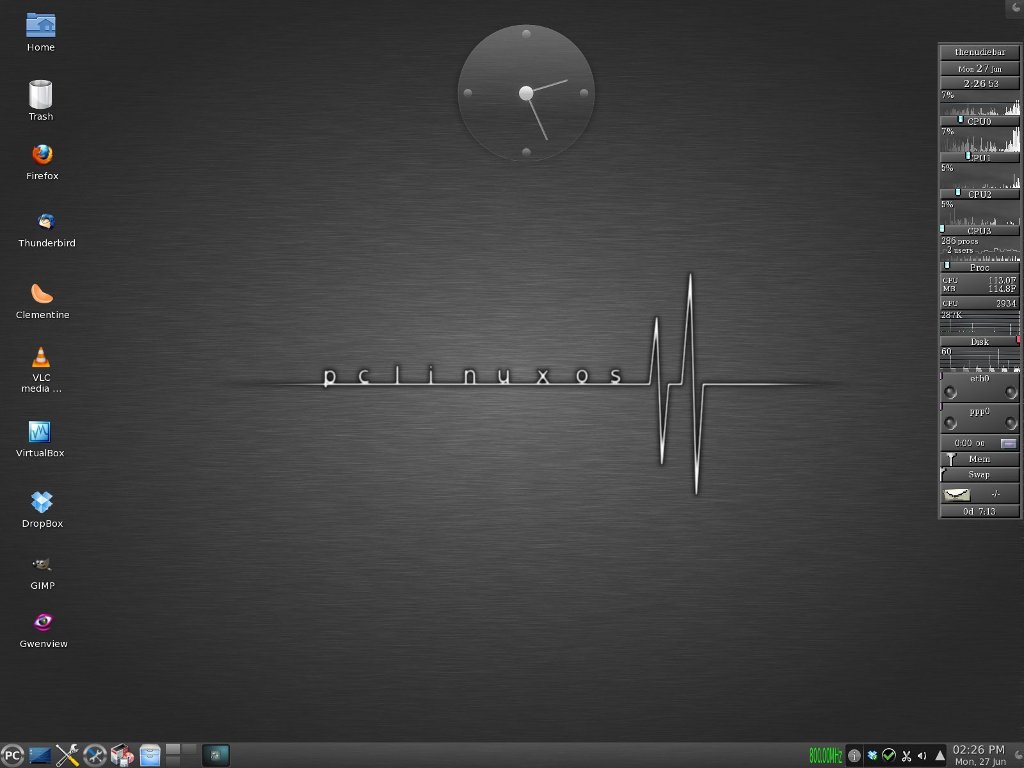
PCLinuxOS KDE 2011.6 Released


PCLinuxOS KDE 2011.6 for 32 and 64 bits computers is now available for download. A 64 bit only release will be available in the coming weeks. PCLinuxOS KDE 2011.6 features the following updates.

What’s new in PCLinuxOS KDE 2011.6:-

Kernel – The kernel was updated to version 2.6.38.8. Additional kernels are available from our repositories such as a PAE kernel for computers with more than 4 gigs of memory. A BFS kernel for maximum desktop performance and a standard kernel with group scheduling enabled.

Xorg - Xorg server was updated to version 1.10.2. Mesa updated to 7.10.3 and libdrm to version 2.4.26. This update brings enhancements to the PCLinuxOS desktop including speed, 3D desktop support for most Intel, Nvidia and AMD/ATi video cards, better font rendering, black screen fixes for most Nvidia cards, better Flash playback and more. The most recent versions of Nvidia and AMD/ATi video drivers are included on the LiveCD and automatically configured for you. The bad news is users with older legacy video cards included in most dated computers may not function properly due to many depreciated xorg video drivers.

Toolchain – Gcc software compiler was updated to version 4.5.2 and glibc updated to 2.10.1. Locales were updated to version 2.12.1.

Package Manager – RPM was updated to version 4.8.1. apt-get and the Synaptic Package Manager were also updated to work with the updated rpm packages. yum and yumex will be available in the coming weeks as an alternative package manager.

Theme Update – The 2011 release received a full makeover. PCLinuxOS features a new brush metal theme including updates to grub, plymouth, kdm, kdesplash and application splash screens. Additional themes are available as well as our previous theme from our software repository.
Theme screenshots located here: http://goo.gl/il3CG

Remastering Tools – mylivecd was updated to work with the latest release. mylivecd added the ability to install PCLinuxOS from the boot menu without having to go to the desktop first. There are 3 compression schemes available now for remastering your installation. xz maximum compression, xz normal compression and gzip for fast compression. xz max takes longer to generate the LiveCD but produces the most compressed image where as gzip will create a LiveCD fairly quick but the compressed image will be larger. mylivecd can also generate a LiveDVD with up to 4 gigs of compressed data. Usually a 10-12 gig installation will compress into a 4 gig DVD.

Software – PCLinuxOS 2011 LiveCD come with the latest versions of most popular programs such as KDE 4.6.4, Firefox 5.0, Thunderbird 3.1.11, Pidgin 2.9.0, VLC 1.10.0 and Clementine 0.7.1 just to name a few. OpenOffice Manager has been replaced with LibreOffice Manager. Due to the limited size of the LiveCD the office suite is not included but can be installed through the LibreOffice Manager either in LiveCD mode (3 gigs memory required) or preferably after hard drive installation. Addlocale has updated translations and can convert a PCLinuxOS installation into over 70 different languages. The software included on the LiveCD was based on community feedback as to what the PCLinuxOS users wanted to be included by default.
A complete package list of what is available on the LiveCD can be found here.

SHARE OUR NEWS DIRECTLY ON SOCIAL NETWORKS:-

Linux Kernel 3.3 Released With Android Merge, New File Systems & More Security

Linux Kernel 3.3 Released With Android Merge, New File Systems & More Security

After a few of rc release, finally Linus Torvalds has released Linux Kernel 3.3. According to the release note by Torvaldas - " Things did indeed calm down during the last week, and the shortlog looks pretty boring. The diffstat from -rc7 is dominated by the arch/tile defconfig changes, the rest is pretty small, although there are changes spread out in various subsystem s(drivers, filesystem, networking, perf tools)."
Summary:- This release features as the most important change the merge of kernel 
code from the Android project. But there is more, it also includes support for a new 
architecture (TI C6X), much improved balancing and the ability to restripe between 
different RAID profiles in Btrfs, and several network improvements: a virtual switch
implementation (Open vSwitch) designed for virtualization scenarios, a faster and 
more scalable alternative to the "bonding" driver, a configurable limit to the 
transmission queue of the network devices to fight bufferbloat, a network priority 
control group and per-cgroup TCP buffer limits. There are also many small 
features and new drivers and fixes are also available. 
 
Prominent Features in Linux 3.3:-
  • Android merge
  • Btrfs: restriping between different RAID levels, improved balancing, improved debugging tools
  • Open vSwitch
  • Bufferbloat fighting: Byte queue limits
  • Per-cgroup TCP buffer limits
  • Network priority control group
  • Better ext4 online resizing
  • New architecture: TI C6X
  • EFI boot support
  • Driver and architecture-specific change
  • Memory Management
  • Virtualization
  • Crypto
  • Security
  • Tracing/profiling
     
     
    For more information click here & to Download  Linux Kernel 3.3  
    Click Here


SHARE OUR NEWS DIRECTLY ON SOCIAL NETWORKS:-

Linux Kernel 3.0


Last week began with speculation about a new kernel version number that ultimately resulted in the first big number change for Linux in more than a decade. Along the way, we also saw new Linux distribution releases, including Fedora 15 and the first beta of Red Hat Enterprise Linux 5.7.

1. Linux 3.0

Make no mistake about it, after two decades of being the leader of the Linux community, Linus Torvalds still makes the big decisions.
This week, Torvalds made the huge decision of starting a new numbered version of Linux, advancing the kernel to Linux 3.0, with a first release candidate debuting early Sunday. The Linux 3.0 kernel came after a week of discussion, which began with Torvalds first mentioning that he was considering advancing the number to Linux 2.8, instead of having a Linux 2.6.40 kernel release. "The voices in my head also tell me that the numbers are getting too big," Torvalds wrote in a mailing list posting. By the end of the week, Torvalds was advocating for a 3.0 release, as Linux is now entering its third decade. While big number version changes can often represent binary compatibility or big feature change issue with a software project, that's not the case with Linux 3.0. The 3.0 nameplate is a time-based thing, and it isn't about new features. Considering Linux 2.0 came out in 1996 and the more recent 2.6 branch began in 2003, the big number change is a long time coming for Linux. While some software projects, like Google's Chrome, change major version numbers every three months, Linux has iterated on the 2.6.x branch for more than seven years. The change to 3.0 may seem a bit arbitrary, but it makes sense on many levels. The time has come for a number change as Linux enters its third decade.

2. Fedora 15

This past week also marked the debut of Fedora 15, codenamed 'Lovelock.' While Linux 3.0 isn't about new features, Fedora 15 is about features, most notably the GNOME 3.0 desktop. Fedora 15 is the first of the big Linux distributions to integrate GNOME 3 and its associated GNOME Shell user interface. Fedora 15's GNOME 3 desktop stands in contrast to the Unity desktop that rival distribution Ubuntu debuted in April. While Fedora is a big backer of GNOME Shell, the project also realizes it's not for everyone and includes fallback mechanisms for older hardware as well as other desktop options, including KDE, Xfce and LXDE. Time will tell whether users prefer GNOME Shell to Unity or if they end up rejecting both desktops in favor of something else.

3. Linux Mint 11

For Ubuntu users that don't want Unity and don't want to move to Fedora (or something else), there is Linux Mint. Over the past couple of years, Mint has emerged as a community favorite alternative to Ubuntu. Based on Ubuntu, Mint takes the best of Ubuntu and aims to make it even easier to use. For GNOME users, Mint has elected not to use either GNOME shell or Unity, providing users with a more traditional user interface. Given the backlash in some corners against Unity on Ubuntu, it's likely that Linux Mint 11 will attract more than its fair share of Ubuntu 11.04 refugees. Will those former Ubuntu users stick with Mint over time? Considering Mint is based on Ubuntu, that's a bet that doesn't carry too much risk.

4. Red Hat Enterprise Linux 5.7

No, it's not a major new version number of Red Hat's Enterprise Linux (RHEL), but RHEL 5.7 is still an important release. This past week, Red Hat released the first beta of RHEL 5.7 with new driver and stability updates. RHEL 5.0 first came out in 2007 and has since been superseded by RHEL 6, which came out at the end of 2010. There is a class of users that don't magically switch overnight to major new releases (if ever) and that's why RHEL 5.7 is important. Looking beyond the usual set of driver updates, Red Hat (NYSE: RHT) also packed in at least one new feature too. RHEL 5.7 supports OpenSCAP, which is an open source implementation of the Security Content Automation Protocol (SCAP) framework for creating a standardized approach for maintaining secure systems. While RHEL 5.7 isn't a major new release, for Red Hat's RHEL 5 customer base, it's a solid update that will refresh their installed servers.

5. Puppy Linux

Linux users come in all shapes and sizes. While big vendors like Red Hat target mission-critical enterprise systems, other distros, like Puppy Linux, serve a different audience. Wary Puppy Linux is a minimal Linux distributions that requires less hardware resources than other distros. This makes it ideal for older hardware that other distros (and any other OS) would deem to be obsolete. This past week Wary Puppy Linux 5.1.2 was released with the promise of even better support for older hardware.


SHARE OUR NEWS DIRECTLY ON SOCIAL NETWORKS:-

Ubuntu 12.04 LTS (Precise Pangolin) Beta 1 Released For Testing

Ubuntu 12.04 LTS (Precise Pangolin) Beta 1 Released For Testing 
After making available two Alpha release of Ubuntu 12.04 LTS code named "Precise Pangolin" now the developer has officially declared the availability Ubuntu 12.04 Beta 1. According to the project's release schedule, the current development milestone will be followed by a second beta on 29 March, with a possible release candidate arriving in April. The final version is planned for 26 April. With this release the most visible of the changes comes in the form of version 5.4 of Canonical's custom Unity desktop interface, which introduces Ubuntu's new HUD (heads-up display) by default. Unity's 2D desktop now looks like the 3D accelerated desktop.
Ubuntu 12.04 LTS Beta 1 is using the 3.2.0-17.27 Ubuntu kernel which is based on the recent 3.2.6 Linux kernel. As with the alpha releases of the kernel, the developers have unified the server and generic flavours of the kernel in a merger designed to reduce the maintenance work needed over the five year life of the LTS release.
The developers have also turned on RC6 power management by default in the beta release. The RC6 technology in Intel's Sandy Bridge processors allows the GPU to go into a low power consumption mode when idle, as low as 0 W, and can result in considerable power savings of 40 to 60 percent. The developers have now switched the default music player to Rhythmbox and included support for the Ubuntu One Music Store within it. Other application updates include moving to the latest version of LibreOffice 3.5 and a beta of Firefox 11.0. Hardware support has also been added for ClickPads. Ubuntu 12.04 will be a Long Term Support (LTS) release that will be supported for five years on both the server edition and, for the first time, the desktop edition.
The current stable release of Ubuntu is 11.10 "Oneiric Ocelot" from October 2011, while the most recent LTS version is Ubuntu 10.04.4 LTS "Lucid Lynx".
For Additional Information & To Download Ubuntu 12.04 Beta 1 Click Here


SHARE OUR NEWS DIRECTLY ON SOCIAL NETWORKS:-

Ubuntu 12.10 (Quantal Quetzal) Alpha 2 Arrives With Linux Kernel 3.5-rc4 & Improved Filesystem Utilities

Ubuntu 12.10 (Quantal Quetzal) Alpha 2 Arrives With Linux Kernel 3.5-rc4 & Improved Filesystem Utilities
The first alpha version of Ubuntu 12.10 was made available in the first week of June. As expected now the Canonical and the Ubuntu developer team has released the second alpha of version 12.10 of their Ubuntu codenamed "Quantal Quetzal". The new alpha release mostly has package updates to the distribution's components, including a Linux 3.5-rc4 based kernel (Ubuntu kernel 3.5.0-2.2), filesystem utilities (e2fsprogs, mdadm, autofs and btrfs-tools), Firefox and Thunderbird, and GTK+ (to the 3.5 series which will allow a number of GNOME 3.5 updates to take place).
Ubuntu Server has seen updates too, with Tomcat 7 replacing Tomcat 6, Chef 0.10.x, Ceph-0.57.2, MySQL 5.5.25 and updates to OpenStack to track the current "folsom" development milestones. The alpha 2 release also sees images for the Calxeda ARM servers being made available. There are also updates for Kubuntu, with KDE SC 4.9 Beta 2 included, and the experimental replacement of LibreOffice with Calligra Suite. Xubuntu sees a later Xfce (4.10) in use and updated Gimp and gThumb. 
ISO images of the general desktop testing release are available for 32- and 64-bit x86 systems and 64-bit Mac systems. For all changes, known issues and links to further information and other images, consult the Alpha 2 Technical Overview. Development releases are meant for testing only and should not be used in a production or critical environment; users wanting a stable system should install Ubuntu 12.04 LTS


-Source (Ubuntu ,The-H)


SHARE OUR NEWS DIRECTLY ON SOCIAL NETWORKS:-

Linux Kernel Update Brings a New Wave of Hardware Support


Updates to the Linux kernel are always exciting because of the advance look they provide at what's to come in upcoming Linux distributions, and Thursday's 2.6.39 release is no exception.
Perhaps most notable for the hundreds of new drivers it includes--portending a world of even better hardware support in upcoming distributions of the free and open source operating system--the new release also includes virtualization improvements, simplified firewall configuration and a host of other new features.
Though it was delayed by a few days, work on version 2.6.39 "has been fairly 'easy'," Linux creator Linus Torvalds wrote in an explanatory e-mail announcing the release.
Not only did the release take just 65 days of development, but "-rc2 was calm, -rc3 was _really_ calm, and -rc7 was tiny," Torvalds explained. "And while this has more commits than -rc7 had, I didn't feel like that changed the overall picture much: we really did have much less churn after the merge window closed than we usually do. Which actually makes me pretty happy about the state of 2.6.39

Not only did the release take just 65 days of development, but "-rc2 was calm, -rc3 was _really_ calm, and -rc7 was tiny," Torvalds explained. "And while this has more commits than -rc7 had, I didn't feel like that changed the overall picture much: we really did have much less churn after the merge window closed than we usually do. Which actually makes me pretty happy about the state of 2.6.39."


AMD 'Cayman' Graphics Support
Among the new and enhanced drivers present in Linux kernel 2.6.39 are support for AMD "Cayman" high-end graphics cards and GPUs as well as drivers for Samsung notebook function keys and Realtek RTL8192CU and RTL8188CU Wi-Fi chips, according to a report on The H.

The b43 driver code for Broadcom 802.11n chips has also been bolstered so that BCM4321 and BCM4322 components, among others, are now at least partly supported. Then there's the iwlwifi driver, which now reportedly supports Intel 2000 series WLAN chips.

An enhanced Nouveau driver boosts support for Nvidia GPUs while a basic Poulsbo KMS driver is included, but without acceleration support, Phoronix reports.


'IP set' for Firewalls
Support for IP set, meanwhile, makes it easier to configure and deploy a firewall, while a new network back-end eases Xen virtualization. Bluetooth code has been enhanced, and modified TCP protocol code can reduce perceived latencies during network communication by as much as 10 percent, The H reports.
Two downsides to the new release, on the other hand, include the fact that the Linux kernel is still "burning through power," according to Phoronix, as well as that support for Intel's Sandy Bridge processors is not yet included.
Linux distributions such as Ubuntu and Linux Mint are drawing more attention and users than ever before thanks to their ever-improving compatibility and usability. It's great to see all the many improvements that are still to come.


SHARE OUR NEWS DIRECTLY ON SOCIAL NETWORKS:-

Microsoft Fixes & Apologizes Embarrassing 'Big Boobs' String (0xB16B00B5) From Linux Code

Microsoft Fixes & Apologizes Embarrassing 'Big Boobs' String (0xB16B00B5) From Linux Code

Buried in the software that connects the Linux kernel to Microsoft‘s HyperV virtualization program was the following code string: '0xB16B00B5'The string was spotted by programmer Paolo Bonzini, who posted about his discovery to the Linux Kernel mailing list saying “Somone (sic) was trying to be funny, I guess”.
The string was used every time the Microsoft program ran a virtual version of Linux. Linux developer Dr Matthew Garrett is upset by what he sees as “straightforward childish humour”. He points out that previously Microsoft used the string 0x0B00B135 (or “BOOBIES” to non-programmers) in a previously submitted piece of code. Dr Garrett points out that the string may be used to connect Linux system to Microsoft’s Azure cloud platform, making the problem even tougher to fix. “So, full marks, Microsoft,” says Dr Garrett. “You’ve managed to make the kernel more offensive to half the population and you’ve made it awkward for us to rectify it”. Microsoft was made aware of the code quickly issued an apologetic statement, saying “We thank the community for reporting this issue and apologize for the offensive string. We have submitted a patch to fix this issue and the change will be published in a future release of the kernel.”  The software giant then immediately issued a patch that corrected the string. In early June, Microsoft suffered another embarrassment over '"vulgar" language used during a song and dance routine at a company conference.


SHARE OUR NEWS DIRECTLY ON SOCIAL NETWORKS:-

Kernel.org is Still Down for Maintenance


kernel.org is still down for maintenance The administrators of the site is still working to restore the Linux developers' web site which went down after a security breach at the end of August. In a status update, H. Peter Anvin reported that they are currently in the process of setting up the kernel.org infrastructure from scratch.
The first Git repositories should be back online this week and Anvin hopes that in early October, they will be able to offer wider access to the developers. The restoration of other services will take some time though. Anvin said nothing about bringing .tgz (tar-gzip) "tarballs" back online; those tarballs offer the traditional and official source of versions of the Linux kernel for users.


SHARE OUR NEWS DIRECTLY ON SOCIAL NETWORKS:-

Linux Kernel 3.4 First Release Candidate (rc1) Available For Testing

Linux Kernel 3.4 First Release Candidate (rc1) Available For Testing
Couple of weeks ago we got Linux Kernel 3.3 final. Just after two weeks of this release Linus Torvaldas announced the immediate availability of the the first release candidate (rc1) of Linux Kernel 3.4. According to the release note by Torvaldas - "If you actually counted, it has only been 13 days. And if somebody delayed their pull request until the last day of the merge window, I'm sure they'll be even happier to delay it another two months until the next merge window. Yay! That said, there are four pull requests in my mailbox that weren't delayed, and that I will (probably) still pull, but that I wanted to get extra confirmation from *other* maintainers from first. So they were sent in time, I just decided that I can make the actual pull choice a bit later.

The four remaining pull requests (and the people I want comments from) are:-

  • HSI (High Speed Synchronous Serial Interface)- framework. I'm planning on pulling this into 3.4, it's in my queue, but I wanted to bring it up one more time in case somebody has issues with it. Ping?
  • pohmelfs- The old pohmelfs got deleted from staging, there's an all-new one waiting in the sidelines. Al was a bit unhappy about some of it, Evgeniy fixed it up some, and then the discussion died. Again, I'm likely to pull this, but I wanted more commentary on it.
  • drm- dma-buf prime support. Dave Airlie sent me the pull request but didn't push very hard for it, it's in my "ok, I can still pull it for 3.4 if individual DRM driver people tell me that it will make their lives easier." So this is in limbo - I have nothing against it, but I won't pull unless I get a few people say "yes, please".
  • DMA-mapping framework- The tree now has a few more acks from people, and it's largely in the same situation as HSI is: I'll probably pull, but I really wanted the users who are impacted to actually talk to me about it."
To Download Linux 3.4-rc1 Click Here

SHARE OUR NEWS DIRECTLY ON SOCIAL NETWORKS:-

Linux Mint Debian 201109 Final (Gnome & Xfce) Released!


Linux Mint Debian 201109 Final Edition (Gnome & Xfce) Released.

What is LMDE:-
  • Linux Mint Debian Edition (LMDE) is a rolling distribution based on Debian Testing.
  • It’s available in both 32 and 64-bit as a live DVD with Gnome or Xfce.
  • The purpose of LMDE is to look identical to the main edition and to provide the same functionality while using Debian as a base.

What’s new in this Release:-
  • All Linux Mint 11 features
  • Installer improvements (keyboard variants, locale, bug fixes, UUID in fstab)
  • Update Packs, dedicated Update Manager and staged repositories
  • GTK2/GTK3 theme compatibility
  • Updated software and packages
Multi-core and multi-CPU support in 32-bit kernel:-

To guarantee compatibility with non-PAE processors, the 32-bit versions of Linux Mint Debian come with a 486 kernel by default. This kernel does not support SMP, and as a consequence is only able to detect one core and one CPU. If your CPU has multiple cores, or if you have more than one CPU, simply install the 686-PAE kernel and reboot your computer.

To download LMDE Click Here

SHARE OUR NEWS DIRECTLY ON SOCIAL NETWORKS:-

Red Hat Enterprise Virtualization 3.0 (Public Beta)


Public beta of Red Hat Enterprise Virtualization 3.0 is now available. The release is based on the KVM hypervisor integrated in the Linux kernel and on the open source virtualisation management system from the oVirt project
RHEV 3.0 supports up to 160 CPU cores and 2 TB of RAM on a host system; up to 64 virtual CPUs can be allocated to guests. Performance has been improved in networks as well as on systems with a lot of memory and heavy I/O loads, now that KVM network stacks have been moved into the kernel; "transparent huge pages" and a para-virtualised interrupt controller also help to improve performance. 

Red Hat Enterprise Virtualization 3.0 Includes Updates Such As:-
  • Red Hat Enterprise Virtualization Manager is now a Java application running on JBoss Enterprise Application Platform on Red Hat Enterprise Linux
  • A power user portal that provides end users with a self-service interface to provision virtual machines, define templates and administer their own environments
  • A RESTful API that allows complete configuration and management of Red Hat Enterprise Virtualization for use by customers or a rich ecosystem of management Partners
  • Extended multi-level administrative capabilities, allowing fine-grained resource control, Role Based Access control, delegation and hierarchical management
  • New local storage capabilities
  • An integrated and embedded reporting engine allowing for analysis of historic usage trends and utilization reports
  • SPICE WAN optimization and enhanced performance including dynamic compression and automatic tuning of desktop effects and color depth. The new version of SPICE also features enhanced support for Linux desktops.  
  • An updated KVM hypervisor with new capabilities focused around scalability, performance and security, such as:

Host Scalability:-
Red Hat Enterprise Virtualization now supports up to 160 cores and 2TB of memory on a host system. This allows customers to get better consolidation ratios running several hundred VMs on a given host.

Guest Scalability:-
Red Hat Enterprise Virtualization can now support up to 64 virtual CPUs per guest, up to twice that of some competitors, allowing even larger workloads to be virtualized.
Red Hat Enterprise Virtualization now supports 512GB.

Performance:-
  • vhost-net: We have moved the KVM networking stack from userspace into the Linux kernel, which greatly improves performance and reduces latency.
  • Transparant Huge Pages: New feature where the Linux kernel dynamically creates large memory pages (2MB -vs- 4KB) for virtual machines, improving performance by reducing the number of times that memory is accessed, typically improving performance for most workloads.
  • x2paic: Paravirtualized interrupt controller in the VM, which reduces guest overhead and can improve guest performance in interrupt-heavy workloads.
  • Async-IO: For block I/O operations, in many cases yielding notable improvement in block I/O.

Security:-
Use of SELinux-based sVirt infrastructure for military-grade hardening of the hypervisor.


For More information and to Download Red Hat Enterprise Virtualization 3.0 Click Here


SHARE OUR NEWS DIRECTLY ON SOCIAL NETWORKS:-

Kernel Vulnerability In Ubuntu Oneiric Ocelot


Vasiliy Kulikov, a security resercher recently discovered vulnerability in the Linux kernel, affecting all the Ubuntu 11.10 (Oneiric Ocelot) operating system. Linux kernel vulnerability that allows a local attacker to read various information on the system, leading to loss of privacy, because taskstats didn't enforce access restrictions. 
To know more about the vulnerability click Here 
This security flaw can be fixed if you update your Ubuntu 11.10 (Oneiric Ocelot) system to the linux-image-3.0.0-13 (3.0.0-13.22) kernel package. Run the Software Update app to do that and reboot the system. 


SHARE OUR NEWS DIRECTLY ON SOCIAL NETWORKS:-

Related Posts Plugin for WordPress, Blogger...