Showing posts sorted by date for query backdoor. Sort by relevance Show all posts

Implementing Intrusion (Cyber) Kill Chain -A Plenary Overview

Implementing an Intrusion (Cyber) Kill Chain 

The Intrusion (Cyber) Kill Chain is a phrase popularized by infosec industry professionals and introduced in a Lockheed Martin Corporation paper titled; “ Intelligence Driven Computer Network Defense Informed by Analysis of Adversary Campaigns and Intrusion Kill Chains”. 
The intrusion kill chain model is derived from a military model describing the phases of an attack. The phases of the military model are: find, fix, track, target, engage, and assess. The analyses of these phases are used to pinpoint gaps in capability and prioritize the development of needed systems. The first phase in this military model is to decide on a target (find). Second, once the target is decided you set about to locate it (fix). Next, you would surveill to gather intelligence (track). Once you have enough information, you decide the best way to realize your objective (target) and then implement your strategy (engage). And finally, you analyze what went wrong and what went right (assess) so that adjustments can be made in future attacks.
Lockheed Martin analysts began by mapping the phases of cyber attacks. The mapping focused on specific types of attacks, Advanced Persistent Threats (APTs) - The adversary/intruder gets into your network and stays for years– sending information, usually encrypted – to collection sites without being detected. Since the intruder spent so much time in the network, analysts were able to gather data about what was happening. Analysts could then sift through the data and begin grouping it into the military attack model phases. Analysts soon realized that while there were predictable phases in cyber attacks, the phases were slightly different from the military model.  The intrusion (cyber) kill chain shown below, describe the phases of a cyber attack.
The chain of events or activities are as follows:
  

Link in the Chain
Description
1.  Reconnaissance
Research, identification and selection of targets- scraping websites for information on companies and their employees in order to select targets.
2.  Weaponization
Most often, a Trojan with an exploit embedded in documents, photos, etc.
3.  Delivery
Transmission of the weapon (document with an embedded exploit) to the targeted environment.  According to Lockheed Martin's Computer Incident Response Team (LM-CIRT), the most prevalent delivery methods are email attachments,websites, and USB removable media.
4.  Exploitation
After the weapon is delivered, the intruder's code is triggered to exploit an operating system or application vulnerability, to make use of an operating system's auto execute feature or exploit the users themselves.
5.  Installation
Along with the exploit the weapon installs a remote access Trojan and/or a backdoor that allows the intruder to maintain presence in the environment
6.  Command and Control
Intruders establish a connection to an outside collection server from compromised systems and gain 'hands on the keyboard' control of the target's compromised network/systems/applications.
7.  Actions on Objective
After progressing through the previous 6 phases, the intruder takes action to achieve their objective.  The most common objectives are:  data extraction, disruption of the network, and/or use of the target's network as a hop point.
Lockheed Martin's analysts also discovered while mapping the intruder's activities, that a break (kill) in any one link in the chain would cause the intrusion to fail in its objective. This is one of the major benefits of the intrusion kill chain framework as security professionals have traditionally taken a defensive approach when it comes to incident response. This means that intrusions can be dealt with offensively too.
Lockheed Martin's case studies reveal that knowledge about previous intrusions and how they were accomplished allow analysts to recognize those previously used tactics and exploits in current attacks.  For example, mapping of three intrusions revealed that all three were delivered via email, all three used  very similar encryption, all three used the same installation program and connected to the same outside collection site. All of the intrusions were stopped before they accomplished their objective.
How did they do this? How can my company utilize this approach?
Monitoring and mapping is the key.
The following list contains some of the necessary components (not in any particular order) needed to do intrusion mapping and setting up the kill.
·         Network Intrusion Detection (NIDS)
·         Network Intrusion Prevention (NIPS)
·         Host Intrusion Detection (HIDS)
·         Firewall access control lists (ACL)
·         Full packet inspection
·         A mature IT asset management system
·         A mature and comprehensive Configuration Management Database (CMDB)
·         Device and system hardening
·         Secure configurations baselines
·         Website inspection
·         Honeypots
·         Anti-virus and anti-malware
·         Verbose logging – network devices, servers, databases, and applications
·         Log correlation
·         Alerting
·         Patching
·         Email and FTP inspection and filtering
·         Network tracing tools
·         Information Security staff trained in tracking and mapping events end-to-end
·         Coordination and partnering with IT, Application Owners, Database Administrators, Business Units and Management both in investigation and communicating the mapped intrusions.

In short, in order to implement intrusion kill chain activity a company needs to have a mature inter-operating and information security program. Additionally, they need trained staff that can investigate, map and advise 'kill' activities, keep a compendium of mapped intrusions, analyze and compare old and new intruder activity, code use, and delivery methods to thwart current and future intrusions.
The intrusion (cyber) kill chain is not an endeavor that can be successfully implemented in place of a comprehensive Information Security Program, it’s another tool to be used to protect the company's data assets.
The good news is if your company doesn't have a mature information security program there is a lot you can do while making plans to introduce an intrusion kill chains in your department's arsenal.
·         Educate your employees to watch for suspicious emails. For instance, emails that seem to be off – such as, someone in accounting receiving an invitation to attend a marketing conference. Let them know that they shouldn't open attachments included in email like this.
·         Make sure you have anti-virus and anti-malware software installed and up to date.
·         Start an inventory of your computing devices, laptops, desktops, tablets, smartphones, network devices and security devices.
·         You have an advantage over intruders. You know your network and what is normal and usual, they don't.  Notice user behavior that is not usual and look into it.  For example, a login at 2am for someone who works 9 to 5. Or an application process that normally runs overnight that is kicking off during the day.
·         Keep your security patches up to date.
·         Create and monitor baseline configurations.
·         Write, publish and communicate information security policies and company standards.
·         Turn on logging and start collecting and keeping logs. Start with network devices and firewalls and then add servers and databases.  Set up alerts for things such as repeated attempts at access.
·         Spend some time using search engines from outside your network to see how much information can be learned about your company from the Internet.  You'd be surprised how much you can find including sensitive documents.

All of these practices and activities give you more information about your computing environment and what is normal and usual. The more you know about your environment, the more likely it is that you will spot the intruder before any damage is done.

Disclaimer:- Before conclusion, on behalf of Team VOGH, I would like to personally thank Mr. Adrian Stolarski for sharing this remarkable article with our readers. I would also like to thank Ryan Fahey  of Infosec Institute for his spontaneous effort. 


SHARE OUR NEWS DIRECTLY ON SOCIAL NETWORKS:-

Linux/Cdorked.A: One of The Most Sophisticated Apache Backdoor Targets Millions of Websites

Linux/Cdorked.A: One of The Most Sophisticated Apache Backdoor Targets Millions of Websites to Serve Blackhole Exploit

ESET one of the world renowned security firm headquartered in Bratislava have figured out what it called a malicious cyber rampage targeting millions of cPanel-based servers. Since last few months security experts have been tracking server level compromises that have been utilizing malicious Apache modules to inject malware into websites and  redirecting some of its requests to the infamous Blackhole Exploit packs. On cPanel-based servers, instead of adding modules or modifying the Apache configuration, the attackers started to replace the Apache binary (httpd) with a malicious one. This new backdoor is very sophisticated and this new malware has been dubbed "Linux/Cdorked.A." Several analysis reveals that it is a sophisticated and stealthy backdoor meant to drive traffic to malicious websites. According to the official blog post of ESET - Linux/Cdorked.A is one of the most sophisticated Apache backdoor's we have seen so far. The backdoor leaves no traces of compromised hosts on the hard drive other than its modified httpd binary, thereby complicating forensics analysis. All of the information related to the backdoor is stored in shared memory. The configuration is pushed by the attacker through obfuscated HTTP requests that aren't logged in normal Apache logs. This means that no command and control information is stored anywhere on the system.
This malicious cyber rampage was first detected by another security firm named 'Sucuri' and later ESET published a detailed analysis of the issue. But still there are thoughtful matter as already thousands of websites get infected. The attack is particularly dangerous as Apache web servers are among the most well-known and widely-used in the world and are used by numerous companies. This means that a successful security breach can affect numerous different businesses across a diverse range of industries.
As this malware also known as Linux/Cdorked.A has already been spotted in the wild, so on behalf of cyber media, we urge all the concern system administrator, security analyst to take care of the above issue while to checking their servers and verify that they are not affected by this threat. Detailed instructions to perform this check are provided in the ESET blog.


SHARE OUR NEWS DIRECTLY ON SOCIAL NETWORKS:-

President of Philippines Official Website Hacked By Anonymous

President of Philippines Official Website Hacked By Anonymous in Protest of "Sabah Issue"

After remaining silent for a certain period, the infamous hacker collective group Anonymous strikes again. As you all might know that normally this group targets high profile websites like government organization, federal authorities, defense, ministry and other giant organization. This time also the same strategy get repeated, as the hacker group targeted the official website of the President of Philippines. During this cyber attack the hacker group has breached the security system and managed to get access in side the website, and as expected they defaced the index page. In the news section of the website the hacker group calling them selves "Anonymous Philippines"; affiliated to one of the worlds most dangerous and largest hackers community going by the name "Anonymous";  left message for the President Benigno Aquino III. From the message left by the hacker, we came to know that the hacking was a part of protest against the Aquino administration’s mishandling of  the crisis in "Sabah issue" 

Message of Anonymous Philippines:- 
“Greetings, President Aquino! We have watched how you signed into law a bill that endangers and tramples upon the netizens’ freedom of speech and expression. Now, we are silent witnesses as to how you are mishandling the Sabah issue. We did not engage the Malaysian hackers who invaded our cyberspace since we expected you to appropriately and judiciously act on the same, but you failed us.
“You did nothing while our fellow brothers are being butchered by the Malaysian forces, and while our women and children become subject of human rights abuses. If you can’t act on the issue as the Philippine President, at least do something as a fellow Filipino. We are watching.” 

As soon as this hack get spotted, the Philippine government took immediate step while closing the backdoor and removing the deface page. After an hour of maintenance the website get restored and came back in proper manner. Later in-front of press the Philippine government acknowledged the issue. In the official statement the Communications Secretary of Philippine Sonny Coloma said -“At around 1:30 a.m. today, we detected a breach when an errant sentence critical of the government on the Sabah issue was found to have been inserted in one of the news items within the website.” Coloma did assure the public that the site will be up and running “in a few hours.” 
“We expect to resume public display of the President's website in a few hours after needed protection measures have been put in place,” Coloma said, adding that the site was not compromised in any other way. “No further intrusions were made as the internal security protocols were activated,” he said. 
While covering the hack of President site, we must give you reminder that, this hack is not the first one, earlier half dozen of major government website of Philippine was targeted by the same hacker group, even in this year the official website of Senator Vicente C. Sotto III get hacked and defaced by Anonymous Philippines for the protest of "Cybercrime Prevention Act" 


SHARE OUR NEWS DIRECTLY ON SOCIAL NETWORKS:-

'Dockster' A New Mac Malware Targeting Apple Users Found on Dalai Lama Related Website

'Dockster' A New Mac Malware Targeting Apple Users Found on Dalai Lama Related Website

Researcher at F-Secure blog has identified that A new piece of malicious software targeted at Apple users has been found on a website dedicated to the Dalai Lama. According to blog post by F-Secure -the website related to Dalai Lama is fully compromised and is pushing new Mac malware, called Dockster, using a Java-based exploit. Dockster tries to infect computers by exploiting a vulnerability in Java, CVE-2012-0507. The vulnerability is the same one used by the Flashback malware, which first appeared around September 2011 and infected as many as 600,000 computers via a drive-by download. Flashback was used to fraudulently click on advertisements in order to generate illicit revenue in a type of scam known as click fraud. Apple patched the vulnerability in Java in early April and then undertook a series of steps to remove the frequently targeted application from Macs. Apple stopped bundling Java in the 10.7 version of its Lion operation system, which continued with the company's Mountain Lion release. In October, Apple removed older Java browser plug-ins in a software update.
But still the matter of relief is that current versions of OS X are not vulnerable; users who have disabled the Java browser plug-in are also not vulnerable. F-Secure researcher Sean Sullivan said Dockster is “a basic backdoor with file download and keylogger capabilities.” Meanwhile F-Secure’s Sullivan, also said that the Dalai Lama’s site is also serving a Windows-based exploit for CVE-2012-4681, the Agent.AXMO Trojan. The Trojan exploits a Java vulnerability that allows remote code execution using a malicious applet that is capable of bypassing the Java SecurityManager. 

Please Note That: The gyalwarinpoche.com site doesn't seem to be as "official" as dalailama.com

While talking about Mac malware, then you must remember that earlier also Mac users faced such attacks when mac Trojan OSX.SabPub was spreading through Java exploits In 2011 we have also seen OSX/Revir-B trojan was installed behind a PDF, and giving hackers remote access to MAC computers, not only Revier-B also Linux Tsunami trojan Called "Kaiten"targeted Mac OS users in 2011. Also another malware named "Devil Robber" which was also make MAC users victim while stealing their personal information. In the very decent past we have seen a trojan named 'BackDoor.Wirenet.1'  apparently providing its masters with a backdoor into infected systems. It is also capable of stealing passwords stored in browsers like ChromeChromium,Firefox and Opera. For any kind of cyber updates and infose news, stay tuned with VOGH.


SHARE OUR NEWS DIRECTLY ON SOCIAL NETWORKS:-

'BackDoor.Wirenet.1' Trojan Stealing Passwords From Mac & Linux Based Systems


'BackDoor.Wirenet.1' Trojan Stealing  Passwords From Mac & Linux Based Systems

A Russian Anti Virus software company named 'Dr Web' has spotted a piece of malware that unusually targeting Macs and Linux-based systems is causing a world of trouble for those in its path. The newly found mlaware dubbed 'BackDoor.Wirenet.1' apparently providing its masters with a backdoor into infected systems. It is also capable of stealing passwords stored in browsers like Chrome, Chromium, Firefox and Opera. Furthermore, it’s also able to obtain passwords from popular applications including SeaMonkey, Pidgin and Thunderbird. Even if you don’t use any of the above mentioned software, you’re still in danger as a keylogger is bundled in the payload. Wirenet.1 installs itself into the user's home directory using the name WIFIADAPT

There are some steps that can be taken right away if you think you could be infected. Dr. Web is quick to point out that their anti-virus software will keep you protected. Another option is to simply disable communication with the control server used by the code’s author. In this case, blocking communication with IP address 212.7.208.65 should do the trick.  

Earlier also Mac users faced such attacks when mac Trojan OSX.SabPub was spreading through Java exploits In 2011 we have also seen OSX/Revir-B trojan was installed behind a PDF, and giving hackers remote access to MAC computers, not only Revier-B also Linux Tsunami trojan Called "Kaiten"targeted Mac OS users in 2011. Also another malware named "Devil Robber" which was also make MAC users victim while stealing their personal information


SHARE OUR NEWS DIRECTLY ON SOCIAL NETWORKS:-

Researcher Security Hole Found in US Power Plants, DHS is Investigating

Researcher Security Hole Found in US Power Plants, DHS is Investigating  

Security researcher figure out seirous flaws in software for specialized networking equipment from Siemens could enable hackers to attack US power plants and other critical systems. A security expert said that he had found a backdoor in hardware from a Siemens subsidiary. The alleged flaw was made public by security researcher Justin W Clarke at a conference in Los Angeles. The equipment is widely used by power companies mainly based on US. Clarke said that the discovery of the flaw is disturbing because hackers who can spy on communications of infrastructure operators could gain credentials to access computer systems that control power plants and other critical systems. "If you can get to the inside, there is almost no authentication, there are almost no checks and balances to stop you," Clarke said.
The Department of Homeland Security said it was in contact with the firm to assess the claim. After this issue came in-front, the US Govt immeditely taken stpes & investigating the whole scenario. RuggedCom, a Canadian subsidiary of Siemens that sells networking equipment for use in harsh environments such as areas with extreme weather, said it was investigating Clarke's findings, but declined to elaborate. This is the second bug that Clarke, a high school graduate who never attended college, has discovered in products from RuggedCom, which are widely used by power companies that rely on its equipment to support communications to remote power stations.
In May, RuggedCom released an update to its Rugged Operating System software after Clarke discovered that it had a previously undisclosed "back door" account that could give hackers remote access to the equipment with an easily obtained password. The Department of Homeland Security's Industrial Control Systems Cyber Emergency Response Team, which is known as ICS-CERT, said in its advisory on Tuesday that government analysts were working with RuggedCom and Clarke to figure out how to best mitigate any risks from the newly identified vulnerability. "According to this report, the vulnerability can be used to decrypt SSL traffic between an end-user and a RuggedCom network device," Read the full advisory. 

This is not the first time, earlier in 2011 - researcher found vulnerability in the security system of US Power Grid, form which NSA suspected that hacktivist Anonymous may even shutdown the entire US Power Grid. later The White House introduced an Electric Sector Cybersecurity Risk Maturity ModelFor these kind of cyber security updates & news, just stay tuned with VOGH


-Source (Reuters & BBC)


SHARE OUR NEWS DIRECTLY ON SOCIAL NETWORKS:-

Java-Based Multi-platform Backdoor Targeting Windows, Mac & Linux Computers

Java-Based  Multi-platform Backdoor Targeting Windows, Mac & Linux Computers 

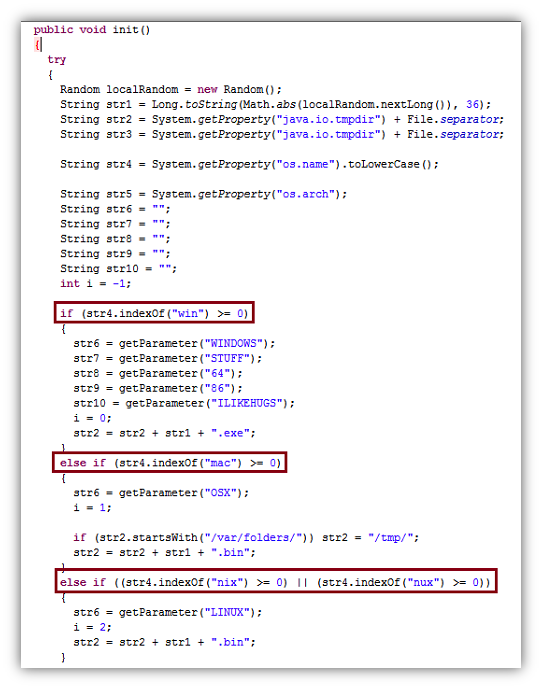
Security researcher at Kaspersky Lab have revealed a new java-based web vulnerability which is targeting Windows, Linux & Mac computers while installing backdoor. Mainly the whole thing is a Web-based social engineering attack that relies on malicious Java applets. According to security researchers from antivirus vendors F-Secure - the attack was detected on a compromised website in Colombia. When users visit the site, they are prompted to run a Java applet that hasn't been signed by a trusted certificate authority.

If allowed to run, the applet checks which operating system is running on the user's computer -- Windows, Mac OS X or Linux -- and drops a malicious binary file for the corresponding platform.

The JAR file checks if the user's machine is running in Windows, Mac or Linux then downloads the appropriate files for the platform. All three files for the three different platforms behave the same way. They all connect to 186.87.69.249 to get additional code to execute. The ports are 8080, 8081, and 8082 for OSX, Linux, and Windows respectively.
The files are detected as:
Trojan-Downloader:Java/GetShell.A (sha1: 4a52bb43ff4ae19816e1b97453835da3565387b7)
Backdoor:OSX/GetShell.A (sha1: b05b11bc8520e73a9d62a3dc1d5854d3b4a52cef)
Backdoor:Linux/GetShell.A (sha1: 359a996b841bc02d339279d29112fe980637bf88)
Backdoor:W32/GetShell.A (sha1: 26fcc7d3106ab231ba0ed2cba34b7611dcf5fc0a)


However, since F-Secure researchers began monitoring the attack, the remote control server hasn't pushed any additional code. It appears that the attack uses the Social Engineer Toolkit (SET), a publicly available tool designed for penetration testers, Aquino said Tuesday via email. However, the chances of this being a penetration test sanctioned by the website's owner are relatively low.
Kaspersky's researchers are in the process of analyzing the backdoor-type malware downloaded by the malicious shell code on Windows and Linux. "The Win32 backdoor is large, about 600KB; the Linux backdoor is over 1MB in size, both appear to contact very complex code which communicates encrypted with other servers."


-Source (CW & F-Secure) 


SHARE OUR NEWS DIRECTLY ON SOCIAL NETWORKS:-

Researchers Found Backdoor in FPGA Chip Used By US Military

Researchers Found Backdoor in FPGA Chip Used By US Military

A researchers team from Cambridge University has figure out that a Chinese-manufactured chip used by US armed forces contains a secret access point that could leave it vulnerable to third party tampering. But the backdoor in the FPGA chip is real, probably part of the manufacturer's debugging hardware, and is unlikely to be easily disabled. The researchers tested an unspecified US military chip — used in weapons, nuclear power plants to public transport – and found that a previously unknown ‘backdoor’ access point had been added, making systems and hardware open to attack, the team says. According to Sergei Skorobogatov, researcher of Cambridge University - "We scanned the silicon chip in an affordable time and found a previously unknown backdoor inserted by the manufacturer. This backdoor has a key, which we were able to extract. If you use this key you can disable the chip or reprogram it at will, even if locked by the user with their own key. This particular chip is prevalent in many systems from weapons, nuclear power plants to public transport. In other words, this backdoor access could be turned into an advanced Stuxnet weapon to attack potentially millions of systems. The scale and range of possible attacks has huge implications for National Security and public infrastructure."
The news comes at a time when Chinese cyber-spying threats are a particular concern. Chinese telecom manufacturers ZTE and Huawei are already under investigation from the US government, which is assessing whether the duo’s telecom businesses pose a national security threat. The Cambridge researchers did not name the company that developed the chip tested, nor did they provide more specific details of its usage. The draft of the associated paper gave more details though. Firstly, the chip in question was a Actel/Microsemi ProASIC3 chip, a "military grade" FPGA (Field Programmable Gate Array) which has a 128-bit AES encryption key to protect its contents and configuration, the intellectual property (IP) of the chip programmer. The chip is not an "American military chip" but an off-the-shelf component used in a wide variety of applications, including US military applications, and its encryption capabilities are specifically designed to only protect the IP.


-Source (The Next Web & The-H)


SHARE OUR NEWS DIRECTLY ON SOCIAL NETWORKS:-

Microsoft Discovered a New Malware Targeting Apple OS X Exploiting Office Vulnerability

Microsoft Discovered a New Malware Targeting Apple OS X Exploiting Office Vulnerability

This year is going bad to worse for MAC users. Earlier we have seen more than 600,000 Mac user infected by Flashback Trojan after this one another Mac Trojan "Backdoor.OSX.SabPub" penetrated mac security. Recently Microsoft has detected a new piece of malware targeting Apple OS X computers that exploits a vulnerability in the Office productivity suite patched nearly three years ago. The malware is not widespread, according to Jeong Wook Oh of Microsoft's Malware Protection Center. But it does show that hackers pay attention if it's found people do not apply patches as those fixes are released, putting their computers at a higher risk of becoming infected.
The exploit discovered by Microsoft doesn't work with OS X Lion, but does work with Snow Leopard and prior versions. Oh wrote that it is likely attackers have knowledge about the computers they are attacking, such as the victim's operating system version and patch levels. The malware delivered by the exploit is written specifically for OS X and is basically a "backdoor," or a tool that allows for remote control of a computer. Microsoft advised those who use Microsoft Office 2004 or 2008 for Mac or the Open XML File Format Converter for Mac to ensure those products have applied the patch.


-Source (Computer World)  

SHARE OUR NEWS DIRECTLY ON SOCIAL NETWORKS:-

Another Mac Trojan "Backdoor.OSX.SabPub" Discovered, Exploiting Java Vulnerability

Another Mac Trojan "Backdoor.OSX.SabPub" Discovered, Exploiting Java Vulnerability 
Few weeks ago security experts found Flashback Trojan infected more than 60,000 Mac users around the world. Immediately after this incident Apple issued patches that curb the vulnerability. Yet again it has been found that another Mac trojan that is also spread through Java exploits. The malware, called Backdoor.OSX.SabPub, can take screen-shots of a user’s current session, execute commands on an infected machine and connect to a remote website to transmit the data. It is not clear how users get infected with the trojan, but because of the low number of instances and the trojan’s backdoor functionality, Securelist speculates that it is most likely used in targeted attacks, possibly launched through emails containing a URL pointing to two one of websites hosting the exploit. Two versions of SabPub were discovered in the wild this past weekend, flying undedected for about two months now. Kaspersky's Costin Raiu wrote in a blog post that SabPub was probably written by the LuckyCat authors.
Version 1: Microsoft Office
One version of SabPub traps Mac (and potentially Windows) users with booby-trapped Microsoft Word documents which exploit the vulnerability 'MSWord.CVE-2009-00563.a.'
The spear-phishing emails containment a malicious Word attachment entitled '10thMarch Statemnet' (with typo) to Tibet sympathizers. March 10, 2011 refers to the day the Dalai Lama delivered his annual speech observing the Tibetan Uprising of 1959. The Word doc was created in August 2010 and updated in February with SabPub thrown in; "quite normal" for such attacks and seen in other APT's like Duqu, Raiu notes.
Version 2: Java
A March version of Sabpub also discovered last weekend exploits the same drive-by Java vulnerability seen in Flashback, one of the biggest botnet attacks seen in OS X. Once the backdoor Trojan is downloaded, a victim's system is connected to a command-and-control center via HTTP. From there the botnet can grab screenshots, upload/download files, and remotely execute commands, Sophos' Graham Cluley writes. SabPub drops the following two files on a user's system, so if you are concerned about infection Cluley recommends searching for these files:
/Users//Library/Preferences/com.apple.PubSabAgent.pfile
/Users//Library/LaunchAgents/com.apple.PubSabAGent.plist

Earlier also Mac users faced such attacks where OSX/Revir-B trojan was installed behind a PDF, and giving hackers remote access to MAC computers, not only Revier-B also Linux Tsunami trojan Called "Kaiten" targeted Mac OS users in 2011. Also another malware named "Devil Robber" which was also make MAC users victim while stealing their personal informations. 


-Source (Securelist & PC Mag)


SHARE OUR NEWS DIRECTLY ON SOCIAL NETWORKS:-

Flashback Trojan Infected Over 600,000 Mac-OS Users, Apple Pushes Out Fix Again

Flashback Trojan Infected Over 600,000 Mac-OS Users, Apple Pushes Out Fix Again 

Russian anti-virus vendor Dr. Web spotted a Trojan affecting nearly 600,000 Macs around the world. The near immune image of the Mac OS X has simply crumbled. So much for Macs being relatively safe against malware attacks. That idea took a punch to the stomach this week when the news broke about the Flashback trojan affecting more than half a million Macs worldwide. Flashback is essentially the malware equivalent of a smash-and-grab thief. Exploiting a Java vulnerability, the code installs and runs when the user visits a compromised or malicious website, intercepting private data, like passwords, and sending it back out over the internet. According to Doctor Web, sources claim that “links to more than four million compromised web-pages could be found on a Google SERP [search results] at the end of March. In addition, some posts on Apple user forums described cases of infection by [the latest variant] BackDoor.Flashback.39 when visiting dlink.com.” The trojan, Backdoor.Flashback.39, can infect computers via an infected web page. The vulnerability itself lies in Java, a product which is not Apple’s
About 57% of infected machines were in the US, 20% in Canada, 13% in UK and 6% in Australia. Apple has already issued patches that curb the vulnerability, but it does not necessarily mean that all users have applied the security patch on their Macs. Even Mozilla has block listed all the older and vulnerable Java plug-in from Firefox. Users are recommended to install the recent Apple Java update to close the hole which allows malicious web pages to drop the trojan onto a system and to always check which application is actually asking for your password when requested.

Update: To detect if a system is infected with Flashback, run each of the following commands in the Mac OS X Terminal:-
defaults read ~/.MacOSX/environment DYLD_INSERT_LIBRARIES
defaults read /Applications/Safari.app/Contents/Info LSEnvironment
defaults read /Applications/Firefox.app/Contents/Info LSEnvironment


If all these commands respond with "The domain/default pair of ... does not exist", then there is no Flashback infection. Otherwise consult the F-Secure advisory for manual removal instructions.

If you’re running Mac OS X v10.6.8, Mac OS X Server v10.6.8, OS X Lion v10.7.3 and Lion Server v10.7.3, be sure to hit up Software Update in your System Preferences.


SHARE OUR NEWS DIRECTLY ON SOCIAL NETWORKS:-

Metasploit 4.2.0 Released With IPv6 Support & Virtualization Target Coverage

Metasploit 4.2.0 Released With IPv6 Support & Virtualization Target Coverage
Earlier we haev discussed many times about one of the most famous and widely used exploitation framework named Metasploit. Yet again the Rapid 7 released another updated version of Metasploit. This update brings Metasploit to version 4.2.0, adding IPv6 support and virtualization target coverage. You'll also notice a new Product News section and update notification for our weekly updates. Since the last major release (4.1.0), added 54 new exploits, 66 new auxiliary modules, 43 new post-exploitation modules, and 18 new payloads. 
Brief About Metasploit:- 
The Metasploit Framework is a penetration testing toolkit, exploit development platform, and research tool. The framework includes hundreds of working remote exploits for a variety of platforms. Payloads, encoders, and nop slide generators can be mixed and matched with exploit modules to solve almost any exploit-related task.
Module Changes:-
  •     Novell eDirectory eMBox Unauthenticated File Access
  •     JBoss Seam 2 Remote Command Execution
  •     NAT-PMP Port Mapper
  •     TFTP File Transfer Utility
  •     VMWare Power Off Virtual Machine
  •     VMWare Power On Virtual Machine
  •     VMWare Tag Virtual Machine
  •     VMWare Terminate ESX Login Sessions
  •     John the Ripper AIX Password Cracker
  •     7-Technologies IGSS 9 IGSSdataServer.exe DoS
  •     Microsoft IIS FTP Server <= 7.0 LIST Stack Exhaustion
  •     DNS and DNSSEC fuzzer
  •     CheckPoint Firewall-1 SecuRemote Topology Service Hostname Disclosure
  •     CorpWatch Company ID Information Search
  •     CorpWatch Company Name Information Search
  •     General Electric D20 Password Recovery
  •     NAT-PMP External Address Scanner
  •     Shodan Search
  •     H.323 Version Scanner
  •     Drupal Views Module Users Enumeration
  •     Ektron CMS400.NET Default Password Scanner
  •     Generic HTTP Directory Traversal Utility
  •     Microsoft IIS HTTP Internal IP Disclosure
  •     Outlook Web App (OWA) Brute Force Utility
  •     Squiz Matrix User Enumeration Scanner
  •     Sybase Easerver 6.3 Directory Traversal
  •     Yaws Web Server Directory Traversal
  •     OKI Printer Default Login Credential Scanner
  •     MSSQL Schema Dump
  •     MYSQL Schema Dump
  •     NAT-PMP External Port Scanner
  •     pcAnywhere TCP Service Discovery
  •     pcAnywhere UDP Service Discovery
  •     Postgres Schema Dump
  •     SSH Public Key Acceptance Scanner
  •     Telnet Service Encyption Key ID Overflow Detection
  •     IpSwitch WhatsUp Gold TFTP Directory Traversal
  •     VMWare ESX/ESXi Fingerprint Scanner
  •     VMWare Authentication Daemon Login Scanner
  •     VMWare Authentication Daemon Version Scanner
  •     VMWare Enumerate Permissions
  •     VMWare Enumerate Active Sessions
  •     VMWare Enumerate User Accounts
  •     VMWare Enumerate Virtual Machines
  •     VMWare Enumerate Host Details
  •     VMWare Web Login Scanner
  •     VMWare Screenshot Stealer
  •     Capture: HTTP JavaScript Keylogger
  •     Oracle DB SQL Injection via SYS.DBMS_CDC_SUBSCRIBE.ACTIVATE_SUBSCRIPTION
  •     Asterisk Manager Login Utility
  •     FreeBSD Telnet Service Encryption Key ID Buffer Overflow
  •     Linux BSD-derived Telnet Service Encryption Key ID Buffer Overflow
  •     Java Applet Rhino Script Engine Remote Code Execution
  •     Family Connections less.php Remote Command Execution
  •     Gitorious Arbitrary Command Execution
  •     Horde 3.3.12 Backdoor Arbitrary PHP Code Execution
  •     OP5 license.php Remote Command Execution
  •     OP5 welcome Remote Command Execution
  •     Plone and Zope XMLTools Remote Command Execution
  •     PmWiki <= 2.2.34 pagelist.php Remote PHP Code Injection Exploit
  •     Support Incident Tracker <= 3.65 Remote Command Execution
  •     Splunk Search Remote Code Execution
  •     Traq admincp/common.php Remote Code Execution
  •     vBSEO <= 3.6.0 proc_deutf() Remote PHP Code Injection
  •     Mozilla Firefox 3.6.16 mChannel Use-After-Free
  •     CTEK SkyRouter 4200 and 4300 Command Execution
  •     Adobe Flash Player MP4 SequenceParameterSetNALUnit Buffer Overflow
  •     Icona SpA C6 Messenger DownloaderActiveX Control Arbitrary File Download and Execute
  •     HP Easy Printer Care XMLCacheMgr Class ActiveX Control Remote Code Execution
  •     Viscom Image Viewer CP Pro 8.0/Gold 6.0 ActiveX Control
  •     Java MixerSequencer Object GM_Song Structure Handling Vulnerability
  •     MS05-054 Microsoft Internet Explorer JavaScript OnLoad Handler Remote Code Execution
  •     MS12-004 midiOutPlayNextPolyEvent Heap Overflow
  •     Viscom Software Movie Player Pro SDK ActiveX 6.8
  •     Adobe Reader U3D Memory Corruption Vulnerability
  •     Aviosoft Digital TV Player Professional 1.0 Stack Buffer Overflow
  •     BS.Player 2.57 Buffer Overflow
  •     CCMPlayer 1.5 m3u Playlist Stack Based Buffer Overflow
  •     Free MP3 CD Ripper 1.1 WAV File Stack Buffer Overflow
  •     McAfee SaaS MyCioScan ShowReport Remote Command Execution
  •     Mini-Stream RM-MP3 Converter v3.1.2.1 PLS File Stack Buffer Overflow
  •     MS11-038 Microsoft Office Excel Malformed OBJ Record Handling Overflow
  •     Ability Server 2.34 STOR Command Stack Buffer Overflow
  •     AbsoluteFTP 1.9.6 - 2.2.10 LIST Command Remote Buffer Overflow
  •     Serv-U FTP Server < 4.2 Buffer Overflow
  •     HP OpenView Network Node Manager ov.dll _OVBuildPath Buffer Overflow
  •     XAMPP WebDAV PHP Upload
  •     Avid Media Composer 5.5 - Avid Phonetic Indexer Buffer Overflow
  •     Citrix Provisioning Services 5.6 SP1 Streamprocess Opcode 0x40020000 Buffer Overflow
  •     HP Diagnostics Server magentservice.exe Overflow
  •     StreamDown 6.8.0 Buffer Overflow
  •     Wireshark console.lua Pre-Loading Script Execution
  •     Oracle Job Scheduler Named Pipe Command Execution
  •     SCADA 3S CoDeSys CmpWebServer <= v3.4 SP4 Patch 2 Stack Buffer Overflow
  •     Sunway Forcecontrol SNMP NetDBServer.exe Opcode 0x57
  •     OpenTFTP SP 1.4 Error Packet Overflow
  •     AIX Gather Dump Password Hashes
  •     Linux Gather Saved mount.cifs/mount.smbfs Credentials
  •     Multi Gather VirtualBox VM Enumeration
  •     UNIX Gather .fetchmailrc Credentials
  •     Multi Gather VMWare VM Identification
  •     UNIX Gather .netrc Credentials
  •     Multi Gather Mozilla Thunderbird Signon Credential Collection
  •     Multiple Linux / Unix Post Sudo Upgrade Shell
  •     Windows Escalate SMB Icon LNK dropper
  •     Windows Escalate Get System via Administrator
  •     Windows Gather RazorSQL Credentials
  •     Windows Gather File and Registry Artifacts Enumeration
  •     Windows Gather Enumerate Computers
  •     Post Windows Gather Forensics Duqu Registry Check
  •     Windows Gather Privileges Enumeration
  •     Windows Manage Download and/or Execute
  •     Windows Manage Create Shadow Copy
  •     Windows Manage List Shadow Copies
  •     Windows Manage Mount Shadow Copy
  •     Windows Manage Set Shadow Copy Storage Space
  •     Windows Manage Get Shadow Copy Storage Info
  •     Windows Recon Computer Browser Discovery
  •     Windows Recon Resolve Hostname
  •     Windows Gather Wireless BSS Info
  •     Windows Gather Wireless Current Connection Info
  •     Windows Disconnect Wireless Connection
  •     Windows Gather Wireless Profile
For additional information click Here. To Download Metasploit version 4.2.0 for windows & Linux click Here.

 -Source (rapid7)


SHARE OUR NEWS DIRECTLY ON SOCIAL NETWORKS:-

Related Posts Plugin for WordPress, Blogger...