Showing posts sorted by relevance for query backdoor. Sort by date Show all posts

Java-Based Multi-platform Backdoor Targeting Windows, Mac & Linux Computers

Java-Based  Multi-platform Backdoor Targeting Windows, Mac & Linux Computers 

Security researcher at Kaspersky Lab have revealed a new java-based web vulnerability which is targeting Windows, Linux & Mac computers while installing backdoor. Mainly the whole thing is a Web-based social engineering attack that relies on malicious Java applets. According to security researchers from antivirus vendors F-Secure - the attack was detected on a compromised website in Colombia. When users visit the site, they are prompted to run a Java applet that hasn't been signed by a trusted certificate authority.

If allowed to run, the applet checks which operating system is running on the user's computer -- Windows, Mac OS X or Linux -- and drops a malicious binary file for the corresponding platform.
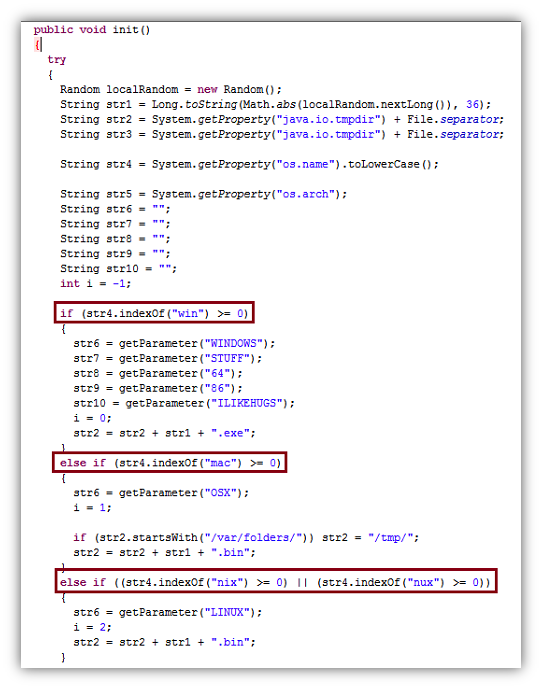
The JAR file checks if the user's machine is running in Windows, Mac or Linux then downloads the appropriate files for the platform. All three files for the three different platforms behave the same way. They all connect to 186.87.69.249 to get additional code to execute. The ports are 8080, 8081, and 8082 for OSX, Linux, and Windows respectively.
The files are detected as:
Trojan-Downloader:Java/GetShell.A (sha1: 4a52bb43ff4ae19816e1b97453835da3565387b7)
Backdoor:OSX/GetShell.A (sha1: b05b11bc8520e73a9d62a3dc1d5854d3b4a52cef)
Backdoor:Linux/GetShell.A (sha1: 359a996b841bc02d339279d29112fe980637bf88)
Backdoor:W32/GetShell.A (sha1: 26fcc7d3106ab231ba0ed2cba34b7611dcf5fc0a)


However, since F-Secure researchers began monitoring the attack, the remote control server hasn't pushed any additional code. It appears that the attack uses the Social Engineer Toolkit (SET), a publicly available tool designed for penetration testers, Aquino said Tuesday via email. However, the chances of this being a penetration test sanctioned by the website's owner are relatively low.
Kaspersky's researchers are in the process of analyzing the backdoor-type malware downloaded by the malicious shell code on Windows and Linux. "The Win32 backdoor is large, about 600KB; the Linux backdoor is over 1MB in size, both appear to contact very complex code which communicates encrypted with other servers."


-Source (CW & F-Secure) 


SHARE OUR NEWS DIRECTLY ON SOCIAL NETWORKS:-

Linux/Cdorked.A: One of The Most Sophisticated Apache Backdoor Targets Millions of Websites

Linux/Cdorked.A: One of The Most Sophisticated Apache Backdoor Targets Millions of Websites to Serve Blackhole Exploit

ESET one of the world renowned security firm headquartered in Bratislava have figured out what it called a malicious cyber rampage targeting millions of cPanel-based servers. Since last few months security experts have been tracking server level compromises that have been utilizing malicious Apache modules to inject malware into websites and  redirecting some of its requests to the infamous Blackhole Exploit packs. On cPanel-based servers, instead of adding modules or modifying the Apache configuration, the attackers started to replace the Apache binary (httpd) with a malicious one. This new backdoor is very sophisticated and this new malware has been dubbed "Linux/Cdorked.A." Several analysis reveals that it is a sophisticated and stealthy backdoor meant to drive traffic to malicious websites. According to the official blog post of ESET - Linux/Cdorked.A is one of the most sophisticated Apache backdoor's we have seen so far. The backdoor leaves no traces of compromised hosts on the hard drive other than its modified httpd binary, thereby complicating forensics analysis. All of the information related to the backdoor is stored in shared memory. The configuration is pushed by the attacker through obfuscated HTTP requests that aren't logged in normal Apache logs. This means that no command and control information is stored anywhere on the system.
This malicious cyber rampage was first detected by another security firm named 'Sucuri' and later ESET published a detailed analysis of the issue. But still there are thoughtful matter as already thousands of websites get infected. The attack is particularly dangerous as Apache web servers are among the most well-known and widely-used in the world and are used by numerous companies. This means that a successful security breach can affect numerous different businesses across a diverse range of industries.
As this malware also known as Linux/Cdorked.A has already been spotted in the wild, so on behalf of cyber media, we urge all the concern system administrator, security analyst to take care of the above issue while to checking their servers and verify that they are not affected by this threat. Detailed instructions to perform this check are provided in the ESET blog.


SHARE OUR NEWS DIRECTLY ON SOCIAL NETWORKS:-

Researchers Found Backdoor in FPGA Chip Used By US Military

Researchers Found Backdoor in FPGA Chip Used By US Military

A researchers team from Cambridge University has figure out that a Chinese-manufactured chip used by US armed forces contains a secret access point that could leave it vulnerable to third party tampering. But the backdoor in the FPGA chip is real, probably part of the manufacturer's debugging hardware, and is unlikely to be easily disabled. The researchers tested an unspecified US military chip — used in weapons, nuclear power plants to public transport – and found that a previously unknown ‘backdoor’ access point had been added, making systems and hardware open to attack, the team says. According to Sergei Skorobogatov, researcher of Cambridge University - "We scanned the silicon chip in an affordable time and found a previously unknown backdoor inserted by the manufacturer. This backdoor has a key, which we were able to extract. If you use this key you can disable the chip or reprogram it at will, even if locked by the user with their own key. This particular chip is prevalent in many systems from weapons, nuclear power plants to public transport. In other words, this backdoor access could be turned into an advanced Stuxnet weapon to attack potentially millions of systems. The scale and range of possible attacks has huge implications for National Security and public infrastructure."
The news comes at a time when Chinese cyber-spying threats are a particular concern. Chinese telecom manufacturers ZTE and Huawei are already under investigation from the US government, which is assessing whether the duo’s telecom businesses pose a national security threat. The Cambridge researchers did not name the company that developed the chip tested, nor did they provide more specific details of its usage. The draft of the associated paper gave more details though. Firstly, the chip in question was a Actel/Microsemi ProASIC3 chip, a "military grade" FPGA (Field Programmable Gate Array) which has a 128-bit AES encryption key to protect its contents and configuration, the intellectual property (IP) of the chip programmer. The chip is not an "American military chip" but an off-the-shelf component used in a wide variety of applications, including US military applications, and its encryption capabilities are specifically designed to only protect the IP.


-Source (The Next Web & The-H)


SHARE OUR NEWS DIRECTLY ON SOCIAL NETWORKS:-

Another Mac Trojan "Backdoor.OSX.SabPub" Discovered, Exploiting Java Vulnerability

Another Mac Trojan "Backdoor.OSX.SabPub" Discovered, Exploiting Java Vulnerability 
Few weeks ago security experts found Flashback Trojan infected more than 60,000 Mac users around the world. Immediately after this incident Apple issued patches that curb the vulnerability. Yet again it has been found that another Mac trojan that is also spread through Java exploits. The malware, called Backdoor.OSX.SabPub, can take screen-shots of a user’s current session, execute commands on an infected machine and connect to a remote website to transmit the data. It is not clear how users get infected with the trojan, but because of the low number of instances and the trojan’s backdoor functionality, Securelist speculates that it is most likely used in targeted attacks, possibly launched through emails containing a URL pointing to two one of websites hosting the exploit. Two versions of SabPub were discovered in the wild this past weekend, flying undedected for about two months now. Kaspersky's Costin Raiu wrote in a blog post that SabPub was probably written by the LuckyCat authors.
Version 1: Microsoft Office
One version of SabPub traps Mac (and potentially Windows) users with booby-trapped Microsoft Word documents which exploit the vulnerability 'MSWord.CVE-2009-00563.a.'
The spear-phishing emails containment a malicious Word attachment entitled '10thMarch Statemnet' (with typo) to Tibet sympathizers. March 10, 2011 refers to the day the Dalai Lama delivered his annual speech observing the Tibetan Uprising of 1959. The Word doc was created in August 2010 and updated in February with SabPub thrown in; "quite normal" for such attacks and seen in other APT's like Duqu, Raiu notes.
Version 2: Java
A March version of Sabpub also discovered last weekend exploits the same drive-by Java vulnerability seen in Flashback, one of the biggest botnet attacks seen in OS X. Once the backdoor Trojan is downloaded, a victim's system is connected to a command-and-control center via HTTP. From there the botnet can grab screenshots, upload/download files, and remotely execute commands, Sophos' Graham Cluley writes. SabPub drops the following two files on a user's system, so if you are concerned about infection Cluley recommends searching for these files:
/Users//Library/Preferences/com.apple.PubSabAgent.pfile
/Users//Library/LaunchAgents/com.apple.PubSabAGent.plist

Earlier also Mac users faced such attacks where OSX/Revir-B trojan was installed behind a PDF, and giving hackers remote access to MAC computers, not only Revier-B also Linux Tsunami trojan Called "Kaiten" targeted Mac OS users in 2011. Also another malware named "Devil Robber" which was also make MAC users victim while stealing their personal informations. 


-Source (Securelist & PC Mag)


SHARE OUR NEWS DIRECTLY ON SOCIAL NETWORKS:-

Flashback Trojan Targeting Mac OS X in VMware Fusion

Underscoring the growing sophistication of Mac-based malware, a trojan preying on OS X users has adopted several stealth techniques since it was discovered last month.
Updates to the Flashback trojan, which gets installed by disguising itself as an Adobe Flash update, now prevent the malware from running on Macs that use VMware Fusion. Such virtual machine software is routinely used by security researchers to test the behavior of a malware sample because it's easier to delete a virtual instance when they're finished than it is to wipe the hard drive clean and reinstall the operating system.
According to MAC Security Blog:-
The latest version, Flashback.D, has gotten a bit sneakier. First, it checks to see if the user is running Mac OS X in VMware Fusion. If so, it does not execute. It does this because many malware researchers test malware in virtual machines, rather than infect full installations, as it is easier to delete them and start over with clean copies. This means that security researchers analyzing and looking for this malware need to be running regular Macs.
Next, the installer for the malware downloads the payload when running the postinstall script.

Finally, it no longer installs the easy-to-spot ~/Library/Preferences/Preferences.dylib. Instead, it installs the backdoor inside Safari, and does so in two ways. It adds information to Safari’s info.plist file, with the location of the backdoor, and it adds the actual backdoor module at /Applications/Safari.app/Contents/Resources/UnHackMeBuild.


Even if a user removes the above file (UnHackMeBuild), they need to edit Safari’s info.plist file; if not, Safari will look for the backdoor on launch, and, if it is not found, Safari will quit.

-News Source (Intego Blog, The Register)


SHARE OUR NEWS DIRECTLY ON SOCIAL NETWORKS:-

'BackDoor.Wirenet.1' Trojan Stealing Passwords From Mac & Linux Based Systems


'BackDoor.Wirenet.1' Trojan Stealing  Passwords From Mac & Linux Based Systems

A Russian Anti Virus software company named 'Dr Web' has spotted a piece of malware that unusually targeting Macs and Linux-based systems is causing a world of trouble for those in its path. The newly found mlaware dubbed 'BackDoor.Wirenet.1' apparently providing its masters with a backdoor into infected systems. It is also capable of stealing passwords stored in browsers like Chrome, Chromium, Firefox and Opera. Furthermore, it’s also able to obtain passwords from popular applications including SeaMonkey, Pidgin and Thunderbird. Even if you don’t use any of the above mentioned software, you’re still in danger as a keylogger is bundled in the payload. Wirenet.1 installs itself into the user's home directory using the name WIFIADAPT

There are some steps that can be taken right away if you think you could be infected. Dr. Web is quick to point out that their anti-virus software will keep you protected. Another option is to simply disable communication with the control server used by the code’s author. In this case, blocking communication with IP address 212.7.208.65 should do the trick.  

Earlier also Mac users faced such attacks when mac Trojan OSX.SabPub was spreading through Java exploits In 2011 we have also seen OSX/Revir-B trojan was installed behind a PDF, and giving hackers remote access to MAC computers, not only Revier-B also Linux Tsunami trojan Called "Kaiten"targeted Mac OS users in 2011. Also another malware named "Devil Robber" which was also make MAC users victim while stealing their personal information


SHARE OUR NEWS DIRECTLY ON SOCIAL NETWORKS:-

Linux Tsunami Trojan Called "Kaiten" Targeting Mac OS


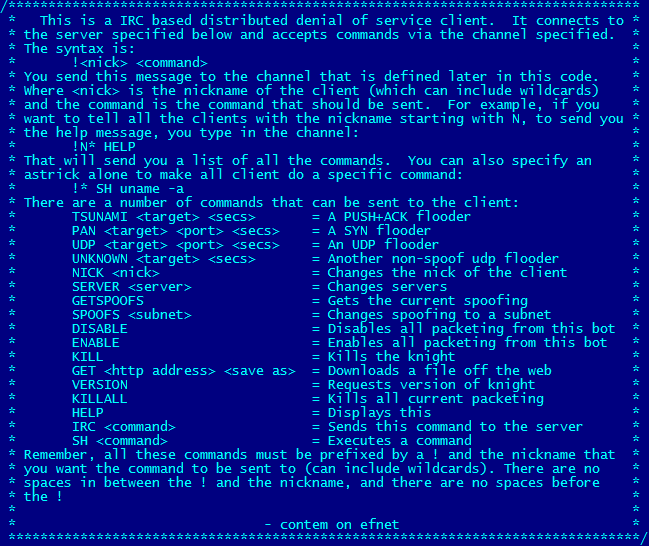
Malware writers have derived a new Trojan for Mac OS X by porting an older Linux backdoor Trojan horse onto another platform. The newly discovered Tsunami Trojan is derived from an earlier Linux-infecting backdoor Trojan, called Kaiten, which phoned home from infected machines to an IRC channel for further instructions. Security firms are still in the process of analysing Tsunami but early speculation suggests it may be a DDoS attack tool.


"Mac users are reminded that even though there is far less malware in existence for Mac OS X than for Windows, that doesn't mean the problem is non-existent," said Graham Cluley 
We fully expect to see cybercriminals continuing to target poorly protected Mac computers in the future. If the bad guys think they can make money out of infecting and compromising Macs, they will keep trying. My advice to Mac users is simple: don't be a soft target, protect yourself.
Mac Trojan authors have previously used Windows backdoor code but the Tsunami Trojan is the first case we've across, at least, where malware tricks from the world of *nix have been turned against Macs


-News Source (Register & NS)


SHARE OUR NEWS DIRECTLY ON SOCIAL NETWORKS:-

'Dockster' A New Mac Malware Targeting Apple Users Found on Dalai Lama Related Website

'Dockster' A New Mac Malware Targeting Apple Users Found on Dalai Lama Related Website

Researcher at F-Secure blog has identified that A new piece of malicious software targeted at Apple users has been found on a website dedicated to the Dalai Lama. According to blog post by F-Secure -the website related to Dalai Lama is fully compromised and is pushing new Mac malware, called Dockster, using a Java-based exploit. Dockster tries to infect computers by exploiting a vulnerability in Java, CVE-2012-0507. The vulnerability is the same one used by the Flashback malware, which first appeared around September 2011 and infected as many as 600,000 computers via a drive-by download. Flashback was used to fraudulently click on advertisements in order to generate illicit revenue in a type of scam known as click fraud. Apple patched the vulnerability in Java in early April and then undertook a series of steps to remove the frequently targeted application from Macs. Apple stopped bundling Java in the 10.7 version of its Lion operation system, which continued with the company's Mountain Lion release. In October, Apple removed older Java browser plug-ins in a software update.
But still the matter of relief is that current versions of OS X are not vulnerable; users who have disabled the Java browser plug-in are also not vulnerable. F-Secure researcher Sean Sullivan said Dockster is “a basic backdoor with file download and keylogger capabilities.” Meanwhile F-Secure’s Sullivan, also said that the Dalai Lama’s site is also serving a Windows-based exploit for CVE-2012-4681, the Agent.AXMO Trojan. The Trojan exploits a Java vulnerability that allows remote code execution using a malicious applet that is capable of bypassing the Java SecurityManager. 

Please Note That: The gyalwarinpoche.com site doesn't seem to be as "official" as dalailama.com

While talking about Mac malware, then you must remember that earlier also Mac users faced such attacks when mac Trojan OSX.SabPub was spreading through Java exploits In 2011 we have also seen OSX/Revir-B trojan was installed behind a PDF, and giving hackers remote access to MAC computers, not only Revier-B also Linux Tsunami trojan Called "Kaiten"targeted Mac OS users in 2011. Also another malware named "Devil Robber" which was also make MAC users victim while stealing their personal information. In the very decent past we have seen a trojan named 'BackDoor.Wirenet.1'  apparently providing its masters with a backdoor into infected systems. It is also capable of stealing passwords stored in browsers like ChromeChromium,Firefox and Opera. For any kind of cyber updates and infose news, stay tuned with VOGH.


SHARE OUR NEWS DIRECTLY ON SOCIAL NETWORKS:-

Microsoft Discovered a New Malware Targeting Apple OS X Exploiting Office Vulnerability

Microsoft Discovered a New Malware Targeting Apple OS X Exploiting Office Vulnerability

This year is going bad to worse for MAC users. Earlier we have seen more than 600,000 Mac user infected by Flashback Trojan after this one another Mac Trojan "Backdoor.OSX.SabPub" penetrated mac security. Recently Microsoft has detected a new piece of malware targeting Apple OS X computers that exploits a vulnerability in the Office productivity suite patched nearly three years ago. The malware is not widespread, according to Jeong Wook Oh of Microsoft's Malware Protection Center. But it does show that hackers pay attention if it's found people do not apply patches as those fixes are released, putting their computers at a higher risk of becoming infected.
The exploit discovered by Microsoft doesn't work with OS X Lion, but does work with Snow Leopard and prior versions. Oh wrote that it is likely attackers have knowledge about the computers they are attacking, such as the victim's operating system version and patch levels. The malware delivered by the exploit is written specifically for OS X and is basically a "backdoor," or a tool that allows for remote control of a computer. Microsoft advised those who use Microsoft Office 2004 or 2008 for Mac or the Open XML File Format Converter for Mac to ensure those products have applied the patch.


-Source (Computer World)  

SHARE OUR NEWS DIRECTLY ON SOCIAL NETWORKS:-

Flashback Trojan Infected Over 600,000 Mac-OS Users, Apple Pushes Out Fix Again

Flashback Trojan Infected Over 600,000 Mac-OS Users, Apple Pushes Out Fix Again 

Russian anti-virus vendor Dr. Web spotted a Trojan affecting nearly 600,000 Macs around the world. The near immune image of the Mac OS X has simply crumbled. So much for Macs being relatively safe against malware attacks. That idea took a punch to the stomach this week when the news broke about the Flashback trojan affecting more than half a million Macs worldwide. Flashback is essentially the malware equivalent of a smash-and-grab thief. Exploiting a Java vulnerability, the code installs and runs when the user visits a compromised or malicious website, intercepting private data, like passwords, and sending it back out over the internet. According to Doctor Web, sources claim that “links to more than four million compromised web-pages could be found on a Google SERP [search results] at the end of March. In addition, some posts on Apple user forums described cases of infection by [the latest variant] BackDoor.Flashback.39 when visiting dlink.com.” The trojan, Backdoor.Flashback.39, can infect computers via an infected web page. The vulnerability itself lies in Java, a product which is not Apple’s
About 57% of infected machines were in the US, 20% in Canada, 13% in UK and 6% in Australia. Apple has already issued patches that curb the vulnerability, but it does not necessarily mean that all users have applied the security patch on their Macs. Even Mozilla has block listed all the older and vulnerable Java plug-in from Firefox. Users are recommended to install the recent Apple Java update to close the hole which allows malicious web pages to drop the trojan onto a system and to always check which application is actually asking for your password when requested.

Update: To detect if a system is infected with Flashback, run each of the following commands in the Mac OS X Terminal:-
defaults read ~/.MacOSX/environment DYLD_INSERT_LIBRARIES
defaults read /Applications/Safari.app/Contents/Info LSEnvironment
defaults read /Applications/Firefox.app/Contents/Info LSEnvironment


If all these commands respond with "The domain/default pair of ... does not exist", then there is no Flashback infection. Otherwise consult the F-Secure advisory for manual removal instructions.

If you’re running Mac OS X v10.6.8, Mac OS X Server v10.6.8, OS X Lion v10.7.3 and Lion Server v10.7.3, be sure to hit up Software Update in your System Preferences.


SHARE OUR NEWS DIRECTLY ON SOCIAL NETWORKS:-

"0zapftis" or "R2D2"(Backdoor Trojan Horse) Discovered By Chaos Computer Club (CCC)

The famous Chaos Computer Club (CCC) has announced the discovery of a backdoor Trojan horse capable of spying on online activity and recording Skype internet calls which, it says, is used by the German police force. The malware - which has been variously dubbed "0zapftis", "Bundestrojaner" or "R2D2" - is likely to kick up a political storm, if the allegations are true.

For some years, German courts have allowed the police to deploy a Trojan known colloquially as "Bundestrojaner" ("Federal Trojan") to record Skype conversations, if they have legal permission for a wiretap.
A CCC spokesperson expressed the group's concern at the discovery:-
"This refutes the claim that an effective separation of just wiretapping internet telephony and a full-blown trojan is possible in practice – or even desired. Our analysis revealed once again that law enforcement agencies will overstep their authority if not watched carefully. In this case functions clearly intended for breaking the law were implemented in this malware: they were meant for uploading and executing arbitrary code on the targeted system."
But the CCC's claim is controversial, as the Trojan they have uncovered has more snooping capabilities than that. For instance, it includes functionality to download updates from the internet, to run code remotely and even to allow remote access to the computer - something specifically in violation of Germany's laws.

Functionality:-
  • The Trojan can eavesdrop on several communication applications - including Skype, MSN Messenger and Yahoo Messenger.
  • The Trojan can log keystrokes in Firefox, Opera, Internet Explorer and SeaMonkey.
  • The Trojan can take JPEG screenshots of what appears on users' screens and record Skype audio calls.
  • The Trojan attempts to communicate with a remote website.


-News Source (NS & CCC)


SHARE OUR NEWS DIRECTLY ON SOCIAL NETWORKS:-

Metasploit 4.2.0 Released With IPv6 Support & Virtualization Target Coverage

Metasploit 4.2.0 Released With IPv6 Support & Virtualization Target Coverage
Earlier we haev discussed many times about one of the most famous and widely used exploitation framework named Metasploit. Yet again the Rapid 7 released another updated version of Metasploit. This update brings Metasploit to version 4.2.0, adding IPv6 support and virtualization target coverage. You'll also notice a new Product News section and update notification for our weekly updates. Since the last major release (4.1.0), added 54 new exploits, 66 new auxiliary modules, 43 new post-exploitation modules, and 18 new payloads. 
Brief About Metasploit:- 
The Metasploit Framework is a penetration testing toolkit, exploit development platform, and research tool. The framework includes hundreds of working remote exploits for a variety of platforms. Payloads, encoders, and nop slide generators can be mixed and matched with exploit modules to solve almost any exploit-related task.
Module Changes:-
  •     Novell eDirectory eMBox Unauthenticated File Access
  •     JBoss Seam 2 Remote Command Execution
  •     NAT-PMP Port Mapper
  •     TFTP File Transfer Utility
  •     VMWare Power Off Virtual Machine
  •     VMWare Power On Virtual Machine
  •     VMWare Tag Virtual Machine
  •     VMWare Terminate ESX Login Sessions
  •     John the Ripper AIX Password Cracker
  •     7-Technologies IGSS 9 IGSSdataServer.exe DoS
  •     Microsoft IIS FTP Server <= 7.0 LIST Stack Exhaustion
  •     DNS and DNSSEC fuzzer
  •     CheckPoint Firewall-1 SecuRemote Topology Service Hostname Disclosure
  •     CorpWatch Company ID Information Search
  •     CorpWatch Company Name Information Search
  •     General Electric D20 Password Recovery
  •     NAT-PMP External Address Scanner
  •     Shodan Search
  •     H.323 Version Scanner
  •     Drupal Views Module Users Enumeration
  •     Ektron CMS400.NET Default Password Scanner
  •     Generic HTTP Directory Traversal Utility
  •     Microsoft IIS HTTP Internal IP Disclosure
  •     Outlook Web App (OWA) Brute Force Utility
  •     Squiz Matrix User Enumeration Scanner
  •     Sybase Easerver 6.3 Directory Traversal
  •     Yaws Web Server Directory Traversal
  •     OKI Printer Default Login Credential Scanner
  •     MSSQL Schema Dump
  •     MYSQL Schema Dump
  •     NAT-PMP External Port Scanner
  •     pcAnywhere TCP Service Discovery
  •     pcAnywhere UDP Service Discovery
  •     Postgres Schema Dump
  •     SSH Public Key Acceptance Scanner
  •     Telnet Service Encyption Key ID Overflow Detection
  •     IpSwitch WhatsUp Gold TFTP Directory Traversal
  •     VMWare ESX/ESXi Fingerprint Scanner
  •     VMWare Authentication Daemon Login Scanner
  •     VMWare Authentication Daemon Version Scanner
  •     VMWare Enumerate Permissions
  •     VMWare Enumerate Active Sessions
  •     VMWare Enumerate User Accounts
  •     VMWare Enumerate Virtual Machines
  •     VMWare Enumerate Host Details
  •     VMWare Web Login Scanner
  •     VMWare Screenshot Stealer
  •     Capture: HTTP JavaScript Keylogger
  •     Oracle DB SQL Injection via SYS.DBMS_CDC_SUBSCRIBE.ACTIVATE_SUBSCRIPTION
  •     Asterisk Manager Login Utility
  •     FreeBSD Telnet Service Encryption Key ID Buffer Overflow
  •     Linux BSD-derived Telnet Service Encryption Key ID Buffer Overflow
  •     Java Applet Rhino Script Engine Remote Code Execution
  •     Family Connections less.php Remote Command Execution
  •     Gitorious Arbitrary Command Execution
  •     Horde 3.3.12 Backdoor Arbitrary PHP Code Execution
  •     OP5 license.php Remote Command Execution
  •     OP5 welcome Remote Command Execution
  •     Plone and Zope XMLTools Remote Command Execution
  •     PmWiki <= 2.2.34 pagelist.php Remote PHP Code Injection Exploit
  •     Support Incident Tracker <= 3.65 Remote Command Execution
  •     Splunk Search Remote Code Execution
  •     Traq admincp/common.php Remote Code Execution
  •     vBSEO <= 3.6.0 proc_deutf() Remote PHP Code Injection
  •     Mozilla Firefox 3.6.16 mChannel Use-After-Free
  •     CTEK SkyRouter 4200 and 4300 Command Execution
  •     Adobe Flash Player MP4 SequenceParameterSetNALUnit Buffer Overflow
  •     Icona SpA C6 Messenger DownloaderActiveX Control Arbitrary File Download and Execute
  •     HP Easy Printer Care XMLCacheMgr Class ActiveX Control Remote Code Execution
  •     Viscom Image Viewer CP Pro 8.0/Gold 6.0 ActiveX Control
  •     Java MixerSequencer Object GM_Song Structure Handling Vulnerability
  •     MS05-054 Microsoft Internet Explorer JavaScript OnLoad Handler Remote Code Execution
  •     MS12-004 midiOutPlayNextPolyEvent Heap Overflow
  •     Viscom Software Movie Player Pro SDK ActiveX 6.8
  •     Adobe Reader U3D Memory Corruption Vulnerability
  •     Aviosoft Digital TV Player Professional 1.0 Stack Buffer Overflow
  •     BS.Player 2.57 Buffer Overflow
  •     CCMPlayer 1.5 m3u Playlist Stack Based Buffer Overflow
  •     Free MP3 CD Ripper 1.1 WAV File Stack Buffer Overflow
  •     McAfee SaaS MyCioScan ShowReport Remote Command Execution
  •     Mini-Stream RM-MP3 Converter v3.1.2.1 PLS File Stack Buffer Overflow
  •     MS11-038 Microsoft Office Excel Malformed OBJ Record Handling Overflow
  •     Ability Server 2.34 STOR Command Stack Buffer Overflow
  •     AbsoluteFTP 1.9.6 - 2.2.10 LIST Command Remote Buffer Overflow
  •     Serv-U FTP Server < 4.2 Buffer Overflow
  •     HP OpenView Network Node Manager ov.dll _OVBuildPath Buffer Overflow
  •     XAMPP WebDAV PHP Upload
  •     Avid Media Composer 5.5 - Avid Phonetic Indexer Buffer Overflow
  •     Citrix Provisioning Services 5.6 SP1 Streamprocess Opcode 0x40020000 Buffer Overflow
  •     HP Diagnostics Server magentservice.exe Overflow
  •     StreamDown 6.8.0 Buffer Overflow
  •     Wireshark console.lua Pre-Loading Script Execution
  •     Oracle Job Scheduler Named Pipe Command Execution
  •     SCADA 3S CoDeSys CmpWebServer <= v3.4 SP4 Patch 2 Stack Buffer Overflow
  •     Sunway Forcecontrol SNMP NetDBServer.exe Opcode 0x57
  •     OpenTFTP SP 1.4 Error Packet Overflow
  •     AIX Gather Dump Password Hashes
  •     Linux Gather Saved mount.cifs/mount.smbfs Credentials
  •     Multi Gather VirtualBox VM Enumeration
  •     UNIX Gather .fetchmailrc Credentials
  •     Multi Gather VMWare VM Identification
  •     UNIX Gather .netrc Credentials
  •     Multi Gather Mozilla Thunderbird Signon Credential Collection
  •     Multiple Linux / Unix Post Sudo Upgrade Shell
  •     Windows Escalate SMB Icon LNK dropper
  •     Windows Escalate Get System via Administrator
  •     Windows Gather RazorSQL Credentials
  •     Windows Gather File and Registry Artifacts Enumeration
  •     Windows Gather Enumerate Computers
  •     Post Windows Gather Forensics Duqu Registry Check
  •     Windows Gather Privileges Enumeration
  •     Windows Manage Download and/or Execute
  •     Windows Manage Create Shadow Copy
  •     Windows Manage List Shadow Copies
  •     Windows Manage Mount Shadow Copy
  •     Windows Manage Set Shadow Copy Storage Space
  •     Windows Manage Get Shadow Copy Storage Info
  •     Windows Recon Computer Browser Discovery
  •     Windows Recon Resolve Hostname
  •     Windows Gather Wireless BSS Info
  •     Windows Gather Wireless Current Connection Info
  •     Windows Disconnect Wireless Connection
  •     Windows Gather Wireless Profile
For additional information click Here. To Download Metasploit version 4.2.0 for windows & Linux click Here.

 -Source (rapid7)


SHARE OUR NEWS DIRECTLY ON SOCIAL NETWORKS:-

Famous Framework Metasploit v4.0.0

The Metasploit Framework is a penetration testing toolkit, exploit development platform, and research tool. The framework includes hundreds of working remote exploits for a variety of platforms. Payloads, encoders, and nop slide generators can be mixed and matched with exploit modules to solve almost any exploit-related task.

New Exploit Modules:

VSFTPD v2.3.4 Backdoor Command Execution
Java RMI Server Insecure Default Configuration Java Code Execution
HP OpenView Network Node Manager Toolbar.exe CGI Buffer Overflow
HP OpenView Network Node Manager Toolbar.exe CGI Cookie Handling Buffer Overflow
Mozilla Firefox nsTreeRange Dangling Pointer Vulnerability
Black Ice Cover Page ActiveX Control Arbitrary File Download
Microsoft Office Visio VISIODWG.DLL DXF File Handling Vulnerability
MicroP 0.1.1.1600 (MPPL File) Stack Buffer Overflow
Lotus Notes 8.0.x – 8.5.2 FP2 – Autonomy Keyview
RealWin SCADA Server DATAC Login Buffer Overflow
Siemens FactoryLink vrn.exe Opcode 9 Buffer Overflow
Iconics GENESIS32 Integer overflow version 9.21.201.01
Siemens FactoryLink 8 CSService Logging Path Param Buffer Overflow
Sielco Sistemi Winlog Buffer Overflow
Blue Coat Authentication and Authorization Agent (BCAAA) 5 Buffer Overflow
HP OmniInet.exe Opcode 20 Buffer Overflow
HP OmniInet.exe Opcode 27 Buffer Overflow
Citrix Provisioning Services 5.6 streamprocess.exe Buffer Overflow
Lotus Notes 8.0.x – 8.5.2 FP2 – Autonomy Keyview

New Post-Exploitation Modules:

Winlogon Lockout Credential Keylogger
Windows Gather Microsoft Outlook Saved Password Extraction
Windows Gather Process Memory Grep
Windows Gather Trillian Password Extractor
Windows PCI Hardware Enumeration
Windows Gather FlashFXP Saved Password Extraction
Windows Gather Local and Domain Controller Account Password Hashes
Windows Gather Nimbuzz Instant Messenger Password Extractor
Windows Gather CoreFTP Saved Password Extraction
Internet Download Manager (IDM) Password Extractor
Windows Gather SmartFTP Saved Password Extraction
Windows Gather Bitcoin wallet.dat
Windows Gather Service Info Enumeration
Windows Gather IPSwitch iMail User Data Enumeration

New Auxiliary Modules:

John the Ripper Password Cracker Fast Mode
Microsoft Windows DNSAPI.dll LLMNR Buffer Underrun DoS
Kaillera 0.86 Server Denial of Service
2Wire Cross-Site Request Forgery Password Reset Vulnerability
SIPDroid Extension Grabber
MSSQL Password Hashdump


Notable Features & Closed Bugs:-

Feature #4982 – Support for custom executable with psexec
Feature #4856 – RegLoadKey and RegUnLoadKey functions for the Meterpreter stdapi
Feature #4578 – Update Nmap XML parsers to support Nokogiri parsing
Feature #4417 – Post exploitation module to harvest OpenSSH credentials
Feature #4015 – Increase test coverage for railgun
Bug #4963 – Rework db_* commands for consistency
Bug #4892 – non-windows meterpreters upload into the wrong filename
Bug #4296 – Meterpreter stdapi registry functions create key if one doesn’t exist
Bug #3565 – framework installer fails on RHEL (postgres taking too long to start)

Armitage integrates with Metasploit 4.0 to:-


Take advantage of the new Meterpreter payload stagers
Crack credentials with the click of a button
Run post modules against multiple hosts
Automatically log all post-exploitation activity
Revision Information:

Framework Revision 13462
Several import parsers were rewritten to use Nokogiri for much faster processing of large import files. Adding to Metasploit’s extensive payload support, Windows and Java Meterpreter now both support staging over HTTP and Windows can use HTTPS. In a similar vein, POSIX Meterpreter is seeing some new development again. It still isn’t perfect nor is it nearly as complete as the Windows version, but many features already work. Java applet signing is now done directly in Ruby, removing the need for a JDK for generating self-signed certificates. The Linux installers now ship with ruby headers, making it possible to install native gems in the Metasploit ruby environment.

Another flexibility improvement comes in the form of a consolidated pcap interface. The pcaprub extension ships with the Linux installers as of this release and support for Windows will come soon. Modules that used Racket for generating raw packets have been converted to Packetfu, which provides a smoother API for modules to capture and inject packets.

To download Metasploit Framework v4.0.0 Click Here
For more information abous MSF click here

SHARE OUR NEWS DIRECTLY ON SOCIAL NETWORKS:-

sqlsus v0.7 (SQL Injection and Takeover Tool)


sqlsus is an open source MySQL injection and takeover tool, written in perl. Via a command line interface, you can retrieve the database(s) structure, inject your own SQL queries (even complex ones), download files from the web server, crawl the website for writable directories, upload and control a backdoor, clone the databases, and much more. sqlsus is an open source (My)SQL injection tool, written in perl. It focuses on speed and efficiency, optimising the available injection space. It provides an easy to use interface with lots of neat features.

Features of Sqlsus v0.7:-
  • Added time-based blind injection support (added option “blind_sleep”, and renamed “string_to_match” to “blind_string”).
  • It is now possible to force sqlsus to exit when it’s hanging (i.e.: retrieving data), by hitting Ctrl-C more than twice.
  • Rewrite of “autoconf max_sendable”, so that sqlsus will properly detect which length restriction applies (WEB server / layer underneath). (removed option “max_sendable”, added options “max_url_length” and “max_inj_length”)
  • Uploading a file now sends it into chunks under the length restriction.
  • sqlsus now saves variables after each command, so that forcing it to quit (or killing it) will not discard the changes that were made.
  • Added a progress bar to inband mode, sqlsus now determines the number of rows to be returned prior to fetching them.
  • get db (tables/columns) in inband mode now uses multithreading (like everything else).
  • clone now uses count(*) if available (set by “get count” / “get db”), instead of using fetch-ahead.
  • In blind mode, “start” will now test if things work the way they should, by injecting 2 queries : one true and one false.
  • sqlsus now prints what configuration options are overridden (when a saved value differs from the configuration file).
To Download sqlsus (My SQL Injection Tool) 

SHARE OUR NEWS DIRECTLY ON SOCIAL NETWORKS:-

10GB of Law Enforcement Data Exposed (#AntiSec)

Hackers associated with the "AntiSec" collaboration between Anonymous and recently disbanded hacker group LulzSec have released more than 10GB of information from 70 different law enforcement agencies across the United States. The leakers called it one of their largest data dumps yet, released as retaliation for recent U.S. and U.K. arrests of alleged AntiSec members.
Nestled within the data dump, posted as both a BitTorrent release and posted on sites accessible via the Tor anonymity network, are more than 300 different email accounts from 56 law enforcement Web sites. Details from the ransacked Missouri Sherriff's Association Web site also appear in the release, including user names and passwords as well as users' home addresses, phone numbers, and Social Security numbers–a move that's sure to infuriate law enforcement officials even before they note the actual name of the hackers' release, "Shooting Sheriffs Saturday."

Also found within the release are various police training files, a list of users who have submitted information to an online "anonymous" crime tip system, and various server-related information and login credentials.

"We have no sympathy for any of the officers or informants who may be endangered by the release of their personal information. For too long they have been using and abusing our personal information, spying on us, arresting us, beating us, and thinking that they can get away with oppressing us in secrecy," reads the hackers' Pastebin-posted. "Well it's retribution time: we want them to experience just a taste of the kind of misery and suffering they inflict upon us on an everyday basis."

The hack was allegedly carried out following an initial breach of a server owned by the company Brooks-Jeffrey Marketing, which hosts various sheriff's association sites. Its server was initially taken offline following confirmation of the first attack, but its subsequent relaunch allegedly kept intact the same backdoor methods the hackers users to access the original server. At that point, the hackers went ahead and started defacing the more than 70 different law enforcement agency domains associated with Brooks-Jeffrey Marketing.
"We lol'd as we watched the news reports come in, quoting various Sheriffs who denied that they were ever hacked, that any personal information was stolen, that they did not store snitch info on their servers. Many lulz have been had as we taunted the sheriffs by responding to their denials by tweeting teasers exposing their SSNs, passwords, addresses, and private emails," reads the hackers' manifesto.

The hackers also used stolen credit card information to make donations to the American Civil Liberties Union, the Electronic Frontier Foundation, and the Bradley Manning Support Network, among other organizations.

-News Source (PC Mag)

SHARE OUR NEWS DIRECTLY ON SOCIAL NETWORKS:-

President of Philippines Official Website Hacked By Anonymous

President of Philippines Official Website Hacked By Anonymous in Protest of "Sabah Issue"

After remaining silent for a certain period, the infamous hacker collective group Anonymous strikes again. As you all might know that normally this group targets high profile websites like government organization, federal authorities, defense, ministry and other giant organization. This time also the same strategy get repeated, as the hacker group targeted the official website of the President of Philippines. During this cyber attack the hacker group has breached the security system and managed to get access in side the website, and as expected they defaced the index page. In the news section of the website the hacker group calling them selves "Anonymous Philippines"; affiliated to one of the worlds most dangerous and largest hackers community going by the name "Anonymous";  left message for the President Benigno Aquino III. From the message left by the hacker, we came to know that the hacking was a part of protest against the Aquino administration’s mishandling of  the crisis in "Sabah issue" 

Message of Anonymous Philippines:- 
“Greetings, President Aquino! We have watched how you signed into law a bill that endangers and tramples upon the netizens’ freedom of speech and expression. Now, we are silent witnesses as to how you are mishandling the Sabah issue. We did not engage the Malaysian hackers who invaded our cyberspace since we expected you to appropriately and judiciously act on the same, but you failed us.
“You did nothing while our fellow brothers are being butchered by the Malaysian forces, and while our women and children become subject of human rights abuses. If you can’t act on the issue as the Philippine President, at least do something as a fellow Filipino. We are watching.” 

As soon as this hack get spotted, the Philippine government took immediate step while closing the backdoor and removing the deface page. After an hour of maintenance the website get restored and came back in proper manner. Later in-front of press the Philippine government acknowledged the issue. In the official statement the Communications Secretary of Philippine Sonny Coloma said -“At around 1:30 a.m. today, we detected a breach when an errant sentence critical of the government on the Sabah issue was found to have been inserted in one of the news items within the website.” Coloma did assure the public that the site will be up and running “in a few hours.” 
“We expect to resume public display of the President's website in a few hours after needed protection measures have been put in place,” Coloma said, adding that the site was not compromised in any other way. “No further intrusions were made as the internal security protocols were activated,” he said. 
While covering the hack of President site, we must give you reminder that, this hack is not the first one, earlier half dozen of major government website of Philippine was targeted by the same hacker group, even in this year the official website of Senator Vicente C. Sotto III get hacked and defaced by Anonymous Philippines for the protest of "Cybercrime Prevention Act" 


SHARE OUR NEWS DIRECTLY ON SOCIAL NETWORKS:-

Researcher Security Hole Found in US Power Plants, DHS is Investigating

Researcher Security Hole Found in US Power Plants, DHS is Investigating  

Security researcher figure out seirous flaws in software for specialized networking equipment from Siemens could enable hackers to attack US power plants and other critical systems. A security expert said that he had found a backdoor in hardware from a Siemens subsidiary. The alleged flaw was made public by security researcher Justin W Clarke at a conference in Los Angeles. The equipment is widely used by power companies mainly based on US. Clarke said that the discovery of the flaw is disturbing because hackers who can spy on communications of infrastructure operators could gain credentials to access computer systems that control power plants and other critical systems. "If you can get to the inside, there is almost no authentication, there are almost no checks and balances to stop you," Clarke said.
The Department of Homeland Security said it was in contact with the firm to assess the claim. After this issue came in-front, the US Govt immeditely taken stpes & investigating the whole scenario. RuggedCom, a Canadian subsidiary of Siemens that sells networking equipment for use in harsh environments such as areas with extreme weather, said it was investigating Clarke's findings, but declined to elaborate. This is the second bug that Clarke, a high school graduate who never attended college, has discovered in products from RuggedCom, which are widely used by power companies that rely on its equipment to support communications to remote power stations.
In May, RuggedCom released an update to its Rugged Operating System software after Clarke discovered that it had a previously undisclosed "back door" account that could give hackers remote access to the equipment with an easily obtained password. The Department of Homeland Security's Industrial Control Systems Cyber Emergency Response Team, which is known as ICS-CERT, said in its advisory on Tuesday that government analysts were working with RuggedCom and Clarke to figure out how to best mitigate any risks from the newly identified vulnerability. "According to this report, the vulnerability can be used to decrypt SSL traffic between an end-user and a RuggedCom network device," Read the full advisory. 

This is not the first time, earlier in 2011 - researcher found vulnerability in the security system of US Power Grid, form which NSA suspected that hacktivist Anonymous may even shutdown the entire US Power Grid. later The White House introduced an Electric Sector Cybersecurity Risk Maturity ModelFor these kind of cyber security updates & news, just stay tuned with VOGH


-Source (Reuters & BBC)


SHARE OUR NEWS DIRECTLY ON SOCIAL NETWORKS:-

Related Posts Plugin for WordPress, Blogger...