Showing posts sorted by date for query Mac OS. Sort by relevance Show all posts

Linux Mint 16 "Petra" Released With Choice of MATE or Cinnamon

Linux Mint 16 "Petra" Released With Choice of MATE or Cinnamon

Earlier we have talked many times on Linux Mint, it is one of most modern, elegant and comfortable operating system based on Ubuntu or Debian which is both powerful and easy to use. The Linux Mint project has started  in 2006, since then the consistent effort of it's developers and contributors has made Linux Mint the 4th most widely used home operating system behind Microsoft Windows, Apple Mac OS and Canonical's Ubuntu. As promised from beginning the mint team used to release their new version in every six months. The last we got was Linux Mint 15 'Olivia'. Again also the team proudly to announced the release of Linux Mint 16 code named "Petra". There's been quite a lot of anticipation for the next version of Linux Mint, and as expected the result is indeed satisfactory. According to the official blog of Linux Mint- "Petra" took 6 months of incremental development on top of stable and reliable technologies. This new release comes with updated software and brings refinements and new features to make your desktop even more comfortable to use. This new release comes with updated software and brings refinements and new features to make your desktop even more comfortable to use." One of the more interesting updates of the release is version 2.0 of Cinnamon (a fork of GNOME Shell), with a large number of new features: "Cinnamon 2.0 represents 5 months of development and 856 commits from 28 developers. It features a lot of bug fixes but also brand new features and many improvements." Lets look at the new features at a glance:

New features in Linux Mint 16 MATE:-
  • Login Screen
  • USB Stick support
  • Performance improvements
  • Software Manager
  • System Improvements
  • Artwork Improvements
  • Main Components 


For a complete overview and to see screenshots of the new features Linux Mint 16 click here. The Linux Mint site has a list of new features separately for both MATE and Cinnamon. Make sure to read the “Release Notes” to be aware of important info or known issues related to this release. So dear friends what are you waiting for! lets download Mint 16 and explore it. 


SHARE OUR NEWS DIRECTLY ON SOCIAL NETWORKS:-

Apple Hacked By The Same Group Who Attacked Facebook

Apple Hacked, Macintosh Computers Infected  By The Same Group Who Attacked Facebook 

The month of February is not going good for cyber space, specially for giant organization. Last week the social networking giant Facebook fallen victim of a devastating cyber attack which did effected a number of  systems. Facebook admitted that it faced a "sophisticated attack" on computers where it has been found the attackers used a zero-day Java exploit to initiate the attack, but that no user data was compromised. The same thing happened to micro blogging site Twitter and New York Times. And now it was the turn for Apple. The California based multinational company acknowledged that recently their systems has been attacked by hackers who infected Macintosh computers of some employees. Like Facebook here also no data has been effected, "there was no evidence that any data left Apple." -said Apple. 
According to an exclusive report of Reuters -some unknown hackers infected the computers of some Apple workers when they visited a website for software developers that had been infected with malicious software. The malware had been designed to attack Mac computers. The same software, which infected Macs by exploiting a flaw in a version of Oracle Corp's Java software used as a plug-in on Web browsers, was used to launch attacks against Facebook, which the social network disclosed on Friday. The malware was also employed in attacks against Mac computers used by "other companies," Apple said, without elaborating on the scale of the assault. Experts are presuming that all these cyber attacks of February, that is Twitter, New York Times, Facebook & Lastly Apple Inc was originated from China, and executed by the same hacker group. On the other side few experts are also saying that the group responsible for the hack, has been identified as "Unit 61398" of the People's Liberation Army. But so far there is no proof. 
Apple also revealed that it plans to release a software tool later Tuesday that will protect customers against the same type of software that was used against its employees. 

Apple also provided a statement as follows:-
"Apple has identified malware which infected a limited number of Mac systems through a vulnerability in the Java plug-in for browsers. The malware was employed in an attack against Apple and other companies, and was spread through a website for software developers. We identified a small number of systems within Apple that were infected and isolated them from our network. There is no evidence that any data left Apple. We are working closely with law enforcement to find the source of the malware.
Since OS X Lion, Macs have shipped without Java installed, and as an added security measure OS X automatically disables Java if it has been unused for 35 days. To protect Mac users that have installed Java, today we are releasing an updated Java malware removal tool that will check Mac systems and remove this malware if found..."


SHARE OUR NEWS DIRECTLY ON SOCIAL NETWORKS:-

Oracle Released Java 7 update 10 With Security Enhancements & Bug Fixes

Oracle Released Java 7 update 10 With Security Enhancements & Bug Fixes 

This is the third time in a year when Oracle has updated the standard edition of Java platform. This release includes new security controls in addition to a bug fix and updated timezone data. This latest update also contains a number of security enhancements and is now certified for Mac OS X 10.8 and Windows 8. The security enhancements include the ability to disable any Java application from running in the browser and the ability to set a desired level of security for unsigned applets, Java Web Start applications, and embedded JavaFX applications. While keeping in mind the last security issues with Java, in the press release of this Java update Oracle said "if the JRE is deemed expired or insecure, additional security warnings are displayed. In most of these dialogs, the user has the option to block running the app, to continue running the app, or to go to java.com to download the latest release."

Security Feature Enhancements

The JDK 7u10 release includes the following enhancements:
  • The ability to disable any Java application from running in the browser. This mode can be set in the Java Control Panel or (on Microsoft Windows platform only) using a command-line install argument.
  • The ability to select the desired level of security for unsigned applets, Java Web Start applications, and embedded JavaFX applications that run in a browser. Four levels of security are supported. This feature can be set in the Java Control Panel or (on Microsoft Windows platform only) using a command-line install argument.
  • New dialogs to warn you when the JRE is insecure (either expired or below the security baseline) and needs to be updated.

Bug Fixes

Notable Bug Fixes in JDK 7u10

The following are some of the notable bug fixes included in JDK 7u10.
Area: java command

Description: Wildcard expansion for single entry classpath does not work on Windows platforms.

The Java command and Setting the classpath documents describe how the wildcard character (*) can be used in a classpath element to expand into a list of the .jar files in the associated directory, separated by the classpath separator (;).
This wildcard expansion does not work in a Windows command shell for a single element classpath due to the Microsoft bug described in Wildcard Handling is Broken.
See 7146424.
For a list of other bug fixes included in this release, see JDK 7u10 Bug Fixes page. 

The updated Java Development Kit and Java Runtime Environment are available to download from the Oracle site. 


SHARE OUR NEWS DIRECTLY ON SOCIAL NETWORKS:-

'Dockster' A New Mac Malware Targeting Apple Users Found on Dalai Lama Related Website

'Dockster' A New Mac Malware Targeting Apple Users Found on Dalai Lama Related Website

Researcher at F-Secure blog has identified that A new piece of malicious software targeted at Apple users has been found on a website dedicated to the Dalai Lama. According to blog post by F-Secure -the website related to Dalai Lama is fully compromised and is pushing new Mac malware, called Dockster, using a Java-based exploit. Dockster tries to infect computers by exploiting a vulnerability in Java, CVE-2012-0507. The vulnerability is the same one used by the Flashback malware, which first appeared around September 2011 and infected as many as 600,000 computers via a drive-by download. Flashback was used to fraudulently click on advertisements in order to generate illicit revenue in a type of scam known as click fraud. Apple patched the vulnerability in Java in early April and then undertook a series of steps to remove the frequently targeted application from Macs. Apple stopped bundling Java in the 10.7 version of its Lion operation system, which continued with the company's Mountain Lion release. In October, Apple removed older Java browser plug-ins in a software update.
But still the matter of relief is that current versions of OS X are not vulnerable; users who have disabled the Java browser plug-in are also not vulnerable. F-Secure researcher Sean Sullivan said Dockster is “a basic backdoor with file download and keylogger capabilities.” Meanwhile F-Secure’s Sullivan, also said that the Dalai Lama’s site is also serving a Windows-based exploit for CVE-2012-4681, the Agent.AXMO Trojan. The Trojan exploits a Java vulnerability that allows remote code execution using a malicious applet that is capable of bypassing the Java SecurityManager. 

Please Note That: The gyalwarinpoche.com site doesn't seem to be as "official" as dalailama.com

While talking about Mac malware, then you must remember that earlier also Mac users faced such attacks when mac Trojan OSX.SabPub was spreading through Java exploits In 2011 we have also seen OSX/Revir-B trojan was installed behind a PDF, and giving hackers remote access to MAC computers, not only Revier-B also Linux Tsunami trojan Called "Kaiten"targeted Mac OS users in 2011. Also another malware named "Devil Robber" which was also make MAC users victim while stealing their personal information. In the very decent past we have seen a trojan named 'BackDoor.Wirenet.1'  apparently providing its masters with a backdoor into infected systems. It is also capable of stealing passwords stored in browsers like ChromeChromium,Firefox and Opera. For any kind of cyber updates and infose news, stay tuned with VOGH.


SHARE OUR NEWS DIRECTLY ON SOCIAL NETWORKS:-

Nmap 6.25 Released! With 85 New Scripts, Windows 8 Enhancements & Better Performance

Nmap 6.25 Released! With 85 New Scripts, Windows 8 Enhancements & Better Performance

Gordon Lyon also known as Fyodor, the author of world's most popular security scanner 'Nmap' announced another update. Almost after five months we got this new version that is Nmap 6.25. This release of Nmap  contains hundreds of improvements, including 85 new NSE scripts, nearly 1,000 new OS and service detection fingerprints, performance enhancements such as the new kqueue and poll I/O engines, better IPv6 traceroute support, Windows 8 improvements, and much more!  It also includes the work of five Google Summer of Code interns who worked full time with Nmap mentors during the summer. 

Here are the most important change since 6.01:
  • Integrated all of your IPv4 OS fingerprint submissions since January (more than 3,000 of them).  Added 373 fingerprints, bringing the new total to 3,946.  Additions include Linux 3.6, Windows 8, Windows Server 2012, Mac OS X 10.8, and a ton of new WAPs, printers, routers, and other devices--including our first IP-enabled doorbell! Many existing fingerprints were improved.
  • Integrated all of your service/version detection fingerprints submitted since January (more than 1,500)!  Our signature count jumped by more than 400 to 8,645.  We now detect 897 protocols, from extremely popular ones like http, ssh, smtp and imap to the more obscure airdroid, gopher-proxy, and enemyterritory. 
  • Integrated your latest IPv6 OS submissions and corrections. We're still low on IPv6 fingerprints, so please scan any IPv6 systems you own or administer and submit them to http://nmap.org/submit/.  Both new fingerprints (if Nmap doesn't find a good match) and corrections (if Nmap guesses wrong) are useful.
  • Enabled support for IPv6 traceroute using UDP, SCTP, and IPProto(Next Header) probes. 
  • Scripts can now return a structured name-value table so that results are query-able from XML output. Scripts can return a string as before, or a table, or a table and a string. In this last case, the table will go to XML output and the string will go to screen output. See http://nmap.org/book/nse-api.html#nse-structured-output 
  • [Nsock] Added new poll and kqueue I/O engines for improved performance on Windows and BSD-based systems including Mac OS X. These are in addition to the epoll engine (used on Linux) and the classic select engine fallback for other system.  
  • [Ncat] Added support for Unix domain sockets. The new -U and --unixsock options activate this mode.  These provide compatibility with Hobbit's original Netcat. 
  • Moved some Windows dependencies, including OpenSSL, libsvn, and the vcredist files, into a new public Subversion directory /nmap-mswin32-aux and moved it out of the source tarball. This reduces the compressed tarball size from 22 MB to 8 MB and similarly reduces the bandwidth and storage required for an svn checkout.
  • [NSE] Replaced old RPC grinder (RPC enumeration, performed as part of version detection when a port seems to run a SunRPC service) with a faster and easier to maintain NSE-based implementation. This also allowed us to remove the crufty old pos_scan scan engine. 


For additional information and to know the full change log of this release click Here. To download Namp 6.25 (Source Code & Binary Packages) for Windows, Linux, Mac, Unix & few other OS click Here


SHARE OUR NEWS DIRECTLY ON SOCIAL NETWORKS:-

Chrome 23 Closes 15 Security Vulnerabilities, Promises Longer Battery Life & Added Do Not Track (DNT)

Chrome 23 Closes 15 Security Vulnerabilities, Promises Longer Battery Life & Added Do Not Track (DNT)

The searching giant Google finally included the Do Not Track (DNT) option into its first stable version of the company's browser which is Google Chrome 23. In February internet giant Google has agreed with the White House's Consumer Privacy Bill and here comes the result. Google has implemented the Do Not Track (DNT) header in its Chrome web browser.  Few months ago Microsoft made Do Not Track (DNT) facility available by default in Internet Explorer 10. Also the Redmond based software giant drew some criticism recently for its decision to enable Do Not Track by default in IE 10First it was Mozilla who proposed the Do Not Track mechanism, in Firefox in June 2011 when it released Firefox 5. The DNT option is disabled by default in Chrome and in order to turn it on, users need to go to the customization menu in the top right corner of the browser window. Then click on the Settings option in the left side and scroll down to open the Advanced Settings menu. Under the Privacy menu, check the box next to the "Send a 'Do Not Track' request with your browsing traffic" option. Once that option is enabled, the user will see a message explaining what the DNT system will do for them.
Not only DNT, with the release of Chrome 23, Google closes several security holes and promises to improve battery life for some users. For systems with dedicated graphics chips that support Chrome's GPU-accelerated video decoding, version 23 of the WebKit-based browser is said to significantly reduce power consumption. According to Google, batteries lasted on average 25% longer in its tests when GPU-accelerated video decoding was enabled compared to only using a system's CPU when streaming online videos. Version 23 of Chrome also addresses a total of 15 security vulnerabilities in the browser, 6 of which are rated as "high severity". These include high-risk use-after-free problems in video layout and in SVG filter handling, a integer bounds check issue in GPU command buffers and a memory corruption flaw in texture handling; a Mac-only problem related to wild writes in buggy graphics drivers has also been fixed. Eight medium-severity flaws including an integer overflow that could lead to an out-of-bounds read in WebP handling, and a low-risk have also been corrected. As part of its Chromium Security Vulnerability Rewards program, Google paid security researchers $9,000 for discovering and reporting these flaws. The update to Chrome also includes a new version of the Adobe Flash Player plugin which eliminates a number of critical vulnerabilities, all of which were discovered by the Google Security Team. Further information about the new features can be found in the release announcement, while a full list of security fixes is provided in a post on the Chrome Releases blog. Chrome 23.0.1271.64 is available to download for Windows, Mac OS X and Linux users. 


-Source (Google Chrome Blog, The-H & threatpost)


SHARE OUR NEWS DIRECTLY ON SOCIAL NETWORKS:-

Apple Releases iOS 6.0.1, Serious Flaws in Kernel, Passcode Lock & WebKit Patched

Apple Releases iOS 6.0.1, Serious Flaws in Kernel, Passcode Lock & WebKit Patched

Couple of moths ago we got iOS6, where Apple added over 200 new features, including Apple's own Maps app, Facebook integration, Siri improvements, Apple's new Passbook digital wallet app, and more. iOS 6 is compatible with the third-generation iPad, iPad 2, iPhone 4S, iPhone 4, iPhone 3GS, and fourth-generation iPod touch. With such tremendous features there also several security bugs have been spotted in the wild, which is affecting millions of iOS users across the globe. Among those bugs the most serious seems to be a kernel flaw discovered by researcher Mark Dowd of Azimuth Security and Eric Monti of Square that affects iPhone 3GS and later, as well iPod Touch and iPad2 and later. An attacker exploiting the vulnerability could essentially bypass address space randomization layout (ASLR) protections using a malicious application, and could determine addresses in the kernel, Apple’s advisory said. The researchers said the vulnerability, which could expose data to an attacker, occurs in the way iOS handles application programming interfaces in relation to kernel extensions. 

Apple has released updates for iOS 6 which include security fixes. The iOS 6.0.1 update includes security fixes for the kernel, passcode locking and WebKit. The WebKit issues were also fixed in an update of the Safari web browser for Mac OS X. “Responses containing an OSBundleMachOHeaders key may have included kernel addresses, which may aid in bypassing address space layout randomization protection,” Apple said. “This issue was addressed by unsliding the addresses before returning them.” 
A vulnerability in iOS’ Passcode Lock was also addressed in the latest update that could allow someone with access to the iOS device to access Passbook passes without entering a passcode. “A state management issue existed in the handling of Passbook passes at the lock screen. This issue was addressed through improved handling of Passbook passes,” Apple said. Finally, a pair of WebKit vulnerabilities were patched.
The first involved how iOS handled JavaScript arrays, and could allow an attacker to remotely execute code if a user visited a malicious site and was infected. Apple said it addressed the matter through additional validation of JavaScript arrays. The other WebKit flaw is a use-after-free issue in the handling of SVG images. Scalable vector graphics (SVG) are file formats for static or animated graphics. A user visiting a website hosting a malicious graphic could experience application crashes or worse, an attacker could remotely execute code.  
The iOS 6.0.1 software update also includes fixes for the iPhone 5 to allow it to install over the air updates and to make it work better with WPA2 Wi-Fi networks. There are also corrections for bugs which flashed horizontal lines over the keyboard and stopped the camera flash going off. The two WebKit issues were also the only issues apparently fixed in the Safari 6.0.2 update. Safari 6.0.2 is available through Software Update for Mac OS X 10.7 Lion and the Mac App Store for Mac OS X 10.8 Mountain Lion.

-Source (Apple, threat post & The-H)


SHARE OUR NEWS DIRECTLY ON SOCIAL NETWORKS:-

Apple Releases iOS 6 With 200+ New Features & Mountain Lion 10.8.2 With Facebook Integration & Game Center

Apple Releases iOS 6 With 200+ New Features & Mountain Lion 10.8.2 With Facebook Integration & Game Center

As expected, here comes double bang from Apple. Apple has also released  iOS 6 along with OS X Mountain Lion 10.8.2 and made available for public. In case of users of recent iPad, iPhone, and iPod touch models can obtain the update either by connecting their devices to iTunes and clicking the "Check for Update" button or checking for over-the-air updates on their devices. iOS 6 adds over 200 new features, including Apple's own Maps app, Facebook integration, Siri improvements, Apple's new Passbook digital wallet app, and more. iOS 6 is compatible with the third-generation iPad, iPad 2, iPhone 4S, iPhone 4, iPhone 3GS, and fourth-generation iPod touch. It will also ship on the iPhone 5, which launches on Friday, and on the fifth-generation iPod touch launching next month. The operating system arrives as the golden master build 10A403 for existing devices, and Apple has also posted a special 10A405 build for the iPhone 5 and a 10A406 build for the upcoming fifth-generation iPod touch.

With iOS Apple quietly pushed out 10.8.2, the second minor update to Mountain Lion since it was released in July. The update is currently available via the Software Update functionality in the Mac App Store. The update includes a number of enhancements, most notably Facebook integration and Game Center. It also includes support for several features integrating with iOS 6, such as Passbook passes and  iMessage/FaceTime access via phone number. 

This update is recommended for all OS X Mountain Lion users, and includes new features and fixes:


Facebook 
• Single sign on for Facebook
• Adds Facebook as an option when sharing links and photos
• See Facebook friends' contact information and profile pictures in Contacts
• Facebook notifications now appear in Notification Center


Game Center
• Share scores to Facebook, Twitter, Mail, or Messages
• Facebook friends are included in Game Center friend recommendations
• Added Facebook "Like" button for games
• Challenge friends to beat your score or achievement


Other new features
• Adds Power Nap support for MacBook Air (Late 2010)
• iMessages sent to your phone number now appear in Messages on your Mac
• You can now add passes to Passbook (on your iPhone or iPod touch) from Safari and Mail on your Mac
• FaceTime can now receive calls sent to your phone number
• New shared Reminders lists
• New sort options allow you to sort notes by title, the date you edited them, and when you created them
• Dictation now supports additional languages: Mandarin, Cantonese, Spanish, Korean, Canadian English, Canadian French, and Italian
• Dictionary app now includes a French definition dictionary
Sina Weibo profile photos can now be added to Contacts

* Requires iOS 6


General fixes
The OS X Mountain Lion v10.8.2 update also includes general operating system fixes that improve the stability, compatibility and security of your Mac, including the following fixes:


• Adds an option to discard the changes in the original document when choosing Save As 
• Unsent drafts are now opened automatically when launching Mail
• Receive Twitter notifications for mentions and replies from anyone
• URLs are shortened when sending tweets from Notification Center
• Notifications are disabled when AirPlay Mirroring is being used
• Adds SSL support for Google searches from the Smart Search Field in Safari
• Adds a new preference to have Safari launch with previously open webpages
• Resolves an issue that may cause the "Enable Autodiscover" checkbox to always remain checked
• Enables access to the Mac App Store when Parental Controls are enabled Support for @icloud.com email addresses
• Resolves a video issue with some VGA projectors when connected to certain Mac notebooks
• Addresses an issue that may prevent Active Directory accounts from being locked out
• Resolves an issue that may cause the policy banner to re-appear prior to logging in
• Improvements to SMB
• Addresses an issue with NIS users when auto-login is enabled
• Addresses an issue in which the Keychain may not be accessible
• Ability to pre-authenticate a FileVault protected system
• Addresses an issue that may cause Xsan to not automatically start after migrating from Mac OS X Snow Leopard 


Direct downloads of OS X 10.8.2 is also available through Apple's site form the following links-


-Source (Apple & MacRumors)                             


SHARE OUR NEWS DIRECTLY ON SOCIAL NETWORKS:-

'BackDoor.Wirenet.1' Trojan Stealing Passwords From Mac & Linux Based Systems


'BackDoor.Wirenet.1' Trojan Stealing  Passwords From Mac & Linux Based Systems

A Russian Anti Virus software company named 'Dr Web' has spotted a piece of malware that unusually targeting Macs and Linux-based systems is causing a world of trouble for those in its path. The newly found mlaware dubbed 'BackDoor.Wirenet.1' apparently providing its masters with a backdoor into infected systems. It is also capable of stealing passwords stored in browsers like Chrome, Chromium, Firefox and Opera. Furthermore, it’s also able to obtain passwords from popular applications including SeaMonkey, Pidgin and Thunderbird. Even if you don’t use any of the above mentioned software, you’re still in danger as a keylogger is bundled in the payload. Wirenet.1 installs itself into the user's home directory using the name WIFIADAPT

There are some steps that can be taken right away if you think you could be infected. Dr. Web is quick to point out that their anti-virus software will keep you protected. Another option is to simply disable communication with the control server used by the code’s author. In this case, blocking communication with IP address 212.7.208.65 should do the trick.  

Earlier also Mac users faced such attacks when mac Trojan OSX.SabPub was spreading through Java exploits In 2011 we have also seen OSX/Revir-B trojan was installed behind a PDF, and giving hackers remote access to MAC computers, not only Revier-B also Linux Tsunami trojan Called "Kaiten"targeted Mac OS users in 2011. Also another malware named "Devil Robber" which was also make MAC users victim while stealing their personal information


SHARE OUR NEWS DIRECTLY ON SOCIAL NETWORKS:-

Oracle Released Emergency Update to Patch Java 0day (CVE-2012-4681)

Oracle Released Emergency Update to Patch Java 0day (CVE-2012-4681)

Zero-day vulnerabilities in Java, which was on the spotlight for last few days; takes a new direction. Several security firms have already declared that, this newly found Java exploit had been added to Blackhole, a popular hacker's tool that bundles numerous exploits and tries each in turn until it finds one that will work against a personal computer. As expected  Oracle has released an emergency update to address those zero-day vulnerabilities. This Security Alert addresses security issues CVE-2012-4681 (US-CERT Alert TA12-240A and Vulnerability Note VU#636312) and two other vulnerabilities affecting Java running in web browsers on desktops. These vulnerabilities are not applicable to Java running on servers or standalone Java desktop applications. They also do not affect Oracle server-based software.
These vulnerabilities may be remotely exploitable without authentication, i.e., they may be exploited over a network without the need for a username and password. To be successfully exploited, an unsuspecting user running an affected release in a browser will need to visit a malicious web page that leverages this vulnerability. Successful exploits can impact the availability, integrity, and confidentiality of the user's system.
In addition, this Security Alert includes a security-in-depth fix in the AWT subcomponent of the Java Runtime Environment.
Due to the severity of these vulnerabilities, the public disclosure of technical details and the reported exploitation of CVE-2012-4681 "in the wild," Oracle strongly recommends that customers apply the updates provided by this Security Alert as soon as possible.

Supported Products Affected

Security vulnerabilities addressed by this Security Alert affect the products listed in the categories below.  Please click on the link in the Patch Availability column or in the Patch Availability Table to access the documentation for those patches.
Affected product releases and versions:
Java SEPatch Availability
JDK and JRE 7 Update 6 and beforeJava SE
JDK and JRE 6 Update 34 and beforeJava SE

Patch Availability Table and Risk Matrix

Java SE fixes in this Security Alert are cumulative; this latest update includes all fixes from previous Critical Patch Updates and Security Alerts.

Patch Availability Table

Product GroupRisk MatrixPatch Availability and Installation Information
Oracle Java SEOracle JDK and JRE Risk Matrix

Also Java 7 Update 7 is now available to download for Windows (32- and 64-bit), Linux (32- and 64-bit), Mac OS X (64-bit), Solaris x86 (32- and 64-bit) and Solaris SPARC (32- and 64-bit). JDKs with the updated Java runtimes are also available. Users with Java installed on their systems, whatever operating system, should install the updates as soon as possible because malicious software that uses the vulnerability is already in circulation. For detailed information click here


SHARE OUR NEWS DIRECTLY ON SOCIAL NETWORKS:-

Java-Based Multi-platform Backdoor Targeting Windows, Mac & Linux Computers

Java-Based  Multi-platform Backdoor Targeting Windows, Mac & Linux Computers 

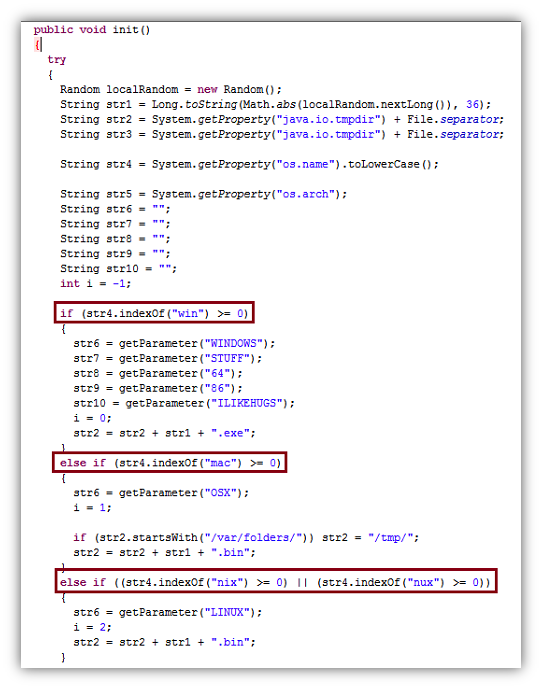
Security researcher at Kaspersky Lab have revealed a new java-based web vulnerability which is targeting Windows, Linux & Mac computers while installing backdoor. Mainly the whole thing is a Web-based social engineering attack that relies on malicious Java applets. According to security researchers from antivirus vendors F-Secure - the attack was detected on a compromised website in Colombia. When users visit the site, they are prompted to run a Java applet that hasn't been signed by a trusted certificate authority.

If allowed to run, the applet checks which operating system is running on the user's computer -- Windows, Mac OS X or Linux -- and drops a malicious binary file for the corresponding platform.

The JAR file checks if the user's machine is running in Windows, Mac or Linux then downloads the appropriate files for the platform. All three files for the three different platforms behave the same way. They all connect to 186.87.69.249 to get additional code to execute. The ports are 8080, 8081, and 8082 for OSX, Linux, and Windows respectively.
The files are detected as:
Trojan-Downloader:Java/GetShell.A (sha1: 4a52bb43ff4ae19816e1b97453835da3565387b7)
Backdoor:OSX/GetShell.A (sha1: b05b11bc8520e73a9d62a3dc1d5854d3b4a52cef)
Backdoor:Linux/GetShell.A (sha1: 359a996b841bc02d339279d29112fe980637bf88)
Backdoor:W32/GetShell.A (sha1: 26fcc7d3106ab231ba0ed2cba34b7611dcf5fc0a)


However, since F-Secure researchers began monitoring the attack, the remote control server hasn't pushed any additional code. It appears that the attack uses the Social Engineer Toolkit (SET), a publicly available tool designed for penetration testers, Aquino said Tuesday via email. However, the chances of this being a penetration test sanctioned by the website's owner are relatively low.
Kaspersky's researchers are in the process of analyzing the backdoor-type malware downloaded by the malicious shell code on Windows and Linux. "The Win32 backdoor is large, about 600KB; the Linux backdoor is over 1MB in size, both appear to contact very complex code which communicates encrypted with other servers."


-Source (CW & F-Secure) 


SHARE OUR NEWS DIRECTLY ON SOCIAL NETWORKS:-

Administrative Password Reset Vulnerability Found in Seagate BlackArmor NAS

Administrative Password Reset Vulnerability Found in Seagate BlackArmor NAS

Security experts have revealed that the Seagate BlackArmor network attached storage device (NAS server) contains a static administrator password reset vulnerability by anyone with access to it and a particular URL. The BlackArmor range of network-attached storage devices is aimed at small businesses and offers storage and backup options from Windows PCs and Mac OS X systems, ranging from 1TB to 12TB of hard disk media. According to an exclusive report of US-CERT A remote unauthenticated attacker with access to the device's management web server can directly access the webpage, http://DevicesIpAddress/d41d8cd98f00b204e9800998ecf8427e.php and reset the administrator password. 
Seagate has been notified, but no fix has yet been made available. Also there is no current solution to the problem and US-CERT are only advising that network access to BlackArmor devices' web interface should be restricted. For additional information click here.


SHARE OUR NEWS DIRECTLY ON SOCIAL NETWORKS:-

Ophcrack LiveCD 3.4.0 Released (Free Windows Password Cracker)

Ophcrack LiveCD 3.4.0 Released (Free Windows Password Cracker)
After the release Ophcrack 3.4.0 both Windows & Linux installer now the developer at Ophcrack has released the new LiveCD includes the latest version of Ophcrack 3.4.0. This edition of Ophcrack is built on Slitaz 4.0, the latest version of this great LiveCD. Christophe Lincoln from Slitaz helped us to enhance the scripts for partitions and tables detection. A new ncurses interface is also available to help users look for tables on other drives or interact with ophcrack.
Finally a LiveCD without tables has been released as well for users that already downloaded or bought tables. The directory containing the table files must be placed inside another directory called tables in order for ophcrack to find them automatically. 

Features:-

  • Runs on Windows, Linux/Unix, Mac OS X, ...
  • Cracks LM and NTLM hashes.
  • Free tables available for Windows XP and Vista/7.
  • Brute-force module for simple passwords.
  • Audit mode and CSV export.
  • Real-time graphs to analyze the passwords.
  • LiveCD available to simplify the cracking.
  • Dumps and loads hashes from encrypted SAM recovered from a Windows partition.
  • Free and open source software (GPL).

To Download Ophcrack 3.4.0 Live CD Click Here.


SHARE OUR NEWS DIRECTLY ON SOCIAL NETWORKS:-

Microsoft Discovered a New Malware Targeting Apple OS X Exploiting Office Vulnerability

Microsoft Discovered a New Malware Targeting Apple OS X Exploiting Office Vulnerability

This year is going bad to worse for MAC users. Earlier we have seen more than 600,000 Mac user infected by Flashback Trojan after this one another Mac Trojan "Backdoor.OSX.SabPub" penetrated mac security. Recently Microsoft has detected a new piece of malware targeting Apple OS X computers that exploits a vulnerability in the Office productivity suite patched nearly three years ago. The malware is not widespread, according to Jeong Wook Oh of Microsoft's Malware Protection Center. But it does show that hackers pay attention if it's found people do not apply patches as those fixes are released, putting their computers at a higher risk of becoming infected.
The exploit discovered by Microsoft doesn't work with OS X Lion, but does work with Snow Leopard and prior versions. Oh wrote that it is likely attackers have knowledge about the computers they are attacking, such as the victim's operating system version and patch levels. The malware delivered by the exploit is written specifically for OS X and is basically a "backdoor," or a tool that allows for remote control of a computer. Microsoft advised those who use Microsoft Office 2004 or 2008 for Mac or the Open XML File Format Converter for Mac to ensure those products have applied the patch.


-Source (Computer World)  

SHARE OUR NEWS DIRECTLY ON SOCIAL NETWORKS:-

Ophcrack 3.4.0 Released (Windows Password Cracker Based on Rainbow Tables)

Ophcrack 3.4.0 Released (Windows Password Cracker Based on Rainbow Tables)
After almost three years without news, here comes the version 3.4.0 of ophcrack. This will probably be the final release in the 3.x branch. It adds the support of the soon to be released XP flash and Vista eight XL tables. On Windows it also adds the support of dumping the hashes through samdump2 live using NTFS low-level access to the locked files.

Brief About Ophcrack:-
Ophcrack is a free Windows password cracker based on rainbow tables. It is a very efficient implementation of rainbow tables done by the inventors of the method. It comes with a Graphical User Interface and runs on multiple platforms. 

Features :-
  •  Runs on Windows, Linux/Unix, Mac OS X, ...
  • Cracks LM and NTLM hashes.
  • Free tables available for Windows XP and Vista/7.
  • Brute-force module for simple passwords.
  • Audit mode and CSV export.
  • Real-time graphs to analyze the passwords.
  • LiveCD available to simplify the cracking.
  • Dumps and loads hashes from encrypted SAM recovered from a Windows partition.
  • Free and open source software (GPL).
To Download Ophcrack 3.4.0 Installer for both Windows & Linux click Here. If you want to get the tables to crack LM Password hashes for (Windows XP, Vista & 7) click Here.  


SHARE OUR NEWS DIRECTLY ON SOCIAL NETWORKS:-

Related Posts Plugin for WordPress, Blogger...